

Archive position — measured, not model output
1 like on Devpost
505 of the 7,850 archived projects have more likes, and 1,758 share exactly 1 — so this project's #2,221 place in the like-ranked listing is a tie-break inside that group, not a ranking.
Projects (log scale)
Likes on Devpost. ▲ marks this project's group.
Show the figures
| Likes | Projects | Share of archive |
|---|---|---|
| 0 | 5,587 | 71.2% |
| 1 | 1,758 | 22.4% |
| 2 | 284 | 3.6% |
| 3–4 | 132 | 1.7% |
| 5–9 | 75 | 1.0% |
| 10+ | 14 | 0.2% |
 User Stories BotA demo video on every pull request
Get a demo video on every new feature
GitHub App that watches your pull requests and records a narrated, captioned demo.
Save time on demo prep and make informed decisions faster with a video walkthrough of every new feature.
Executive Summary
What the company appears to be
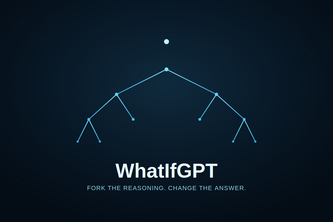
WhatIfGPT is a self-reported tool that visualizes AI reasoning as an interactive tree structure, allowing users to edit assumptions mid-reasoning and explore alternate outcomes. It was built for the OpenAI 2026 hackathon.
What changed
The project description does not indicate any prior version or evolution; it is presented as a new submission.
Single most important open question
Is there evidence of user adoption, revenue, or customer traction beyond the hackathon submission?
What The Product Actually Is
The description states that WhatIfGPT:
- Turns AI reasoning into an interactive, explorable tree instead of text
- Allows users to ask questions or make decisions (e.g., "Should I launch this product in Q1 or Q2?")
- Renders the AI’s reasoning as connected step-by-step nodes
- Enables clicking any node, editing the assumption it's based on, and forking a new branch while keeping the original intact
- Provides AI-suggested next steps to explore alternate paths automatically
- Allows comparing two branches side by side with an AI-generated explanation of divergence
- Exports final synthesized answers as clean, formatted reports
Inference The tool appears to be built around a chain-of-thought visualization and editing workflow using LLMs.
Positioning & Claim Evolution
The description states:
- The product aims to solve the problem that "AI chatbots give you one answer based on one hidden assumption"
- It introduces an alternative where users can "open up the model's reasoning, change one assumption, and watch the answer update live"
- It positions itself as a tool for inspecting and editing AI decision-making processes
Inference The positioning is focused on transparency and control over AI reasoning, not general-purpose chatbot replacement.
Target Customer & ICP
The description does not state:
- Who the target customer is
- Whether it targets individuals or enterprises
- What specific use cases or industries it addresses
Not evidenced.
Business Model & Pricing Evidence
The description states:
- The tool was built for a hackathon
- No mention of pricing, monetization, or business model
Not evidenced.
Technical & Delivery Signals
The description states:
- Built with: React + Vite + Tailwind CSS + React Flow (frontend)
- Backend: FastAPI (Python)
- LLMs accessed via Groq API, with Codex and GPT-5.6 explored
- Deployment on Render (backend) and Vercel/Render (frontend)
- UI styled with glassmorphism design elements
Inference The tool uses modern web stack and integrates with LLM APIs for reasoning.
Traction & Maturity Signals
The description states:
- Submitted to the OpenAI 2026 hackathon
- Built by a team of four members
- No mention of users, customers, revenue, or product usage metrics
Not evidenced.
Competitive Context
The description does not state:
- Who the competitors are
- How WhatIfGPT compares to existing tools in AI reasoning visualization or editing
- Whether similar products exist in the market
Not evidenced.
Open Questions & Risks
- The project is described as a hackathon submission with no evidence of traction, revenue, or customer adoption.
- No indication of scalability beyond prototype-level functionality.
- No mention of data privacy, model governance, or enterprise readiness.
- The tool appears to be experimental and not yet production-ready.
Inference The lack of any commercial or user-facing signals raises concerns about viability as a product or business.
Questions the description leaves open
- What is the intended target market for this tool?
- Are there any users or early adopters beyond the hackathon?
- How does the team plan to monetize or scale this product?
- What are the technical limitations of current LLM integration and how might they be addressed?
- Is there a roadmap for moving from prototype to production-ready version?
Overall Assessment
The description states:
- This is a hackathon submission
- No evidence of revenue, customers, or traction
- No indication of a business model or monetization strategy
Not evidenced.
Given the self-reported nature and lack of external validation, this project does not demonstrate commercial viability or traction beyond its initial development phase.
User Stories BotA demo video on every pull request
Get a demo video on every new feature
GitHub App that watches your pull requests and records a narrated, captioned demo.
Save time on demo prep and make informed decisions faster with a video walkthrough of every new feature.
Source
Submitted to the OpenAI 2026 hackathon on Devpost. Project home on Devpost. Back to the full gallery on Devpost.
This competitive analysis was produced by top-founders.com (opens in a new tab)
Generated by a language model from this project's public Devpost page — its tagline, the author's own write-up and any built-with tags listed there — as captured in August 2026. Short quotations are the author's words. It is an opinion on the idea as a business, not on the people behind it, and it reflects the description as published then. If the project has moved on, request a correction below. The analysis is not independent research and contains no verified traction, revenue or customer data.
An independent guide by KFG International LLC — not affiliated with, endorsed by, or connected to Devpost or OpenAI.