

Archive position — measured, not model output
1 like on Devpost
505 of the 7,850 archived projects have more likes, and 1,758 share exactly 1 — so this project's #2,222 place in the like-ranked listing is a tie-break inside that group, not a ranking.
Projects (log scale)
Likes on Devpost. ▲ marks this project's group.
Show the figures
| Likes | Projects | Share of archive |
|---|---|---|
| 0 | 5,587 | 71.2% |
| 1 | 1,758 | 22.4% |
| 2 | 284 | 3.6% |
| 3–4 | 132 | 1.7% |
| 5–9 | 75 | 1.0% |
| 10+ | 14 | 0.2% |
 User Stories BotA demo video on every pull request
Get a demo video on every new feature
GitHub App that watches your pull requests and records a narrated, captioned demo.
Save time on demo prep and make informed decisions faster with a video walkthrough of every new feature.
Executive Summary
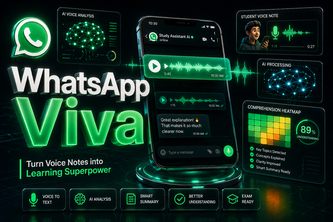
What the company appears to be: WhatsApp Viva is a self-reported educational tool designed to automate oral understanding checks for students using WhatsApp. The system uses AI to generate personalized questions based on written homework submissions, collects student responses via voice notes, and provides teachers with insights through transcription and analysis.
What changed: The project was built as a hackathon submission (OpenAI 2026) and is described as a proof-of-concept for an AI-powered teaching assistant that integrates with WhatsApp to scale oral defense of homework.
Single most important open question: Is there any evidence of real-world adoption, usage or traction beyond the hackathon context?
Analysis basis: This report is based entirely on the self-reported project description provided by the author. No external verification, revenue data, customer names, or traction metrics are available. All claims are attributed to the author's own account.
What The Product Actually Is
The description states that WhatsApp Viva is an AI-powered teaching assistant that:
- Accepts written homework submissions via a mobile-friendly web form built with Next.js.
- Triggers a WhatsApp conversation using Twilio when a submission is evaluated.
- Generates 2–3 personalized follow-up questions using OpenAI GPT-5.6.
- Collects student responses as voice notes on WhatsApp.
- Stores audio in Cloudflare R2 and transcribes them locally using Workers AI Whisper.
- Provides teachers with a dashboard showing comprehension heatmaps, summaries of gaps, and full session transcripts.
Inference: The system is described as an automated oral defense mechanism that scales beyond individual teacher capacity. It uses a serverless stack including Cloudflare Workers, Supabase, Twilio, and OpenAI models.
Positioning & Claim Evolution
The author claims WhatsApp Viva addresses two key issues in education:
- Copying and lack of conceptual understanding in traditional written homework.
- Teacher time constraints for individual verification of student learning.
It positions itself as a lightweight solution that meets students where they already communicate — on WhatsApp — to test understanding interactively and dynamically, offering teachers "deep conceptual scorecards" instead of simple grades.
Claim: The system is described as scalable and automated, aiming to replace or supplement traditional oral exams with AI-driven interaction. It is not evidenced to have evolved from prior versions or products; it is a single hackathon project.
Target Customer & ICP
The description states that WhatsApp Viva targets:
- Teachers who want to assess student understanding beyond grades.
- Students who submit homework via a web form and engage with voice-based follow-up questions on WhatsApp.
Inference: The target is likely educators in K–12 or higher education settings, particularly those using digital learning platforms. No specific ICP data or segmentation is provided.
Business Model & Pricing Evidence
There is no evidence of pricing, monetization, or business model in the description.
Not evidenced: No mention of subscription tiers, usage fees, or revenue streams.
Technical & Delivery Signals
The system is built using:
- Frontend: Next.js
- Backend API: Cloudflare Worker with Hono framework
- Database/Auth: Supabase (PostgreSQL)
- AI Engine: OpenAI GPT-5.6
- Audio/Transcription: Cloudflare R2 + Workers AI Whisper
- Messaging: Twilio WhatsApp API
Inference: The stack is serverless and lightweight, designed for rapid development and deployment in a hackathon context.
Traction & Maturity Signals
The project is described as a hackathon submission (OpenAI 2026) with no evidence of:
- Real users
- Revenue
- Customer adoption
- Product-market fit
- Iteration beyond the prototype stage
Not evidenced: No traction data, user base, or product maturity indicators are provided.
Competitive Context
The description does not mention any competitors. It is unclear whether similar tools exist in the market for automated oral assessments or AI-powered homework verification.
Not evidenced: No competitive landscape or differentiation analysis is available.
Open Questions & Risks
- Unverified claims: The system is described as using GPT-5.6, which does not currently exist; this may be a placeholder or misstatement.
- Limited scope: Built for a hackathon, with no evidence of real-world deployment or scalability.
- Dependency on sandboxed environments: Twilio WhatsApp Sandbox limits usability without full access.
- No commercialization strategy: No indication of how the product would transition from prototype to market.
Inference: The project lacks commercial viability indicators and is likely in early-stage prototyping.
Questions the description leaves open
- What is the actual technical architecture and scalability plan beyond a hackathon prototype?
- Are there any real-world test users or pilot programs?
- How does the system handle edge cases like poor audio quality, language barriers, or student refusal to participate?
- Is GPT-5.6 a placeholder for an actual model, or is it a misstatement of capabilities?
- What are the plans for monetization and product-market fit beyond the demo?
Overall Assessment
The project is described as a hackathon prototype with no evidence of traction, revenue, or commercial viability.
Assessment: Not suitable for investment or partnership at this stage. The system lacks real-world adoption and maturity indicators. It may be a promising concept in need of further development, but the current description does not support any due-diligence conclusions beyond its hackathon origin.
User Stories BotA demo video on every pull request
Get a demo video on every new feature
GitHub App that watches your pull requests and records a narrated, captioned demo.
Save time on demo prep and make informed decisions faster with a video walkthrough of every new feature.
Source
Submitted to the OpenAI 2026 hackathon on Devpost. Project home on Devpost. Back to the full gallery on Devpost.
This competitive analysis was produced by top-founders.com (opens in a new tab)
Generated by a language model from this project's public Devpost page — its tagline, the author's own write-up and any built-with tags listed there — as captured in August 2026. Short quotations are the author's words. It is an opinion on the idea as a business, not on the people behind it, and it reflects the description as published then. If the project has moved on, request a correction below. The analysis is not independent research and contains no verified traction, revenue or customer data.
An independent guide by KFG International LLC — not affiliated with, endorsed by, or connected to Devpost or OpenAI.