

Archive position — measured, not model output
0 likes on Devpost
2,263 of the 7,850 archived projects have more likes, and 5,587 share exactly 0 — so this project's #7,664 place in the like-ranked listing is a tie-break inside that group, not a ranking.
Projects (log scale)
Likes on Devpost. ▲ marks this project's group.
Show the figures
| Likes | Projects | Share of archive |
|---|---|---|
| 0 | 5,587 | 71.2% |
| 1 | 1,758 | 22.4% |
| 2 | 284 | 3.6% |
| 3–4 | 132 | 1.7% |
| 5–9 | 75 | 1.0% |
| 10+ | 14 | 0.2% |
 User Stories BotA demo video on every pull request
Get a demo video on every new feature
GitHub App that watches your pull requests and records a narrated, captioned demo.
Save time on demo prep and make informed decisions faster with a video walkthrough of every new feature.
Executive Summary
What the company appears to be
Weft is a self-reported AI-powered tool for small businesses to discover, rank, and respond to high-intent public conversations on Threads. It uses GPT-5.6 and SocialCrawl API to analyze conversations based on commercial intent, relevance, engagement potential, and language context. The tool ranks opportunities and generates human-reviewed reply drafts but does not auto-post.
What changed
The project was initially an early MVP before Build Week, then extended and hardened during a 2026 OpenAI hackathon using Codex for code review, security fixes, testing, and system improvements. It transitioned from prototype to a working product with a secure admin dashboard and credit system.
Single most important open question
Is there evidence of early traction or user feedback from Malaysian small businesses or service providers who are active on Threads?
Note: This analysis is based solely on the self-reported description provided by the author. No external verification, revenue data, customer names, or adoption metrics are available.
What The Product Actually Is
The description states that Weft:
- Searches recent public Threads conversations based on user-defined keywords and time ranges.
- Uses the SocialCrawl API to retrieve posts.
- Applies GPT-5.6 for analyzing conversations using signals like commercial intent, topic relevance, recency, engagement potential, and language/market context.
- Ranks results by opportunity score.
- Provides reply drafts that can be edited or copied before manual publishing.
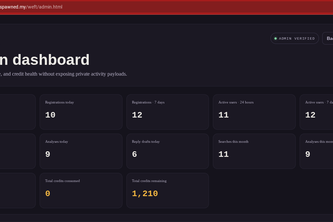
- Includes a secure admin dashboard tracking registrations, searches, AI analyses, generated replies, credit balances, and adjustments.
The product is described as a PHP application designed to run on shared hosting, with JavaScript, HTML, CSS for UI, and integration with OpenAI API and Codex.
Inference: The tool appears to be built for small businesses or individuals looking to engage in relevant Threads conversations without automation or impersonation. It emphasizes human control over AI-generated content.
Positioning & Claim Evolution
The author claims:
- Weft helps businesses find valuable conversations where they can add genuine value.
- It is not about creating noise but participating meaningfully in existing threads.
- The tool avoids auto-posting, impersonation, or mass replies.
- It focuses on helping users identify and respond to high-intent opportunities manually.
The positioning evolves from a simple idea (finding conversations) to a more structured workflow involving opportunity scoring, reply drafting, and user control. During Build Week, it was refined to include:
- Inferred market relevance
- Improved language consistency for mixed BM-English replies
- Secure credit system with refund logic
- Automated tests and deployment packages
Claim vs Fact: These are self-reported claims about intent and functionality; no evidence of actual adoption or performance metrics is provided.
Target Customer & ICP
The description states:
- The target audience includes small businesses, service providers, founders, and independent professionals active on Threads.
- It specifically targets users in Malaysia, Singapore, Indonesia, or global markets.
- The tool was developed with Malaysian users in mind due to feedback about overseas search results being too frequent.
Inference: Based on the author's stated focus and localization efforts (e.g., Bahasa Melayu support), the ICP likely centers around small business owners or service providers in Southeast Asia who use Threads for customer engagement.
Business Model & Pricing Evidence
The description mentions:
- A credit-based system for usage tracking.
- Admin dashboard tracks credits, registrations, searches, and AI analyses.
- Future plans include subscription billing and configurable credit plans.
- No explicit pricing model or revenue streams are described.
Not evidenced: There is no mention of actual pricing tiers, monetization strategy, or customer acquisition costs. The business model remains conceptual.
Technical & Delivery Signals
The description states:
- Built as a lean PHP application suitable for shared hosting.
- Uses SocialCrawl API, GPT-5.6, Codex, GitHub, and other technologies.
- During Build Week, Codex was used to audit code, implement features, add tests, and improve security.
- Security measures include separation of config from version control, file access rules, secret scanning, and endpoint validation.
Inference: The architecture suggests a minimal viable product (MVP) approach with deliberate design choices around cost-efficiency and scalability. However, no details on infrastructure scaling or long-term technical strategy are provided.
Traction & Maturity Signals
The description states:
- Weft existed as an early MVP before Build Week.
- It was extended during a hackathon using Codex to improve functionality and security.
- A live version exists with working search, ranking, reply generation, and admin dashboard.
- The author claims to have fixed a real billing defect (credit refund issue).
- Automated regression tests were added.
Not evidenced: No data on active users, usage frequency, conversion rates, or customer feedback is available. There is no evidence of product-market fit or user retention.
Competitive Context
The description does not mention any competitors directly. However, it implies a niche in:
- AI-powered social media engagement tools.
- Tools that help businesses find relevant conversations without auto-posting.
- Platforms focused on human-in-the-loop workflows for AI-assisted replies.
Inference: The product likely competes with general-purpose AI assistants or social listening tools, but no direct comparison or competitive landscape is described.
Open Questions & Risks
Key risks and open questions based on the description:
- No traction evidence: No customers, revenue, or usage data.
- Unproven market demand: The author describes a problem they observed, but there’s no validation from real users.
- Single-person team: Only one developer is involved, which may limit scalability or feature development speed.
- Limited tech stack: Reliance on shared hosting and PHP suggests constraints in performance or growth.
- AI dependency risks: Heavy reliance on GPT-5.6 and third-party APIs introduces potential instability or cost concerns.
Inference: The lack of verified traction, revenue, or user feedback raises questions about whether the product meets a real market need beyond the developer’s personal experience.
Questions the description leaves open
- Have you validated your concept with actual small businesses in Malaysia or Southeast Asia?
- What specific feedback have you received from early users (if any)?
- How do you plan to scale beyond shared hosting and manage increasing API usage costs?
- Are there plans to integrate directly with Threads' official APIs, or are you relying on third-party data sources?
- What is your long-term vision for monetization beyond credit-based access?
- How do you intend to differentiate from other social listening tools or AI engagement platforms?
Overall Assessment
Not evidenced: There is no evidence of revenue, customer base, or traction that would support an investment or partnership decision.
Assessment: Based on the self-reported description alone, Weft appears to be a functional MVP with clear intent and some technical execution. However, without validated user feedback, market demand, or financial data, it cannot be evaluated for commercial viability or strategic fit. The project shows promise in addressing a specific niche but lacks the signals needed for due-diligence readiness.
User Stories BotA demo video on every pull request
Get a demo video on every new feature
GitHub App that watches your pull requests and records a narrated, captioned demo.
Save time on demo prep and make informed decisions faster with a video walkthrough of every new feature.
Source
Submitted to the OpenAI 2026 hackathon on Devpost. Project home on Devpost. Back to the full gallery on Devpost.
This competitive analysis was produced by top-founders.com (opens in a new tab)
Generated by a language model from this project's public Devpost page — its tagline, the author's own write-up and any built-with tags listed there — as captured in August 2026. Short quotations are the author's words. It is an opinion on the idea as a business, not on the people behind it, and it reflects the description as published then. If the project has moved on, request a correction below. The analysis is not independent research and contains no verified traction, revenue or customer data.
An independent guide by KFG International LLC — not affiliated with, endorsed by, or connected to Devpost or OpenAI.