

Archive position — measured, not model output
1 like on Devpost
505 of the 7,850 archived projects have more likes, and 1,758 share exactly 1 — so this project's #1,777 place in the like-ranked listing is a tie-break inside that group, not a ranking.
Projects (log scale)
Likes on Devpost. ▲ marks this project's group.
Show the figures
| Likes | Projects | Share of archive |
|---|---|---|
| 0 | 5,587 | 71.2% |
| 1 | 1,758 | 22.4% |
| 2 | 284 | 3.6% |
| 3–4 | 132 | 1.7% |
| 5–9 | 75 | 1.0% |
| 10+ | 14 | 0.2% |
 User Stories BotA demo video on every pull request
Get a demo video on every new feature
GitHub App that watches your pull requests and records a narrated, captioned demo.
Save time on demo prep and make informed decisions faster with a video walkthrough of every new feature.
Executive Summary
What the company appears to be
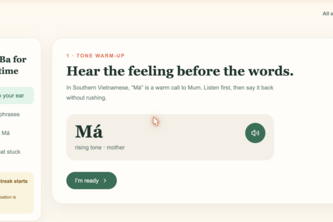
Rể is a voice-first, dialect-aware language-learning tool designed for individuals marrying into Vietnamese families. It is described as built for "the son-in-law terrified of dinner with the in-laws." The project was submitted to the OpenAI 2026 hackathon and is self-reported as using technologies such as GPT-4o-mini, OpenAI Realtime API, and React.
What changed
No evidence of prior version or evolution. This is a single, unverified submission to a hackathon with no indication of prior development or product iteration.
The single most important open question
Is there any evidence of user testing, customer feedback, or real-world adoption beyond the hackathon submission? The description does not indicate traction, revenue, or even a clear definition of how the product would be used outside of a hackathon context.
What The Product Actually Is
The description states:
"Rể - Speak Vietnamese with the family you're marrying into"
It also says:
"voice-first, dialect-aware, built for the son-in-law terrified of dinner with the in-laws."
The author declares that it was built using:
- codex
- fish-audio
- gpt-4o-mini
- next.js
- openai
- openai-realtime-api
- react
- tailwindcss
- typescript
- vercel
- web-speech-api
Inference The product appears to be a voice-based language-learning tool, likely leveraging AI for speech recognition and synthesis, with a focus on Vietnamese dialects. It is positioned as a tool for people marrying into Vietnamese families.
Not evidenced There is no evidence of how the product works beyond its tech stack or whether it has any functional UI/UX, training data, or user interaction model.
Positioning & Claim Evolution
The description states:
"Learn to speak Vietnamese with the family you're marrying into — voice-first, dialect-aware, built for the son-in-law terrified of dinner with the in-laws."
Claim
The product is positioned as a niche language-learning tool for people marrying into Vietnamese families, emphasizing voice-based interaction and dialect awareness.
Inference It appears to be a hackathon project with a humorous, niche positioning. The tagline suggests it targets a specific cultural or emotional context — not a broad market.
Not evidenced There is no evidence of prior positioning, evolution of claims, or feedback loops in product development.
Target Customer & ICP
The description states:
"built for the son-in-law terrified of dinner with the in-laws."
Claim
The target customer is a person marrying into a Vietnamese family and feeling anxious about communication during family dinners.
Inference This implies a very narrow, emotionally driven ICP — likely a subset of expats or foreign spouses in Vietnamese households.
Not evidenced There is no evidence of customer research, segmentation, or validation beyond the author’s own description.
Business Model & Pricing Evidence
The description does not state anything about pricing, monetization, or business model.
Not evidenced No information on how the product would be sold, whether it's freemium, subscription-based, or one-time purchase. No evidence of revenue streams.
Technical & Delivery Signals
The author declares that the project was built with:
- codex
- fish-audio
- gpt-4o-mini
- next.js
- openai
- openai-realtime-api
- react
- tailwindcss
- typescript
- vercel
- web-speech-api
Inference The product is built using modern AI and frontend stacks, suggesting a voice-enabled interface with possible real-time interaction capabilities.
Not evidenced There is no evidence of delivery mechanism (e.g., app store presence, web deployment), user experience design, or technical performance metrics.
Traction & Maturity Signals
The description states:
"This project was submitted to the OpenAI 2026 hackathon on Devpost."
Claim
It is a hackathon submission with no indication of prior traction or product maturity.
Not evidenced There is no evidence of user adoption, customer feedback, revenue, or product iteration. No mention of post-hackathon development or deployment.
Competitive Context
The description does not mention any competitors or market context.
Not evidenced No information on existing language-learning tools, voice-based apps, or niche products for expats or intercultural communication.
Open Questions & Risks
- Unverified claims: All descriptions are self-reported and unverified.
- No traction or adoption: The product is only described as a hackathon submission.
- Narrow ICP: The target market is extremely niche, limiting scalability.
- No business model: No indication of how the product would generate revenue.
- No user feedback: No evidence of testing or real-world usage.
Questions the description leaves open
- What was the process of identifying and validating this specific use case?
- Has there been any user testing beyond the hackathon?
- How does the product plan to scale beyond a single hackathon submission?
- What is the intended monetization strategy?
- Are there plans for localization or expansion into other languages or cultures?
Overall Assessment
Not evidenced There is no evidence of a viable business, traction, or commercial potential beyond a hackathon project.
Inference This appears to be an early-stage idea with no demonstrated product-market fit, revenue model, or customer base. It may have potential as a prototype or proof-of-concept but lacks the signals for investment or partnership at this stage.
Confidence level Low — based on thin self-reported evidence only.
User Stories BotA demo video on every pull request
Get a demo video on every new feature
GitHub App that watches your pull requests and records a narrated, captioned demo.
Save time on demo prep and make informed decisions faster with a video walkthrough of every new feature.
Source
Submitted to the OpenAI 2026 hackathon on Devpost. Project home on Devpost. Back to the full gallery on Devpost.
This competitive analysis was produced by top-founders.com (opens in a new tab)
Generated by a language model from this project's public Devpost page — its tagline and any built-with tags listed there, since the author published no write-up — as captured in August 2026. Short quotations are the author's words. It is an opinion on the idea as a business, not on the people behind it, and it reflects the description as published then. If the project has moved on, request a correction below. The analysis is not independent research and contains no verified traction, revenue or customer data.
An independent guide by KFG International LLC — not affiliated with, endorsed by, or connected to Devpost or OpenAI.