

Archive position — measured, not model output
0 likes on Devpost
2,263 of the 7,850 archived projects have more likes, and 5,587 share exactly 0 — so this project's #3,740 place in the like-ranked listing is a tie-break inside that group, not a ranking.
Projects (log scale)
Likes on Devpost. ▲ marks this project's group.
Show the figures
| Likes | Projects | Share of archive |
|---|---|---|
| 0 | 5,587 | 71.2% |
| 1 | 1,758 | 22.4% |
| 2 | 284 | 3.6% |
| 3–4 | 132 | 1.7% |
| 5–9 | 75 | 1.0% |
| 10+ | 14 | 0.2% |
 User Stories BotA demo video on every pull request
Get a demo video on every new feature
GitHub App that watches your pull requests and records a narrated, captioned demo.
Save time on demo prep and make informed decisions faster with a video walkthrough of every new feature.
Executive Summary
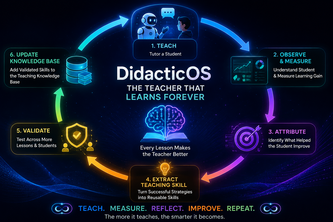
What the company appears to be: DidacticOS is a self-reported AI tutoring system that claims to continuously learn how to teach without becoming a black box. The project was built as part of an OpenAI 2026 hackathon submission and is described as a system with a persistent control loop using Codex, with distinct runtime and teacher learning components.
What changed: The description presents a novel architecture for AI tutoring that separates live student interaction (the "Runtime") from offline pedagogical improvement ("Teacher Learning Kernel"). It emphasizes a governed loop with explicit verification, human oversight, and immutable evidence handling.
Single most important open question: Is there any evidence of actual deployment, usage or measurable learning outcomes beyond the described architecture and local replay artifact?
Analysis basis: This report is based entirely on the self-reported project description provided by the caller. No external verification, traction data, revenue figures, customer names or independent sources are available. All claims in this document are stated by the author and not independently confirmed.
What The Product Actually Is
The description states that DidacticOS is an AI tutor designed to continuously learn how to teach while maintaining transparency. It consists of two main components:
- Runtime Kernel: A microkernel-style supervisor that handles live tutoring turns, including:
- Central Orchestrator
- Working Memory
- Student Model (using a Rasch-style IRT baseline)
- Policy Engine
- Prompt Compiler
- Output Guardrail
- Teacher Learning Kernel: A blackboard-style set of specialists that process completed Runtime telemetry offline to improve teaching rules.
The system uses:
- Append-only evidence for all decisions
- Deterministic state transitions based on Rasch IRT model
- A controlled lifecycle from evidence collection to skill promotion
- Circuit breakers and escalation protocols
Claim: The system separates live execution from pedagogical learning, with no in-place editing of production teaching rules.
Inference: The architecture implies a complex multi-agent system with distinct phases for execution, analysis, validation, and deployment.
Positioning & Claim Evolution
The project positions itself as an AI tutor that improves pedagogy without becoming a black box. It claims to use a "governed loop" approach where:
- Human review retains authority over irreversible data and safety decisions
- Autonomous execution is guided by explicit acceptance criteria
- Continuous learning happens through offline processing of immutable evidence
Claim: The system avoids mutating production pedagogy in real-time, instead proposing new versions with supporting evidence.
Inference: This positioning suggests a focus on explainability, safety, and reproducibility over rapid adaptation or experimentation.
Target Customer & ICP
Not evidenced. The description does not state who the intended users are, what their needs are, or how they would interact with the system beyond general AI tutoring use cases.
Absence of evidence: No mention of specific customer segments, personas, or user types.
Business Model & Pricing Evidence
Not evidenced. There is no information about monetization strategies, pricing models, or revenue streams in the description.
Absence of evidence: No indication of how this would be sold, licensed, or consumed commercially.
Technical & Delivery Signals
The project claims to use:
- Codex for implementation with a persistent control loop
- Specialist agents handling distinct roles (planning, implementation, verification)
- A task ledger guiding workflow
- LangGraph for state machine representation
- Langfuse for telemetry tracking
- Hugging Face for benchmarking (MathDial protocol)
- Deterministic Rasch-style IRT student model
It also describes:
- Monitoring UI with persistent left pane and central activity stream
- Circuit breakers, escalation mechanisms, and acceptance gates
- Append-only event logs (.loop/events.jsonl)
- Evidence boundary protocols (MathDial) to separate development from validation
- Double-Runtime evidence recovery under final acceptance protocol
Claim: The system is engineered with safety, traceability, and governance built-in.
Inference: These technical details suggest a high degree of engineering sophistication and attention to process control.
Traction & Maturity Signals
Not evidenced. There is no mention of:
- Actual deployments
- User feedback or adoption
- Performance metrics beyond local replay artifact
- Customer acquisition or retention data
- Product usage statistics
Absence of evidence: No indication of real-world application or measurable impact.
Competitive Context
Not evidenced. The description does not reference competitors, market positioning, or competitive advantages.
Absence of evidence: No comparison to existing AI tutoring platforms or educational technology solutions.
Open Questions & Risks
- Unverified claims: All descriptions are self-reported and unverified.
- No traction evidence: No data on real users, performance, or adoption.
- Local artifact only: The demonstration relies solely on a local replay artifact (184 turns), not live usage.
- Limited scope: The system is described as a hackathon project with no indication of scalability or commercial viability.
- High complexity without validation: The architecture is complex but lacks evidence of successful operation in practice.
Inference: The lack of real-world testing, user feedback, and measurable outcomes raises significant concerns about readiness for production deployment.
Questions the description leaves open
- What specific educational outcomes or learning gains were measured in the 184 turns?
- How does DidacticOS plan to scale beyond a local replay artifact?
- Are there any external benchmarks or third-party evaluations of its performance?
- What is the roadmap for transitioning from offline learning to live teaching?
- Has the system been tested with real students or educators?
- How will it integrate into existing educational infrastructures?
- What are the key assumptions behind the Rasch model and how were they validated?
Overall Assessment
Not evidenced. The description provides no information about:
- Financials
- Team traction
- Market opportunity
- Strategic fit for potential partners or investors
Absence of evidence: No basis to assess investment or partnership potential.
User Stories BotA demo video on every pull request
Get a demo video on every new feature
GitHub App that watches your pull requests and records a narrated, captioned demo.
Save time on demo prep and make informed decisions faster with a video walkthrough of every new feature.
Source
Submitted to the OpenAI 2026 hackathon on Devpost. Project home on Devpost. Back to the full gallery on Devpost.
This competitive analysis was produced by top-founders.com (opens in a new tab)
Generated by a language model from this project's public Devpost page — its tagline, the author's own write-up and any built-with tags listed there — as captured in August 2026. Short quotations are the author's words. It is an opinion on the idea as a business, not on the people behind it, and it reflects the description as published then. If the project has moved on, request a correction below. The analysis is not independent research and contains no verified traction, revenue or customer data.
An independent guide by KFG International LLC — not affiliated with, endorsed by, or connected to Devpost or OpenAI.