

Archive position — measured, not model output
0 likes on Devpost
2,263 of the 7,850 archived projects have more likes, and 5,587 share exactly 0 — so this project's #3,742 place in the like-ranked listing is a tie-break inside that group, not a ranking.
Projects (log scale)
Likes on Devpost. ▲ marks this project's group.
Show the figures
| Likes | Projects | Share of archive |
|---|---|---|
| 0 | 5,587 | 71.2% |
| 1 | 1,758 | 22.4% |
| 2 | 284 | 3.6% |
| 3–4 | 132 | 1.7% |
| 5–9 | 75 | 1.0% |
| 10+ | 14 | 0.2% |
 User Stories BotA demo video on every pull request
Get a demo video on every new feature
GitHub App that watches your pull requests and records a narrated, captioned demo.
Save time on demo prep and make informed decisions faster with a video walkthrough of every new feature.
Executive Summary
What the company appears to be
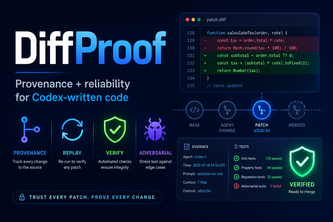
DiffProof is a self-reported tool that verifies AI-generated code patches by linking them to their source (provenance), running behavioral tests on both original and patched versions, and blocking merges that fail adversarial tests. It claims to separate model proposal from deterministic judgment using Git, pytest, and structured evidence.
What changed
The author states they built DiffProof as a response to the problem of AI-generated patches appearing correct but failing real-world behavior tests. It was developed through staged writing with Codex (GPT-5.6), using Python 3.12+, Pydantic for schema validation, and Git/pytest for behavioral verification.
Single most important open question
Is there any evidence that DiffProof has been used in production or integrated into real software delivery systems? The description contains no mention of adoption, customers, revenue, or even a deployed version beyond the author's own local development environment.
Note: This analysis is based entirely on the self-reported project description provided by the author. No external verification, traction data, or third-party sources were used. All claims are stated by the author and not independently confirmed.
What The Product Actually Is
The description states that DiffProof is:
- A deterministic behavioral-verification and provenance gate for AI-generated patches
- Designed to verify exact repo base and patch
- To run current test suite on unchanged base and patched candidate
- To generate one bounded adversarial regression test from checked-in fixture or optional model request
- To validate generated test before execution
- To run same adversarial test on both versions
- To check that test fails on base and passes on candidate
- To validate supplied provenance metadata
- To produce three independent results:
- Behaviour: VERIFIED, BLOCKED or INCONCLUSIVE
- Provenance: COMPLETE, PARTIAL, MISMATCHED or INVALID
- Composite gate: PASS, BLOCK or REVIEW
It also includes:
- Deterministic multi-run replay analysis
- Strict fixture-only verify_patch programmatic tool
- Strict fixture-only verify_patch function-calling adapter (no network requests)
- Offline GitHub pull-request dry run
- Deterministic PR review Markdown and suggested check conclusions
- Read-only localhost evidence dashboard showing only saved evidence
Inference: The product appears to be a verification layer that can be used in CI/CD pipelines or as part of developer workflows, but the description does not confirm whether it has been deployed or integrated into any real system.
Positioning & Claim Evolution
The author states:
- AI coding agents may produce convincing patches that are not actually correct
- Similarity is not proof of correctness
- The motivation was to split proposal and judgment — models propose, Git/pytest/deterministic policy decide
- DiffProof does not trust model explanations or confidence scores; assessment is computed from saved execution evidence
Key claims:
- "Models may propose a fix or an adversarial test but they should not decide if the patch is right"
- "Git provides the exact patch, pytest provides behavioural evidence and deterministic policy provides the final assessment"
- "DiffProof splits proposal and judgement"
Inference: The positioning is that DiffProof acts as a gatekeeper between AI-generated code and software delivery systems, ensuring behavioral correctness without relying on model confidence or explanations.
Target Customer & ICP
The description does not state:
- Who the target customer is
- What specific use case or industry it addresses
- Whether it targets individual developers, teams, or enterprises
- If there are any named customers or partnerships
Not evidenced: No information about target customer segments, personas, or specific industries.
Business Model & Pricing Evidence
The description does not state:
- How the product will be monetized
- Whether it is a SaaS offering, open-source, or freemium
- Any pricing model or revenue streams
- If there are plans for commercialization beyond the hackathon submission
Not evidenced: No business model or pricing information provided.
Technical & Delivery Signals
The description states:
- Built with Python 3.12+, Pydantic, Git, pytest, junit
- Uses AST-based validation gate before adversarial test execution
- Core verification loop makes isolated git workspaces for base and candidate
- Commands run with fixed argument vectors, shell=False, timeouts, sanitized environment
- Adversarial test is piped into an AST-based validation gate before running
- Provenance handled separately via declared base, patch, and task hashes
- GitHub PR adapter validates exact diff-base SHA, head SHA, and canonical diff
- Local dashboard is a Python standard-library HTTP server with read-only routes
- Everything is made so integrations transport and display evidence without becoming decision authorities
Inference: The technical stack suggests a secure, deterministic, and offline-capable system designed for integration into CI/CD or developer workflows.
Traction & Maturity Signals
The description states:
- The author completed three Codex patch runs with 100% replay score
- 3 requested runs, 3 completed patches, 3 VERIFIED results, 3 unique patches
- No execution failures or no-patch runs
- Live replay acceptance completed three Codex patch runs
- The system has been tested in a local environment
However, it does not state:
- Any real-world deployment or integration
- Adoption by other developers or organizations
- Customer feedback or usage metrics
- Whether the tool is available for public use or open-source release
Not evidenced: No evidence of traction, adoption, or commercial deployment beyond the author's own development.
Competitive Context
The description does not state:
- Who the competitors are
- What existing tools or platforms address similar problems
- How DiffProof differentiates from other code verification or AI-assisted development tools
Not evidenced: No competitive landscape or differentiation analysis provided.
Open Questions & Risks
Key risks and open questions inferred from the description:
- The tool is described as a hackathon submission, not a commercial product
- No evidence of real-world usage or integration into software delivery pipelines
- No mention of open-source release or public availability
- The author states that "the dashboard shows only saved evidence. It never calls git, tests, patches, openai, codex or github" — suggesting it's not yet fully functional in a live environment
- The system is described as "offline", implying no real-time integration capability
- No mention of scalability, performance, or security testing beyond local development
Inference: DiffProof appears to be an experimental prototype with limited evidence of production readiness or commercial viability.
Questions the description leaves open
- Has DiffProof been integrated into any real software delivery systems or CI/CD pipelines?
- Are there any users or customers currently using the tool in production?
- What is the plan for monetization or commercial deployment?
- How does DiffProof handle edge cases like large-scale repositories or complex test suites?
- Is there a roadmap for open-sourcing or releasing the tool publicly?
- What are the performance implications of running adversarial tests on large codebases?
- How does DiffProof deal with false positives or false negatives in adversarial testing?
- Are there any plans to support other programming languages or test frameworks beyond Python/pytest?
Overall Assessment
The description indicates that DiffProof is a hackathon submission, not a commercial product. It lacks evidence of:
- Real-world adoption
- Revenue or customer traction
- Commercial viability
- Public availability or open-source release
Assessment: Not evidenced as a viable investment or partnership opportunity at this time. The tool appears to be an experimental prototype with no demonstrated market traction or commercial readiness.
User Stories BotA demo video on every pull request
Get a demo video on every new feature
GitHub App that watches your pull requests and records a narrated, captioned demo.
Save time on demo prep and make informed decisions faster with a video walkthrough of every new feature.
Source
Submitted to the OpenAI 2026 hackathon on Devpost. Project home on Devpost. Back to the full gallery on Devpost.
This competitive analysis was produced by top-founders.com (opens in a new tab)
Generated by a language model from this project's public Devpost page — its tagline, the author's own write-up and any built-with tags listed there — as captured in August 2026. Short quotations are the author's words. It is an opinion on the idea as a business, not on the people behind it, and it reflects the description as published then. If the project has moved on, request a correction below. The analysis is not independent research and contains no verified traction, revenue or customer data.
An independent guide by KFG International LLC — not affiliated with, endorsed by, or connected to Devpost or OpenAI.