

Archive position — measured, not model output
0 likes on Devpost
2,263 of the 7,850 archived projects have more likes, and 5,587 share exactly 0 — so this project's #3,741 place in the like-ranked listing is a tie-break inside that group, not a ranking.
Projects (log scale)
Likes on Devpost. ▲ marks this project's group.
Show the figures
| Likes | Projects | Share of archive |
|---|---|---|
| 0 | 5,587 | 71.2% |
| 1 | 1,758 | 22.4% |
| 2 | 284 | 3.6% |
| 3–4 | 132 | 1.7% |
| 5–9 | 75 | 1.0% |
| 10+ | 14 | 0.2% |
 User Stories BotA demo video on every pull request
Get a demo video on every new feature
GitHub App that watches your pull requests and records a narrated, captioned demo.
Save time on demo prep and make informed decisions faster with a video walkthrough of every new feature.
Executive Summary
Company: DIFARYX
Self-reported purpose: An AI agent for scientific workflows that transforms fragmented experimental data into transparent, evidence-based scientific decisions.
Key claim: The system acts as a scientific collaborator rather than a chatbot, reasoning from evidence, identifying uncertainty, and recommending next experiments.
What changed: The project is a self-reported hackathon submission with no evidence of traction, revenue or customer adoption.
Single most important open question: Does the described AI agent actually perform the claimed scientific reasoning, or does it merely simulate it in a demo?
What The Product Actually Is
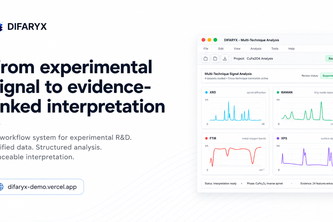
The description states that DIFARYX is an AI agent for scientific workflows, built to work with experimental datasets (XRD, FTIR, Raman, XPS). It accepts these datasets and:
- analyzes experimental evidence,
- organizes findings into a structured workspace,
- detects validation gaps,
- recommends next experiments,
- generates traceable research reports.
The system is described as not producing single answers, but instead connecting every step to supporting evidence so users can understand how conclusions were reached.
Inference: The product appears to be an experimental AI tool for scientific data analysis and decision-making, built as a prototype or proof-of-concept.
Not evidenced: No actual functionality, performance metrics, or user feedback are provided.
Positioning & Claim Evolution
The author states that DIFARYX was built because current AI tools behave like chatbots and fail to answer the real questions scientists ask:
- Does the evidence support this conclusion?
- What assumptions are being made?
- What experiment should I run next?
The product is positioned as a scientific collaborator that:
- reasons from evidence,
- identifies uncertainty,
- recommends experiments,
- makes decisions traceable.
It is described as a shift from “better models” to “better workflows,” aiming to improve scientific reproducibility.
Inference: The positioning is that of an AI-powered research assistant for scientists, focused on trustworthiness and evidence-based decision-making.
Not evidenced: No market positioning data, competitor comparison, or customer feedback.
Target Customer & ICP
The description states that DIFARYX is built for researchers, particularly those working with experimental data (XRD, FTIR, Raman, XPS). It is intended to help them:
- make reproducible decisions,
- understand uncertainty,
- identify validation gaps,
- plan next experiments.
Inference: The primary customer is likely a scientist or researcher in materials science or related fields who uses these specific analytical techniques.
Not evidenced: No evidence of actual users, customer segments, or personas. No indication of whether the tool has been tested with real users.
Business Model & Pricing Evidence
The description does not mention any business model, pricing, or monetization strategy.
Inference: The project is a hackathon submission and likely not yet commercialized.
Not evidenced: No revenue, pricing, or monetization plans are described.
Technical & Delivery Signals
The system is built with:
- Frontend: React, TypeScript, Vite, Tailwind CSS
- Backend: Python, FastAPI, NumPy, SciPy, Pandas
- AI models: OpenAI (GPT), used for reasoning and agent workflow
It is described as combining modern AI agents with scientific data processing, and uses AI to:
- understand scientific objectives,
- interpret uploaded evidence,
- evaluate observations,
- identify uncertainty,
- recommend next actions.
Inference: The tool integrates modern software stacks with scientific computing libraries and AI models for reasoning.
Not evidenced: No details on system architecture, scalability, or performance. No evidence of production deployment or delivery mechanism.
Traction & Maturity Signals
The project is described as a hackathon submission, built in a short timeframe (not specified). It has no evidence of:
- Revenue,
- Customers,
- Product usage,
- Adoption,
- Iteration history,
- Production use.
Inference: The product is at an early stage, likely a prototype or proof-of-concept.
Not evidenced: No traction data, user feedback, or product maturity indicators.
Competitive Context
The description does not mention any direct competitors, nor does it describe how DIFARYX compares to existing tools in the scientific AI space.
Inference: The author sees a gap in current AI tools for science, but no competitive analysis is provided.
Not evidenced: No market landscape, competitor names, or differentiation strategy.
Open Questions & Risks
- Unproven AI reasoning: The system claims to reason from evidence and detect uncertainty, but there is no demonstration of this capability.
- Prototype-only status: Built for a hackathon, with no indication of further development or commercialization.
- No user validation: No real-world testing or feedback from scientists.
- Lack of business model clarity: No indication of how the product will be monetized or scaled.
- Overpromising on AI capabilities: The system is described as a scientific collaborator, but no evidence of its actual reasoning depth or accuracy.
Inference: The project is a speculative idea with no demonstrated traction or commercial viability.
Questions the description leaves open
- What specific scientific problems does DIFARYX solve that existing tools do not?
- Can you demonstrate how the AI agent actually reasons from evidence in practice?
- Have you tested the system with real researchers or experimental data?
- What is your plan for scaling beyond a hackathon prototype?
- How will the product be monetized, and what is the target pricing model?
Overall Assessment
Not evidenced: No financials, traction, or commercial viability are provided.
Inference: At this stage, DIFARYX appears to be an early-stage idea or prototype with no demonstrated value proposition or path to market. It lacks the evidence required for investment or partnership consideration.
Confidence level: Very low — based entirely on self-reported claims and a hackathon submission.
User Stories BotA demo video on every pull request
Get a demo video on every new feature
GitHub App that watches your pull requests and records a narrated, captioned demo.
Save time on demo prep and make informed decisions faster with a video walkthrough of every new feature.
Source
Submitted to the OpenAI 2026 hackathon on Devpost. Project home on Devpost. Back to the full gallery on Devpost.
This competitive analysis was produced by top-founders.com (opens in a new tab)
Generated by a language model from this project's public Devpost page — its tagline, the author's own write-up and any built-with tags listed there — as captured in August 2026. Short quotations are the author's words. It is an opinion on the idea as a business, not on the people behind it, and it reflects the description as published then. If the project has moved on, request a correction below. The analysis is not independent research and contains no verified traction, revenue or customer data.
An independent guide by KFG International LLC — not affiliated with, endorsed by, or connected to Devpost or OpenAI.