

Archive position — measured, not model output
0 likes on Devpost
2,263 of the 7,850 archived projects have more likes, and 5,587 share exactly 0 — so this project's #7,654 place in the like-ranked listing is a tie-break inside that group, not a ranking.
Projects (log scale)
Likes on Devpost. ▲ marks this project's group.
Show the figures
| Likes | Projects | Share of archive |
|---|---|---|
| 0 | 5,587 | 71.2% |
| 1 | 1,758 | 22.4% |
| 2 | 284 | 3.6% |
| 3–4 | 132 | 1.7% |
| 5–9 | 75 | 1.0% |
| 10+ | 14 | 0.2% |
 User Stories BotA demo video on every pull request
Get a demo video on every new feature
GitHub App that watches your pull requests and records a narrated, captioned demo.
Save time on demo prep and make informed decisions faster with a video walkthrough of every new feature.
Executive Summary
What the company appears to be
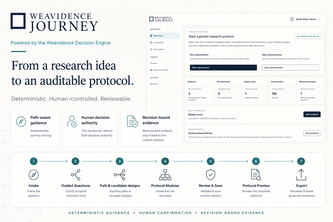
Weavidence Journey is a self-reported web application designed to guide researchers through a structured, deterministic process for creating auditable research protocols. It is described as a methodological decision journey that makes protocol construction visible, reviewable, and traceable.
What changed
The author states that the project was not created from scratch during the hackathon but was substantially refactored into a governed decision system during Build Week. The transformation involved rearchitecting an existing research-design application into one with deterministic routing, explicit human confirmation workflows, and revision-aware outputs.
Single most important open question
Is there evidence of real-world usage or validation by researchers beyond the author’s own development experience?
What The Product Actually Is
The description states that Weavidence Journey is a full-stack web application built around a deterministic decision engine, not a generative chatbot. It guides users through seven lifecycle stages:
- Intake
- Guided Questions
- Path & candidate designs
- Protocol Modules
- Review & Save
- Protocol Preview
- Export
It supports multiple methodological paths and presents candidate study designs with visible rationale, allowing researchers to confirm or override decisions while keeping important choices traceable.
The system includes:
- Structured semantic registry for questions, concepts, answers, study designs, and methodological contracts.
- Deterministic routing across methodological paths.
- Candidate-design evaluation and transparent rationale.
- Human confirmation and justified override workflows.
- Selective invalidation when upstream answers change.
- Revision-aware review and evidence binding.
- Professional protocol generation and export in formats like JSON, HTML, PDF, DOCX.
The author notes that AI (GPT-5.6 and Codex) was used for engineering support but not as the runtime scientific authority; final decision-making remains with the human researcher.
Evidence strength Evidenced from self-report only.
Positioning & Claim Evolution
The project is positioned as a tool for creating auditable research protocols, emphasizing:
- Deterministic, human-controlled journeys.
- Transparent guidance and traceable decisions.
- Professional outputs (structured JSON, HTML, PDF, DOCX).
- Audit history and decision traces.
- Separation of methodological quality indicators (Decision Score, Design Fit, Readiness).
It is described as addressing a gap in current tools: general-purpose AI can draft text but cannot govern methodological processes.
The author claims that the tool does not collapse uncertainty into one definitive answer, instead separating candidate designs, fit, methodological quality, readiness, caveats, and human confirmation.
Evidence strength Evidenced from self-report only. No third-party validation or market positioning data provided.
Target Customer & ICP
The target customer is described as researchers, particularly those working in public health and epidemiology. The author identifies themselves as an epidemiologist and public-health professional who has seen research protocols written as documents without explicit methodological decisions being made visible.
There is no mention of specific user personas, segments, or use cases beyond the general category of researchers needing to build structured, auditable protocols.
Evidence strength Evidenced from self-report only. No evidence of customer interviews, market segmentation, or competitive targeting.
Business Model & Pricing Evidence
No information is provided about pricing models, monetization strategies, or business model assumptions. The project description does not include any claims regarding revenue streams, subscription tiers, licensing, or commercial partnerships.
Evidence strength Not evidenced.
Technical & Delivery Signals
The application is built using:
- Frontend: React, TypeScript, HTML5, CSS3
- Backend: Node.js, Express, Prisma, PostgreSQL
- DevOps: Docker, Vercel, Render, GitHub Actions
- AI tools: GPT-5.6, Codex, Playwright, Vitest
- Authentication: OAuth
- APIs: REST, OpenAI API
The system supports:
- Automated unit, integration, browser, semantic, and regression testing.
- Semantic registry for questions, concepts, answers, study designs, and methodological contracts.
- Revision-aware review and evidence binding.
- Export of professional outputs including structured JSON, HTML, PDF, DOCX.
It is described as a production-ready web architecture with adversarial validation and negative testing practices.
Evidence strength Evidenced from self-report only. No data on performance metrics, scalability, or deployment history.
Traction & Maturity Signals
There is no evidence of traction, revenue, customers, or adoption beyond the author’s own development work. The project was not presented as having launched or being used in real-world settings prior to or during the hackathon.
The author states that the system existed before the hackathon and underwent a major refactoring during Build Week, but there is no indication of user feedback, usage statistics, or product-market fit validation.
Evidence strength Not evidenced.
Competitive Context
No mention of competitors or competitive landscape. The description does not reference existing tools for research protocol design, methodological guidance, or scientific workflow management.
Evidence strength Not evidenced.
Open Questions & Risks
- Lack of external validation: No evidence of real-world usage, customer feedback, or product-market fit.
- Single-founder development: The team size is listed as one member (VaX1989 CORONA), raising questions about scalability and long-term maintenance.
- Unproven market demand: The author’s own experience is the only context for the tool’s utility; no third-party validation or market research is presented.
- AI dependency without clarity on autonomy: While AI was used in development, it is unclear how much of the runtime functionality relies on AI, and whether this could be a risk if AI access changes.
- Highly specialized domain: The focus on epidemiology and public health may limit broader applicability unless expanded.
Evidence strength Inferred from lack of evidence and self-reporting limitations.
Questions the description leaves open
- What specific research workflows or problems does the tool aim to solve, and how do you know these are real needs?
- Have you tested the system with actual researchers outside of your own development process?
- How is the methodological content validated? Is there domain expertise embedded in the design?
- What would constitute success for this product beyond its current prototype stage?
- Are there any early adopters or pilot users who have provided feedback?
- How do you plan to scale beyond a single developer’s capacity?
- What are your thoughts on integrating with existing research infrastructure or platforms?
Evidence strength Inferred from lack of evidence and need for deeper exploration.
Overall Assessment
The project is described as a self-contained, deterministic system for guiding researchers through methodological decision-making, built using modern full-stack technologies. It shows technical sophistication and clear intent to address a gap in research protocol design.
However, there is no evidence of traction, revenue, or customer validation beyond the author’s own development efforts. The tool appears to be at an early prototype stage, with no indication of market readiness or commercial viability.
Given the lack of external signals, this project should be considered a highly speculative opportunity, suitable for early-stage investment or partnership only if further due diligence confirms real-world demand and scalability potential.
Evidence strength Inferred from self-reporting and absence of traction data.
User Stories BotA demo video on every pull request
Get a demo video on every new feature
GitHub App that watches your pull requests and records a narrated, captioned demo.
Save time on demo prep and make informed decisions faster with a video walkthrough of every new feature.
Source
Submitted to the OpenAI 2026 hackathon on Devpost. Project home on Devpost. Back to the full gallery on Devpost.
This competitive analysis was produced by top-founders.com (opens in a new tab)
Generated by a language model from this project's public Devpost page — its tagline, the author's own write-up and any built-with tags listed there — as captured in August 2026. Short quotations are the author's words. It is an opinion on the idea as a business, not on the people behind it, and it reflects the description as published then. If the project has moved on, request a correction below. The analysis is not independent research and contains no verified traction, revenue or customer data.
An independent guide by KFG International LLC — not affiliated with, endorsed by, or connected to Devpost or OpenAI.