

Archive position — measured, not model output
0 likes on Devpost
2,263 of the 7,850 archived projects have more likes, and 5,587 share exactly 0 — so this project's #7,651 place in the like-ranked listing is a tie-break inside that group, not a ranking.
Projects (log scale)
Likes on Devpost. ▲ marks this project's group.
Show the figures
| Likes | Projects | Share of archive |
|---|---|---|
| 0 | 5,587 | 71.2% |
| 1 | 1,758 | 22.4% |
| 2 | 284 | 3.6% |
| 3–4 | 132 | 1.7% |
| 5–9 | 75 | 1.0% |
| 10+ | 14 | 0.2% |
 User Stories BotA demo video on every pull request
Get a demo video on every new feature
GitHub App that watches your pull requests and records a narrated, captioned demo.
Save time on demo prep and make informed decisions faster with a video walkthrough of every new feature.
Executive Summary
What the company appears to be
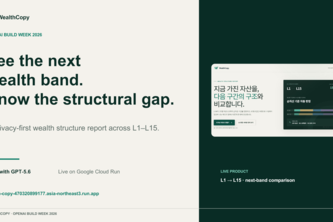
WealthCopy is a self-reported financial diagnostic tool that classifies household wealth into 15 bands (L1–L15) based on user-entered asset and liability data, without requiring bank connections or personal identifiers. It provides structured review priorities for moving between bands, using deterministic logic for calculations and generative AI only for explanation framing.
What changed
The project was built as a hackathon submission with a focus on privacy-first design, deterministic financial logic, and bounded use of GPT-5.6 for narrative structure. It includes an English Judge Mode and portable report snapshots but lacks any evidence of revenue, customers, or traction beyond its own description.
Single most important open question
Is the internal wealth classification system (L1–L15) credible or useful to users without external validation?
What The Product Actually Is
The description states that WealthCopy is a financial diagnostic tool for households. It classifies user-entered data into 15 wealth bands (L1 through L15), calculates net worth, and provides structured review priorities based on comparisons with internal reference ranges.
- The product does not require bank connections or personal identifiers.
- It uses deterministic logic to compute household classification and safety checks.
- GPT-5.6 is used only for bounded explanation decisions: framing, lead insight, explanation order, and connection — never for financial calculations or recommendations.
- A strict JSON API, no-store responses, and browser gate are implemented.
- Reports can be downloaded as portable snapshots and compared across sessions.
Inference The product appears to be a prototype built under time constraints for a hackathon. It is not described as having any live user base or monetization features.
Positioning & Claim Evolution
The description states that WealthCopy starts with the question: “what separates this household’s current structure from the next internal wealth band, and what must be reviewed before trying to close that gap?”
- It positions itself as a diagnostic tool, not a financial advisor or investment platform.
- It claims to avoid leaving users to interpret numbers themselves by offering structured guidance.
- It emphasizes privacy-first design and deterministic logic over generative AI in financial outcomes.
Inference The positioning is narrow and focused on internal wealth banding rather than external benchmarks or market-based advice. The claim of separating “financial truth from generative explanation” is presented as a key differentiator, but no evidence supports whether this approach resonates with users or advisors.
Target Customer & ICP
The description does not name specific customer segments or personas.
- It targets households seeking to understand their wealth structure and next steps.
- The tool assumes users can estimate values for eight canonical asset groups, total debt, income, expenses, and one near-term event.
- No mention of demographic or geographic targeting.
Inference The ICP is likely financially self-aware individuals or households in a specific region (Korea) who are interested in structured financial planning but not necessarily seeking active investment advice. There is no evidence of segmentation or targeting beyond the general user type.
Business Model & Pricing Evidence
The description does not mention any pricing, monetization, or business model.
- No indication of paid features, subscriptions, or transaction fees.
- The product is described as a prototype built for a hackathon.
- No revenue streams or customer acquisition strategies are stated.
Inference There is no evidence of a business model. The project appears to be in early development and not yet monetized.
Technical & Delivery Signals
The description states that WealthCopy was built with:
- Technologies: Next.js, React, TypeScript, OpenAI (GPT-5.6), Cloud Run, Codex.
- GPT-5.6 is used only for bounded explanation decisions, not financial data or output.
- The system uses Structured Outputs, low reasoning effort, and hashed safety identifiers.
- It includes 89 automated tests, responsive browser layouts, and API smoke tests.
- A no-store response policy and same-origin browser gate are implemented.
Inference The technical architecture is designed with security and privacy in mind. However, the lack of production deployment or user feedback limits understanding of its real-world performance.
Traction & Maturity Signals
The description states that:
- It was built for a hackathon.
- It has a working Cloud Run deployment.
- It includes 89 automated tests, linting, type checking, and responsive layout testing.
- It passed API smoke tests and browser QA.
- No user data or feedback is mentioned.
Inference There is no evidence of traction, revenue, or customer adoption. The project remains in a prototype phase with no indication of real-world usage or market validation.
Competitive Context
The description does not mention any competitors or direct market context.
- It references the 2025 Korean Household Survey for official data but does not compare itself to existing personal finance tools.
- No mention of how it differs from other financial planning platforms, budgeting apps, or wealth management services.
Inference There is no evidence of competitive analysis or positioning in the market. The project appears to be a standalone prototype with no known competitors.
Open Questions & Risks
- No external validation of internal wealth bands: The 15-band classification system (L1–L15) is described as “WealthCopy-owned review policies” and not based on observed population data or official benchmarks.
- Limited use of generative AI: While GPT-5.6 is used for explanation framing, it is not clear how this adds value to the user experience or whether users perceive it as helpful.
- No evidence of real-world testing or feedback: The product has no known users, customer data, or performance metrics beyond internal tests.
- Privacy-first approach may limit utility: The lack of account persistence or data retention could reduce long-term value for users.
Inference The risk lies in the unvalidated internal classification system and lack of user engagement or market traction. The product’s utility is uncertain without real-world use cases or expert validation.
Questions the description leaves open
- What is the basis for the 15 wealth bands (L1–L15)? Are they validated against real household data or expert financial advice?
- How do you plan to validate or refine the internal composition policies with Korean financial advisors or research?
- Is there any intention to monetize this product, and if so, how?
- What is the expected user journey for someone who wants to move from one wealth band to another?
- How does the English Judge Mode differ in utility from the standard report, and what feedback have you received on it?
- Have you considered integrating with financial institutions or advisors for credibility?
Overall Assessment
Not evidenced.
There is no evidence of revenue, customers, traction, or a validated business model. The project is described as a hackathon prototype with no indication of commercial viability or market readiness.
The product’s design and use of AI are novel in its approach to separating financial facts from generative explanation, but without real-world testing or expert validation, it remains speculative. The internal wealth classification system (L1–L15) is the core differentiator, but its credibility is unproven.
Confidence Low. This analysis is based entirely on self-reported information with no external corroboration.
User Stories BotA demo video on every pull request
Get a demo video on every new feature
GitHub App that watches your pull requests and records a narrated, captioned demo.
Save time on demo prep and make informed decisions faster with a video walkthrough of every new feature.
Source
Submitted to the OpenAI 2026 hackathon on Devpost. Project home on Devpost. Back to the full gallery on Devpost.
This competitive analysis was produced by top-founders.com (opens in a new tab)
Generated by a language model from this project's public Devpost page — its tagline, the author's own write-up and any built-with tags listed there — as captured in August 2026. Short quotations are the author's words. It is an opinion on the idea as a business, not on the people behind it, and it reflects the description as published then. If the project has moved on, request a correction below. The analysis is not independent research and contains no verified traction, revenue or customer data.
An independent guide by KFG International LLC — not affiliated with, endorsed by, or connected to Devpost or OpenAI.