

Archive position — measured, not model output
1 like on Devpost
505 of the 7,850 archived projects have more likes, and 1,758 share exactly 1 — so this project's #1,764 place in the like-ranked listing is a tie-break inside that group, not a ranking.
Projects (log scale)
Likes on Devpost. ▲ marks this project's group.
Show the figures
| Likes | Projects | Share of archive |
|---|---|---|
| 0 | 5,587 | 71.2% |
| 1 | 1,758 | 22.4% |
| 2 | 284 | 3.6% |
| 3–4 | 132 | 1.7% |
| 5–9 | 75 | 1.0% |
| 10+ | 14 | 0.2% |
 User Stories BotA demo video on every pull request
Get a demo video on every new feature
GitHub App that watches your pull requests and records a narrated, captioned demo.
Save time on demo prep and make informed decisions faster with a video walkthrough of every new feature.
Executive Summary
What the company appears to be: The project described by the caller is a tool named Quote Evidence Matrix (QEM), which claims to process contractor quotes into an evidence-linked scope matrix. It uses synthetic data and AI models to evaluate whether items are included, excluded, not mentioned, or unresolved in each quote, with a focus on transparency and inspectability of evidence.
What changed: The project is presented as a hackathon submission (Devpost entry for OpenAI 2026 hackathon), built using Codex and GPT-5.6 Sol, and designed to demonstrate how AI can be used in a way that makes uncertainty visible rather than pretending the model is always right.
Single most important open question: Is there any evidence of real-world adoption or traction beyond this single synthetic demonstration? The description does not indicate any revenue, customers, or usage outside of the author’s own experiments.
Note: This analysis is based entirely on the self-reported and unverified project description provided by the caller. No external verification or historical data is available.
What The Product Actually Is
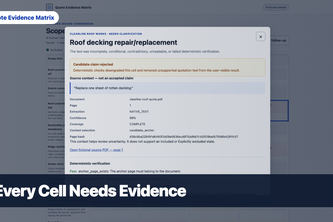
The description states that Quote Evidence Matrix (QEM) turns contractor quotes into a 9-by-4 evidence-linked matrix. Each cell in the matrix shows one of four states: INCLUDED, EXCLUDED, NOT_MENTIONED, or UNREADABLE_OR_UNRESOLVED.
- Functionality: The tool processes fictional roof quotes and maps them into an evidence-based scope matrix.
- User interaction: Users can open a strong cell to inspect the exact source quote, page, extraction status, verification result, and provenance.
- Technology stack: Built with Node.js 22 ESM, browser-native HTML/CSS/JS, JSON Schema, Git, GitHub; uses Codex and GPT-5.6 Sol for synthetic experiments.
- Design principle: It avoids inventing normalized prices or choosing winners without underlying evidence.
Inference: The tool is not a production-ready system but a prototype or proof-of-concept built during a hackathon.
Positioning & Claim Evolution
The author states that the inspiration came from a practical question: when contractor quotes show different prices, are they actually promising the same work?
- Core claim: QEM refuses to flatten differences in scope by turning missing information into confidence.
- Positioning: It aims to make AI workflows more inspectable and honest by showing what is known or unknown about each item in a quote.
- Evolution of claims: The project evolved from a simple idea (comparing quotes) to a demonstration of how AI can be used without pretending it’s always right — emphasizing uncertainty, evidence inspection, and auditability.
Claim vs Fact: These are self-reported claims about intent and design philosophy. No evidence of actual use or impact is provided.
Target Customer & ICP
The description does not clearly identify a target customer or ideal customer profile (ICP).
- Implicit audience: Homeowners or contractors who need to compare quotes.
- Use case context: The tool focuses on home-improvement domains, particularly roofing.
- Not evidenced: No stated customer segments, personas, or buyer profiles.
Inference: The tool may appeal to users in construction or contracting industries needing structured quote comparison tools, but this is not explicitly stated.
Business Model & Pricing Evidence
There is no evidence of a business model or pricing strategy in the project description.
- Not evidenced: No mention of monetization, licensing, subscriptions, or fees.
- Not evidenced: No indication of whether QEM will be offered as SaaS, open-source, or another format.
Inference: If this becomes a product, it would likely follow a freemium or enterprise model, but no such plans are described.
Technical & Delivery Signals
The description provides some technical details:
- Built with: Codex, GPT-5.6 Sol, Node.js 22 ESM, browser-native HTML/CSS/JS.
- Tools used: JSON Schema, Git, GitHub.
- Methodology: Synthetic fixture generator, deterministic verifier, record/replay interface, forensic recovery tools.
- Key features:
- Deterministic code retains final authority over output.
- No runtime OpenAI API calls in the public sample.
- Failed experiments are preserved as audit evidence.
Inference: The system is built with a strong emphasis on reproducibility and transparency, which may be valuable for future development or auditing purposes.
Traction & Maturity Signals
There is no evidence of traction or maturity beyond the author’s own synthetic experiments.
- Not evidenced: No customers, revenue, usage metrics, or product adoption.
- Not evidenced: No production deployment, user feedback, or real-world testing.
- Sample data: The public sample contains only fictional quotes and synthetic runs.
- Evaluation results: One reviewed synthetic run yielded 13 scopes and 52 cells; assessment was INCONCLUSIVE.
Inference: This is a prototype or proof-of-concept with no demonstrated market traction or real-world deployment.
Competitive Context
The description does not provide any information about competitors or the competitive landscape.
- Not evidenced: No mention of existing tools for quote comparison, scope management, or contractor quoting platforms.
- Not evidenced: No indication of how QEM compares to other solutions in the market.
Inference: The tool may address a niche within construction or home improvement, but no competitive analysis is available.
Open Questions & Risks
Several risks and open questions emerge from the lack of evidence:
- No real-world validation: The system has only been tested on synthetic data.
- Unproven scalability: No indication that it can handle real documents or large volumes.
- Limited scope: Focus is on home-improvement domains; unclear if it generalizes.
- No monetization path: No business model described, raising questions about sustainability.
- Author-only team: Only one person involved (Dried Sandwich), which may limit development capacity.
Inference: The project lacks commercial viability or traction without further evidence of real-world use or product-market fit.
Questions the description leaves open
- What is the intended user journey for someone using this tool in a real-world scenario?
- How does QEM plan to scale beyond synthetic data and into handling actual PDFs and OCR?
- Are there any plans to integrate with existing contractor quoting platforms or CRM systems?
- Has the author considered privacy and retention policies for uploaded documents?
- What are the next steps in terms of product development, testing, or launch?
Note: These questions aim to uncover whether the project is evolving into a viable product or remains a prototype.
Overall Assessment
Not evidenced: No financials, revenue, traction, or clear path to monetization are provided.
- Confidence level: Low — based on a single self-reported write-up with no external validation.
- Assessment: This is a hackathon prototype that demonstrates an interesting idea around AI transparency and evidence-based decision-making. However, there is no evidence of real-world adoption, customer feedback, or commercial viability.
Inference: If this project evolves into a product, it could have potential in industries requiring transparent quote comparisons, but current evidence does not support investment or partnership interest.
User Stories BotA demo video on every pull request
Get a demo video on every new feature
GitHub App that watches your pull requests and records a narrated, captioned demo.
Save time on demo prep and make informed decisions faster with a video walkthrough of every new feature.
Source
Submitted to the OpenAI 2026 hackathon on Devpost. Project home on Devpost. Back to the full gallery on Devpost.
This competitive analysis was produced by top-founders.com (opens in a new tab)
Generated by a language model from this project's public Devpost page — its tagline, the author's own write-up and any built-with tags listed there — as captured in August 2026. Short quotations are the author's words. It is an opinion on the idea as a business, not on the people behind it, and it reflects the description as published then. If the project has moved on, request a correction below. The analysis is not independent research and contains no verified traction, revenue or customer data.
An independent guide by KFG International LLC — not affiliated with, endorsed by, or connected to Devpost or OpenAI.