

Archive position — measured, not model output
0 likes on Devpost
2,263 of the 7,850 archived projects have more likes, and 5,587 share exactly 0 — so this project's #7,653 place in the like-ranked listing is a tie-break inside that group, not a ranking.
Projects (log scale)
Likes on Devpost. ▲ marks this project's group.
Show the figures
| Likes | Projects | Share of archive |
|---|---|---|
| 0 | 5,587 | 71.2% |
| 1 | 1,758 | 22.4% |
| 2 | 284 | 3.6% |
| 3–4 | 132 | 1.7% |
| 5–9 | 75 | 1.0% |
| 10+ | 14 | 0.2% |
 User Stories BotA demo video on every pull request
Get a demo video on every new feature
GitHub App that watches your pull requests and records a narrated, captioned demo.
Save time on demo prep and make informed decisions faster with a video walkthrough of every new feature.
Executive Summary
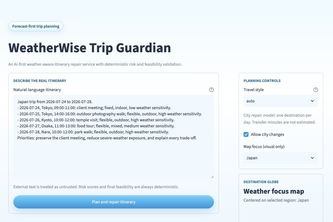
What the company appears to be: WeatherWise Trip Guardian is a self-reported tool that interprets natural-language travel itineraries using large language models (LLMs) and deterministic validation logic. It aims to adjust flexible trip elements in response to weather forecasts, while preserving fixed commitments.
What changed: The project was built as part of a hackathon submission. It uses LLMs for understanding intent and proposing repairs, but enforces safety through deterministic code. The system is deployed via Streamlit on Google Cloud Run.
Single most important open question: Is there any evidence of real-world usage or customer traction beyond the author's own demonstration?
What The Product Actually Is
The description states that WeatherWise Trip Guardian:
- Interprets natural-language travel itineraries using Gemini on Vertex AI.
- Fetches weather forecasts from Open-Meteo.
- Computes weather risk with deterministic Python rules.
- Proposes and validates trip repairs, prioritizing safety over disruption.
- Returns one recommended repair per day.
- Generates a final itinerary in PDF and ICS formats.
- Uses a strict sequence: typed Gemini proposal → deterministic validation → bounded correction → deterministic re-validation.
It is described as a Streamlit application deployed on Google Cloud Run. The system uses Pydantic schemas, and integrates with Vertex AI, Open-Meteo, and other tools.
Evidence: Self-reported by the author; no external verification or data on actual usage.
Positioning & Claim Evolution
The description states that WeatherWise Trip Guardian is designed for travelers who need a clear decision—not a list of loosely related suggestions. It positions itself as an answer to the question: “What should change in a real trip without breaking the commitments that cannot move?”
It claims to be a tool that turns weather-disrupted trips into one safer, validated day-by-day itinerary while preserving fixed commitments.
Evidence: Self-reported; no external validation or market positioning data provided.
Target Customer & ICP
The description does not specify target customer segments or ideal customer profiles (ICP). It implies the product is for travelers who have flexible and fixed trip elements and are concerned about weather impacts.
Evidence: Not evidenced. The author does not describe a specific persona or market segment.
Business Model & Pricing Evidence
There is no evidence of pricing, monetization strategy, or business model in the description. The project is presented as a hackathon submission with no indication of revenue streams or customer acquisition plans.
Evidence: Not evidenced.
Technical & Delivery Signals
The system uses:
- Gemini on Vertex AI for semantic intake and repair synthesis.
- Pydantic schemas for typed model and tool boundaries.
- Open-Meteo for forecast and geocoding data.
- Deterministic Python risk scoring and feasibility validation.
- Bounded Gemini correction followed by deterministic re-validation.
- In-memory PDF and ICS generation.
- A dedicated Cloud Run service account and Secret Manager-backed state signing.
It is described as a public Streamlit app deployed on Google Cloud Run, with Codex and GPT-5.6 used during development.
Evidence: Self-reported; no independent technical audit or performance data provided.
Traction & Maturity Signals
The description states that the project includes:
- A working public application with a complete intake-to-download flow.
- Ten-case evaluation in which all four deterministic integrity metrics reached 1.0.
- Batched, cached weather retrieval.
- A production deployment separate from an inherited service.
However, there is no evidence of customer adoption, usage statistics, or revenue.
Evidence: Self-reported; no traction or maturity data beyond the author’s own claims.
Competitive Context
The description does not mention any competitors. It does not reference existing weather or trip planning tools in the market.
Evidence: Not evidenced.
Open Questions & Risks
- No real-world usage or customer feedback: The product is described as a hackathon submission with no evidence of adoption.
- Unverified claims: All features and performance metrics are self-reported without external validation.
- Limited scope: The system only supports one destination city per day, which may limit its utility for complex trips.
- Dependency on LLMs: While the system uses deterministic logic to enforce safety, it still relies on LLMs for initial interpretation and repair synthesis.
Evidence: Inferences based on self-reported description; no external data or risk analysis provided.
Questions the description leaves open
- What is the actual usage of this tool beyond the demo?
- How does the system handle edge cases, such as multi-day fixed commitments or complex itinerary structures?
- Are there any plans to monetize or scale this product beyond a hackathon prototype?
- Has the team considered integrating with existing travel platforms or APIs?
- What are the limitations of the current deterministic validation logic in real-world scenarios?
Overall Assessment
The description presents WeatherWise Trip Guardian as a hackathon project with no evidence of traction, revenue, or customer adoption. It is not clear whether this is a prototype or a product in development.
Confidence: Low. The entire analysis is based on self-reported information with no external corroboration.
Assessment: Not evidenced. No commercial due-diligence basis to assess viability or investment potential without further evidence of usage, revenue, or market traction.
User Stories BotA demo video on every pull request
Get a demo video on every new feature
GitHub App that watches your pull requests and records a narrated, captioned demo.
Save time on demo prep and make informed decisions faster with a video walkthrough of every new feature.
Source
Submitted to the OpenAI 2026 hackathon on Devpost. Project home on Devpost. Back to the full gallery on Devpost.
This competitive analysis was produced by top-founders.com (opens in a new tab)
Generated by a language model from this project's public Devpost page — its tagline, the author's own write-up and any built-with tags listed there — as captured in August 2026. Short quotations are the author's words. It is an opinion on the idea as a business, not on the people behind it, and it reflects the description as published then. If the project has moved on, request a correction below. The analysis is not independent research and contains no verified traction, revenue or customer data.
An independent guide by KFG International LLC — not affiliated with, endorsed by, or connected to Devpost or OpenAI.