

Archive position — measured, not model output
0 likes on Devpost
2,263 of the 7,850 archived projects have more likes, and 5,587 share exactly 0 — so this project's #7,649 place in the like-ranked listing is a tie-break inside that group, not a ranking.
Projects (log scale)
Likes on Devpost. ▲ marks this project's group.
Show the figures
| Likes | Projects | Share of archive |
|---|---|---|
| 0 | 5,587 | 71.2% |
| 1 | 1,758 | 22.4% |
| 2 | 284 | 3.6% |
| 3–4 | 132 | 1.7% |
| 5–9 | 75 | 1.0% |
| 10+ | 14 | 0.2% |
 User Stories BotA demo video on every pull request
Get a demo video on every new feature
GitHub App that watches your pull requests and records a narrated, captioned demo.
Save time on demo prep and make informed decisions faster with a video walkthrough of every new feature.
Executive Summary
What the company appears to be
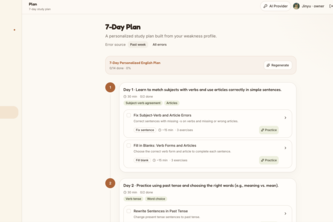
WeakSpot English Coach is an AI-powered language learning tool that claims to offer personalized, cross-session English coaching. The product uses a combination of deterministic scheduling and generative AI (specifically GPT-5.6) to create practice missions based on learner memory and performance history. It allows learners to control their own data and practice through various formats including roleplay, storytelling, listening retelling, situational decisions, and vocabulary use.
What changed
The project was submitted as part of the OpenAI 2026 hackathon. The description indicates it's a prototype or proof-of-concept built during a short development period (likely a "Build Week"), with no evidence of prior traction, revenue, or customer adoption.
Single most important open question
Is there any evidence that learners actually engage with the product beyond its initial demo? The self-reported write-up describes functionality and architecture but does not include any data on usage, retention, or feedback from real users.
What The Product Actually Is
The description states that WeakSpot English Coach is an AI English coach with learner-controlled, cross-session memory. It stores goals, preferences, recurring language weaknesses, effective strategies, and practice outcomes in DynamoDB.
It uses a deterministic scheduler to determine what should be practiced and GPT-5.6 (via the OpenAI Responses API) to generate natural-sounding missions based on that information.
Learners can practice through five formats:
- Live situational roleplay
- Picture-based description and storytelling
- Listening and retelling
- Open-ended situational decisions
- Vocabulary used in a realistic message
The system also integrates naturally into ordinary conversation, suggesting a conversational interface or integration point where it prompts learners to apply previously identified weaknesses without interrupting the flow.
It includes structured outputs from GPT-5.6 that include:
- WhyNow (why the task was selected)
- EvidenceUsed
- Adaptation
- EvaluationFocus
The frontend is built with Next.js and the backend with FastAPI, using Docker for deployment and Vercel for hosting.
Inference The product appears to be a prototype or MVP designed for demonstration purposes, likely developed within a constrained timeframe (e.g., hackathon).
Positioning & Claim Evolution
The author states that most AI tutors correct answers but forget the learner when the conversation ends. This is presented as a core problem the product solves.
WeakSpot positions itself as an AI coach that remembers recurring weaknesses and creates opportunities to apply skills independently in new situations—not just repeating corrections.
It emphasizes:
- Cross-session memory
- Learner control over data and practice
- Adaptive missions generated by GPT-5.6
- Transparent evidence trail for every recommendation
The positioning evolves from a generic "AI tutor" to a more specific "adaptive English coach with persistent memory."
Inference The product is positioned as a novel approach to language learning that leverages AI not just for correction, but for strategic, personalized practice planning.
Target Customer & ICP
The description does not explicitly state the target customer segment or ideal customer profile (ICP). However, it implies:
- Language learners seeking improvement in English
- Individuals who want to practice speaking/writing in a structured way
- Users interested in adaptive learning tools that remember past performance
It also suggests a focus on those who value transparency and control over their learning data.
Inference The ICP likely includes self-motivated language learners, particularly those using AI tools for personal development or professional communication improvement.
Business Model & Pricing Evidence
There is no evidence in the description of any business model or pricing structure. No mention of monetization, subscription plans, freemium tiers, or revenue streams.
Not evidenced
Technical & Delivery Signals
The product uses:
- Next.js (frontend)
- FastAPI (backend)
- DynamoDB (storage)
- GPT-5.6 via OpenAI Responses API
- Pydantic Structured Outputs
- Codex for engineering support during build week
- Docker, Vercel, React, TypeScript, Python
It implements:
- Deterministic scheduler for practice prioritization
- Generative AI for mission creation and explanation
- Privacy controls including server-only credentials, no-store requests, and bounded evidence summaries
- Fail-closed model guard (only accepts GPT-5.6 family models)
The architecture separates decision-making from generation to maintain consistency while allowing flexibility.
Inference The technical stack suggests a modern, scalable approach with attention to privacy and structured output handling.
Traction & Maturity Signals
There is no evidence of traction or maturity beyond the hackathon submission:
- No mention of users, customers, or adoption
- No revenue data or monetization strategy
- No product metrics (e.g., active users, session length, retention)
- No production deployment details beyond demo video and architecture
The project was built during a short timeframe (Build Week) and submitted to a hackathon.
Inference The product is at an early stage—likely a prototype or MVP with no proven market traction.
Competitive Context
There are no references to competitors in the description. However, based on the stated functionality:
- AI language learning tools that offer memory or adaptive features
- Language coaching platforms (e.g., Duolingo, Babbel, Speakly, etc.)
The key differentiator described is the use of persistent memory and learner-controlled practice scheduling.
Inference The product enters a competitive space where many players already exist, but its unique value proposition lies in how it uses memory to shape future learning paths.
Open Questions & Risks
- Unproven market demand: No evidence of user engagement or feedback beyond the demo.
- Limited scope: Built for a hackathon; unclear if it has been scaled beyond prototype level.
- Dependency on GPT-5.6: Reliance on one specific model may pose risks if access changes or performance degrades.
- Privacy assumptions: While privacy controls are mentioned, there is no evidence of actual user consent mechanisms or compliance measures.
- Demo-only validation: The entire product seems validated only through a demo video and internal testing.
Inference The risk of failure is high unless the team can demonstrate real-world usage and engagement beyond the hackathon prototype.
Questions the description leaves open
- What specific user problems are you solving, and how do you know?
- Have you conducted any user research or testing with actual learners?
- How will you monetize this product? Is there a business model in place?
- What is the plan for scaling beyond the current prototype?
- Are there any existing competitors who have already implemented similar features?
- How do you ensure data privacy and security, especially around learner memory?
- What are the technical limitations of GPT-5.6 that could affect long-term viability?
Overall Assessment
The description indicates this is a hackathon project with no evidence of traction, revenue, or customer adoption. It presents an idea with potential but lacks validation.
Confidence Level: Low
There is insufficient evidence to assess commercial viability or scalability.
Assessment Not ready for investment or partnership at this stage. Requires further development, user testing, and proof of concept before any serious consideration.
User Stories BotA demo video on every pull request
Get a demo video on every new feature
GitHub App that watches your pull requests and records a narrated, captioned demo.
Save time on demo prep and make informed decisions faster with a video walkthrough of every new feature.
Source
Submitted to the OpenAI 2026 hackathon on Devpost. Project home on Devpost. Back to the full gallery on Devpost.
This competitive analysis was produced by top-founders.com (opens in a new tab)
Generated by a language model from this project's public Devpost page — its tagline, the author's own write-up and any built-with tags listed there — as captured in August 2026. Short quotations are the author's words. It is an opinion on the idea as a business, not on the people behind it, and it reflects the description as published then. If the project has moved on, request a correction below. The analysis is not independent research and contains no verified traction, revenue or customer data.
An independent guide by KFG International LLC — not affiliated with, endorsed by, or connected to Devpost or OpenAI.