

Archive position — measured, not model output
0 likes on Devpost
2,263 of the 7,850 archived projects have more likes, and 5,587 share exactly 0 — so this project's #7,650 place in the like-ranked listing is a tie-break inside that group, not a ranking.
Projects (log scale)
Likes on Devpost. ▲ marks this project's group.
Show the figures
| Likes | Projects | Share of archive |
|---|---|---|
| 0 | 5,587 | 71.2% |
| 1 | 1,758 | 22.4% |
| 2 | 284 | 3.6% |
| 3–4 | 132 | 1.7% |
| 5–9 | 75 | 1.0% |
| 10+ | 14 | 0.2% |
 User Stories BotA demo video on every pull request
Get a demo video on every new feature
GitHub App that watches your pull requests and records a narrated, captioned demo.
Save time on demo prep and make informed decisions faster with a video walkthrough of every new feature.
Executive Summary
What the company appears to be
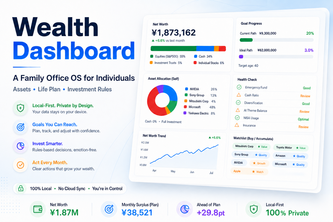
Wealth Dashboard is a self-reported local-first financial planning tool built by two individuals, designed for personal use. It integrates budgeting, brokerage insights, and long-term financial planning through an AI-driven interview process and a dashboard that displays financial data without executing trades.
What changed
The project began as a personal tool used by an entrepreneur to manage his own finances. During OpenAI Build Week, it was transformed into a reusable system using Codex and GPT-5.6, enabling another person to set up and operate the system from scratch.
Single most important open question
Is there any evidence of user adoption or feedback beyond the authors' own use cases?
What The Product Actually Is
The description states that Wealth Dashboard is a local-first family-office OS for individuals, integrating information across budgeting apps, brokerage accounts, spreadsheets, and financial-planning tools.
It operates through:
- A voice or text-based AI financial planner interview using the OpenAI Realtime API.
- A dashboard showing net worth, asset allocation, goal progress, portfolio health checks, investment performance (using Modified Dietz method), and prioritized actions.
- A life-plan page projecting assets under three scenarios including cash-flow tables and retirement planning.
- No trade execution or account access; all decisions remain with the user.
The system uses:
- Local Excel ledger
- Versioned JSON configuration
- Local SQLite store for interview drafts
- Python scripts for calculations
- HTML dashboards generated from these inputs
Inference The product is described as a personal financial OS, not a commercial SaaS offering. It is built to be self-contained and auditable, with no cloud-based data storage or external integrations beyond user consent.
Positioning & Claim Evolution
The description claims Wealth Dashboard connects budgeting apps (past), brokerages (present), and financial planners (future) — aiming to show what to prioritize next.
It positions itself as:
- A local-first solution
- An AI-powered interview-based approach to financial planning
- A personal OS, not a commercial tool
There is no indication of how the product evolved beyond its initial personal use case. The evolution from a creator’s private tool to a reusable system was driven by Codex and GPT-5.6 during OpenAI Build Week.
Inference The positioning reflects an attempt to differentiate from traditional financial tools by combining historical data, current status, and future planning in one interface — but this is framed as a personal tool, not a scalable product for mass market.
Target Customer & ICP
The description states that the system is intended for individuals who want to manage their personal finances using a local-first approach.
It supports:
- Users starting from zero or selecting one of four fictional quick-start personas
- Voice or text interaction with an AI financial planner
- Integration of personal data into a structured dashboard
There is no mention of targeting specific demographics, income levels, or professional roles beyond "individuals."
Inference The ICP appears to be highly technical individuals who are comfortable working locally and may have some familiarity with Python or CLI tools. It does not appear to target mainstream consumers or financial institutions.
Business Model & Pricing Evidence
The description makes no mention of pricing, monetization, or business model.
It states that:
- The system does not execute trades
- It organizes information and evaluates it against explicit rules
- Every decision remains with the user
- No external integrations are made
There is no indication of whether the tool will be sold, offered free, or used internally by individuals.
Inference There is no evidence of a business model, pricing strategy, or revenue streams. The project seems to be a prototype or personal tool rather than a commercial offering.
Technical & Delivery Signals
The system uses:
- Python scripts for deterministic financial calculations
- Local storage (Excel, JSON, SQLite)
- OpenAI Realtime API with gpt-realtime-2.1 and gpt-4o-mini-transcribe
- Codex for guided setup and operation
- HTML dashboards generated from local data
Key technical features include:
- Voice/text interviews via AI
- Auditable investment performance using Modified Dietz method
- Local-first architecture (no cloud sync or external access)
- Atomic commits of settings only after user confirmation
- No raw audio storage; only normalized text and drafts
Inference The delivery is highly technical, with a focus on local execution, privacy, and auditability. It leverages AI for interaction but avoids black-box decision-making.
Traction & Maturity Signals
The description states:
- The project started as a personal tool used by an entrepreneur
- It was transformed into a reusable system during OpenAI Build Week
- It includes setup guidance via Codex and AGENTS.md
- It has a versioned JSON schema (v3)
- It supports multiple data formats (Excel, JSON, SQLite)
However, there is no evidence of user adoption, revenue, customer base, or usage metrics.
Inference The project shows early-stage maturity in terms of architecture and functionality, but lacks any traction signals such as users, feedback, or market validation.
Competitive Context
The description does not reference competitors directly. However, it positions itself as a tool that bridges:
- Budgeting apps (e.g., YNAB, Mint)
- Brokerage platforms (e.g., Robinhood, E*TRADE)
- Financial planning tools (e.g., Personal Capital, Wealthfront)
It claims to offer a unified experience across past, present, and future financial states.
There is no mention of existing tools or how this differs from them in practice.
Inference The competitive landscape includes traditional personal finance apps and platforms, but the project does not clearly articulate its unique value proposition or differentiation in the market.
Open Questions & Risks
- No user feedback or adoption data: The tool is described only as a personal prototype.
- Highly technical for end-users: Requires local setup, CLI commands, and understanding of Python/JSON.
- Limited scalability: Designed for individuals, not scalable to enterprise or mass market.
- AI interview limitations: AI cannot write directly to financial records; it can only edit drafts.
- No monetization strategy: No indication of how the tool will be sold or funded.
Inference The project is in a very early stage and may not yet be ready for commercial use. It lacks any evidence of traction, market fit, or sustainable business model.
Questions the description leaves open
- What was the original personal use case that led to this tool?
- How many people have actually used the tool beyond the creators?
- Is there a plan for how users will be onboarded and supported?
- Are there any plans to expand beyond individual use or add integrations?
- What are the long-term goals for the project — is it intended to become a commercial product?
Overall Assessment
Not evidenced
There is no evidence of revenue, customers, traction, or business model. The project is described as a personal prototype, not a commercial venture.
It appears to be an early-stage technical experiment with potential for future development — but there is no indication that it has moved beyond the idea or prototype phase.
The authors state they are building this tool for personal use and have no intention of selling or monetizing it at present. As such, there is no basis for investment or partnership consideration based on the provided information.
User Stories BotA demo video on every pull request
Get a demo video on every new feature
GitHub App that watches your pull requests and records a narrated, captioned demo.
Save time on demo prep and make informed decisions faster with a video walkthrough of every new feature.
Source
Submitted to the OpenAI 2026 hackathon on Devpost. Project home on Devpost. Back to the full gallery on Devpost.
This competitive analysis was produced by top-founders.com (opens in a new tab)
Generated by a language model from this project's public Devpost page — its tagline, the author's own write-up and any built-with tags listed there — as captured in August 2026. Short quotations are the author's words. It is an opinion on the idea as a business, not on the people behind it, and it reflects the description as published then. If the project has moved on, request a correction below. The analysis is not independent research and contains no verified traction, revenue or customer data.
An independent guide by KFG International LLC — not affiliated with, endorsed by, or connected to Devpost or OpenAI.