

Archive position — measured, not model output
0 likes on Devpost
2,263 of the 7,850 archived projects have more likes, and 5,587 share exactly 0 — so this project's #7,631 place in the like-ranked listing is a tie-break inside that group, not a ranking.
Projects (log scale)
Likes on Devpost. ▲ marks this project's group.
Show the figures
| Likes | Projects | Share of archive |
|---|---|---|
| 0 | 5,587 | 71.2% |
| 1 | 1,758 | 22.4% |
| 2 | 284 | 3.6% |
| 3–4 | 132 | 1.7% |
| 5–9 | 75 | 1.0% |
| 10+ | 14 | 0.2% |
 User Stories BotA demo video on every pull request
Get a demo video on every new feature
GitHub App that watches your pull requests and records a narrated, captioned demo.
Save time on demo prep and make informed decisions faster with a video walkthrough of every new feature.
Executive Summary
What the company appears to be
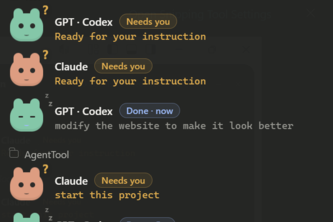
Warren for VS Code is a desktop companion tool that aggregates and visualizes the activity of multiple coding agents running in separate VS Code windows. It presents agent states (Working, Needs You, Done, Error) in an always-on-top interface with animated icons and colors. The tool is built as a local-first solution using TypeScript, Electron, and VS Code extensions, designed to help developers manage parallel agent workflows without losing track of which agent needs attention.
What changed
The project was submitted as part of the OpenAI 2026 hackathon. It represents an early-stage prototype focused on solving a specific UX problem for developers using multiple coding agents in VS Code. No prior version or commercial product is evidenced.
Single most important open question
Is there evidence of developer adoption or feedback beyond the hackathon context, and how does the tool’s local-first architecture affect scalability or integration with other IDEs or platforms?
What The Product Actually Is
The description states that Warren for VS Code is:
- A desktop companion for coding agents running in multiple VS Code windows.
- An always-on-top interface that aggregates agent activity into four clear states: Working, Needs You, Done, and Error.
- A local-first tool using an in-memory broker to communicate between components.
- A Windows installer-based product including a desktop app, VS Code extension, and agent adapters.
- Designed to show one-line previews of user instructions and allow jumping back to the original terminal or window.
Inference The tool is built for developers working with multiple AI agents simultaneously in VS Code. It aims to reduce cognitive load by centralizing visibility into agent activity.
Positioning & Claim Evolution
The description states:
- Warren is positioned as a “small, friendly companion” that answers the question: “Which coding agent needs me right now?”
- The name “Warren” is derived from a rabbit warren—a connected network of small burrows—symbolizing how it connects multiple agent sessions.
- It is described as a local-first tool with no data persistence beyond runtime.
Inference The positioning emphasizes simplicity, clarity, and developer-centric UX. There is no evidence of broader market positioning or branding beyond the hackathon submission.
Target Customer & ICP
The description states:
- The target user is a developer using multiple coding agents (e.g., Claude Code, Codex, OpenCode) in VS Code.
- The tool is designed for developers managing parallel agent workflows.
- It supports Windows users and integrates with VS Code.
Inference The ICP appears to be developers working in environments where multiple AI agents are used simultaneously. No evidence of segmentation beyond this.
Business Model & Pricing Evidence
The description states:
- Warren is installed via a single Windows setup executable.
- It does not persist data or communicate externally.
- The tool is described as local-first and privacy-focused.
Inference No pricing model, monetization strategy, or business model is evidenced. The tool appears to be a prototype with no commercial offering.
Technical & Delivery Signals
The description states:
- Built using TypeScript, Electron, VS Code extension APIs, and Node.js.
- Uses a local HTTP broker for communication between components.
- Includes agent-specific lifecycle hooks (Claude Code, Codex, OpenCode).
- Supports Windows via NSIS installer with safe uninstaller.
- The tool is described as “local-first,” not persisting source code or credentials.
Inference The technical stack and architecture suggest a lightweight, developer-focused solution. No evidence of scalability beyond VS Code or cross-platform support.
Traction & Maturity Signals
The description states:
- This is a hackathon submission.
- The tool works with real coding-agent sessions.
- It includes automated tests covering event normalization.
- It supports multiple independent agents and isolates sessions correctly.
Inference There is no evidence of users, customers, or adoption beyond the prototype. No revenue, ARR, or usage metrics are provided.
Competitive Context
The description states:
- The tool addresses a problem with managing multiple coding agents in VS Code.
- It does not directly name competitors but implies a gap in current tools for agent orchestration or visibility.
Inference No evidence of direct competition is provided. The tool may be addressing an unmet need in the developer tooling space, but no market analysis or competitive positioning is evident.
Open Questions & Risks
The description states:
- The tool is a hackathon prototype.
- It only supports Windows and VS Code.
- It does not persist data or communicate externally.
- It relies on specific agent hooks and plugins for accurate state reporting.
Inference Key risks include limited platform support, lack of commercial traction, and dependency on specific agent integrations. No evidence of long-term viability or scalability is provided.
Questions the description leaves open
- What is the current development stage beyond the hackathon prototype?
- Are there plans to expand support beyond Windows and VS Code?
- How does the tool handle edge cases, such as agent crashes or misconfigured hooks?
- Has there been any user feedback or testing beyond the team?
- Is there a roadmap for monetization or commercialization?
Overall Assessment
The description states:
- This is a hackathon submission.
- No evidence of revenue, customers, or traction is provided.
- The tool is described as a prototype with no commercial offering.
Inference There is insufficient evidence to assess investment or partnership potential. The project is early-stage and lacks commercial signals. It may be a promising idea for further development, but no due-diligence basis exists for commercial evaluation at this time.
User Stories BotA demo video on every pull request
Get a demo video on every new feature
GitHub App that watches your pull requests and records a narrated, captioned demo.
Save time on demo prep and make informed decisions faster with a video walkthrough of every new feature.
Source
Submitted to the OpenAI 2026 hackathon on Devpost. Project home on Devpost. Back to the full gallery on Devpost.
This competitive analysis was produced by top-founders.com (opens in a new tab)
Generated by a language model from this project's public Devpost page — its tagline, the author's own write-up and any built-with tags listed there — as captured in August 2026. Short quotations are the author's words. It is an opinion on the idea as a business, not on the people behind it, and it reflects the description as published then. If the project has moved on, request a correction below. The analysis is not independent research and contains no verified traction, revenue or customer data.
An independent guide by KFG International LLC — not affiliated with, endorsed by, or connected to Devpost or OpenAI.