

Archive position — measured, not model output
0 likes on Devpost
2,263 of the 7,850 archived projects have more likes, and 5,587 share exactly 0 — so this project's #7,632 place in the like-ranked listing is a tie-break inside that group, not a ranking.
Projects (log scale)
Likes on Devpost. ▲ marks this project's group.
Show the figures
| Likes | Projects | Share of archive |
|---|---|---|
| 0 | 5,587 | 71.2% |
| 1 | 1,758 | 22.4% |
| 2 | 284 | 3.6% |
| 3–4 | 132 | 1.7% |
| 5–9 | 75 | 1.0% |
| 10+ | 14 | 0.2% |
 User Stories BotA demo video on every pull request
Get a demo video on every new feature
GitHub App that watches your pull requests and records a narrated, captioned demo.
Save time on demo prep and make informed decisions faster with a video walkthrough of every new feature.
Executive Summary
What the company appears to be
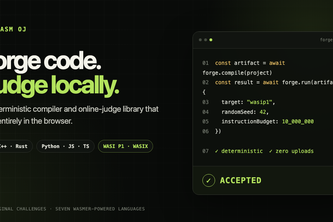
WASM OJ is a self-reported distributed online judge system that compiles and executes code in the browser or on the server using WebAssembly (WASM) and WASI, aiming to make execution reproducible and resource measurement deterministic. It positions itself as a solution to scalability and consistency issues in traditional online judges by offloading compilation and testing to user devices while maintaining consistent judging semantics.
What changed
The project description indicates that WASM OJ was rebuilt during Build Week, integrating multi-language support, shared browser/server judging semantics, and deterministic resource measurement. It evolved from prior experiments into a complete learner-facing system with practical implementation across languages and environments.
Single most important open question — the commercial due-diligence read
Is there evidence of real-world usage or adoption beyond the author’s own development? The description is entirely self-reported and lacks any indication of product-market fit, customer traction, or revenue generation. Any commercial viability hinges on whether educators, learners, or platforms adopt this system in practice.
What The Product Actually Is
The description states that WASM OJ is a distributed, multi-language online judge that supports compilation and execution in the browser or on the server using WebAssembly (WASM) and WASI. It claims to use deterministic resource measurement instead of wall-clock time to ensure consistent results across devices.
- The system separates three responsibilities:
- Compilation
- Execution
- Judging
These are implemented through shared contracts for both browser and server environments, allowing platforms to choose where each workload runs while preserving one judging model.
- It supports both compiled and interpreted languages via a portable execution model.
- Learners can write, build, test locally, and receive structured feedback without requiring server jobs for every attempt.
Inference The system appears designed for educational or competitive programming use cases where consistent resource measurement is critical.
Positioning & Claim Evolution
The author states that WASM OJ addresses a resource problem in online judging, particularly in education, where frequent submissions and potential infinite loops increase server load. It positions itself as a way to scale the judge without scaling servers.
Key claims:
- “How can we distribute compilation and execution without distributing the meaning of the result?”
- “Scale the judge, not the server.”
- The system uses WebAssembly and WASI for portability and deterministic resource measurement.
- It separates user experience (local testing) from official validation (server execution).
- It enables fast local experimentation while reducing infrastructure costs.
Inference The positioning evolved from solving a technical bottleneck in online judges to offering a scalable, portable, and reproducible platform for programming education and competitive environments.
Target Customer & ICP
The description does not name specific customers or personas. However, it implies several potential user groups:
- Learners (especially in educational settings)
- Educators who manage classrooms
- Online-judge platforms
- Researchers and language-tooling developers
It says:
“For learners, WASM-OJ enables fast local experimentation...”
“For educators, it reduces the infrastructure required to serve a classroom...”
“For online-judge platforms, it turns every capable browser into a compilation and execution worker.”
Inference The core ICP likely includes educational institutions or platforms that host programming challenges or coding exercises. However, no explicit segmentation or customer validation is provided.
Business Model & Pricing Evidence
There is no evidence of pricing, revenue, or business model in the description. The author does not describe how the product would be monetized, whether it’s a freemium offering, platform-as-a-service (PaaS), or something else.
Inference The business model remains undefined and speculative based on the self-reported account alone.
Technical & Delivery Signals
The project is built with:
- Languages: C, C++, Go, Python, Rust, JavaScript, TypeScript
- Tools: React, Monaco Editor, WASI, WASIX, Wasmer, OpenAI (Codex, GPT-5.6)
- Technologies: WebAssembly, WASI execution, deterministic resource measurement
Key technical claims:
- Multi-language compilation and execution in the browser
- Shared browser and server judging semantics
- Deterministic execution and resource measurement across language environments
- Portable computational work signal independent of elapsed time
- Safe, responsive local compilation with bounded execution
Inference The system is technically ambitious, leveraging modern web standards and AI tools for development. However, no evidence of production deployment or performance benchmarks is given.
Traction & Maturity Signals
There is no evidence of traction, including:
- Revenue
- Customers
- Users
- Product adoption
- Market validation
The description says:
“This project was submitted to the OpenAI 2026 hackathon on Devpost.”
“WASM-OJ succeeds earlier experiments, but the integrated system was substantially rebuilt during Build Week.”
Inference The product is at a prototype or early-stage development stage. No indication of real-world usage or market traction exists.
Competitive Context
The description does not mention competitors or existing solutions in the online judge space. It focuses on its own innovation around WASM and WASI rather than comparing itself to other platforms like LeetCode, HackerRank, Codeforces, etc.
Inference The competitive landscape is unknown from this report. There is no evidence of how WASM OJ differentiates from or competes with existing online judges.
Open Questions & Risks
- No traction or revenue: The system has not been adopted by users or platforms.
- Unproven commercial viability: No evidence of demand, pricing strategy, or monetization.
- Self-reported only: All claims are unverified and based on the author’s own account.
- High technical complexity: Distributed execution, multi-language support, deterministic resource measurement are challenging to implement correctly.
- Unclear scalability assumptions: While it aims to reduce server load, no data is provided on how well it scales in practice.
- Dependency on browser capabilities: Relies heavily on browser-based WASM support, which may vary.
Inference The project is technically promising but lacks any commercial or operational evidence. Risks include failure to gain traction, technical implementation issues, and unclear path to monetization.
Questions the description leaves open
- Has the system been tested in real-world educational or competitive environments?
- What is the current level of adoption among learners or educators?
- How does WASM OJ handle edge cases like memory leaks or malicious code in browser execution?
- Are there any known performance limitations when running on low-end devices?
- What are the plans for monetization and long-term sustainability?
- Is there a roadmap for integrating with existing online judge platforms or LMS systems?
- How does WASM OJ compare to current solutions in terms of usability, accuracy, and scalability?
- What is the expected timeline for production deployment?
Overall Assessment
Not evidenced: There is no evidence of revenue, customers, traction, or financial performance.
Confidence level: Low
This is a self-reported technical prototype, not a commercial product. It shows ambition and technical sophistication but lacks any indication of real-world usage or market validation. Any investment or partnership decision should be contingent on further due diligence into:
- Real-world adoption
- Product-market fit
- Scalability and performance data
- Commercial viability
Conclusion: The project is an interesting experiment in distributed execution and reproducible programming environments, but it does not yet demonstrate commercial readiness or traction.
User Stories BotA demo video on every pull request
Get a demo video on every new feature
GitHub App that watches your pull requests and records a narrated, captioned demo.
Save time on demo prep and make informed decisions faster with a video walkthrough of every new feature.
Source
Submitted to the OpenAI 2026 hackathon on Devpost. Project home on Devpost. Back to the full gallery on Devpost.
This competitive analysis was produced by top-founders.com (opens in a new tab)
Generated by a language model from this project's public Devpost page — its tagline, the author's own write-up and any built-with tags listed there — as captured in August 2026. Short quotations are the author's words. It is an opinion on the idea as a business, not on the people behind it, and it reflects the description as published then. If the project has moved on, request a correction below. The analysis is not independent research and contains no verified traction, revenue or customer data.
An independent guide by KFG International LLC — not affiliated with, endorsed by, or connected to Devpost or OpenAI.