

Archive position — measured, not model output
0 likes on Devpost
2,263 of the 7,850 archived projects have more likes, and 5,587 share exactly 0 — so this project's #3,707 place in the like-ranked listing is a tie-break inside that group, not a ranking.
Projects (log scale)
Likes on Devpost. ▲ marks this project's group.
Show the figures
| Likes | Projects | Share of archive |
|---|---|---|
| 0 | 5,587 | 71.2% |
| 1 | 1,758 | 22.4% |
| 2 | 284 | 3.6% |
| 3–4 | 132 | 1.7% |
| 5–9 | 75 | 1.0% |
| 10+ | 14 | 0.2% |
 User Stories BotA demo video on every pull request
Get a demo video on every new feature
GitHub App that watches your pull requests and records a narrated, captioned demo.
Save time on demo prep and make informed decisions faster with a video walkthrough of every new feature.
Executive Summary
What the company appears to be
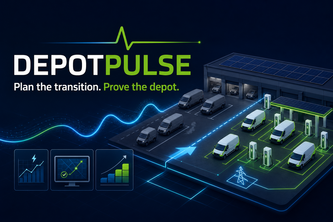
DepotPulse is described as an AI-assisted planning digital twin for mixed-fleet electrification. The product enables fleet managers to input ordinary-language descriptions of their current fleet, transition targets, depot constraints, and commercial assumptions. It uses GPT-5.6 to convert these into structured inputs, which are then processed through deterministic models to calculate operational and financial outcomes.
What changed
The project is presented as a personal, independent effort built during a hackathon (OpenAI 2026). It was not affiliated with any employer or fleet operator. The author states that the tool is designed to help fleet operators make decisions about infrastructure investments, transition timing, and operational feasibility without relying on fragmented spreadsheets or tools.
Single most important open question — commercial due-diligence read
Is there a viable business model or path to monetization beyond a prototype built for a hackathon? The description does not indicate any revenue, customers, or traction. There is no evidence of a go-to-market strategy, pricing structure, or customer feedback loop.
What The Product Actually Is
The description states that DepotPulse is an AI-assisted planning digital twin for mixed-fleet electrification. It allows fleet managers to describe their current fleet, transition goals, depot constraints, and commercial assumptions in natural language. GPT-5.6 converts this into structured inputs, which are then processed through deterministic models to compute operational and financial results.
Key components include:
- Mixed ICE/HEV/PHEV/B EV transition planning
- Phased vehicle replacement and fleet-growth modeling
- Charger, grid, transformer, civil-works, and software cost calculations
- Dynamic power management and grid-upgrade alternatives
- Vehicle-level charging across 96 fifteen-minute time slots
- Operational CO₂ impact analysis
The system uses React, TypeScript, Vite, and OpenAI’s API integrations. GPT-5.6 is used in five structured workflows to interpret input and generate outputs, but it does not perform calculations or final assessments.
Evidence
- The author describes the product as an AI-assisted planning digital twin.
- It uses GPT-5.6 for interpretation and scenario generation.
- Deterministic logic handles all operational and financial modeling.
- The tool supports mixed-fleet transitions, grid economics, and TCO analysis.
Inference The architecture combines natural language processing with deterministic models to ensure accountability in decision-making.
Positioning & Claim Evolution
DepotPulse positions itself as a solution for fleet operators who struggle with fragmented planning tools. It claims to address two major risks:
- Buying infrastructure too early.
- Approving EV transitions that the depot cannot physically operate.
The product is framed as an answer to the question: “What should a fleet operator install now, prepare for later, or defer—and will the resulting depot actually work?”
It also emphasizes that it separates financial feasibility from operational feasibility, ensuring that optimistic commercial assumptions do not override physical constraints.
Evidence
- The tagline: “AI-powered EV fleet transition planning that turns messy depot requirements into verified infrastructure, resilience, investment, TCO, and CO₂ decisions.”
- The author states the tool helps answer practical questions about infrastructure and transition timing.
- It distinguishes between financial and operational feasibility.
Inference The positioning suggests a niche within fleet electrification planning, targeting operators who need structured decision-making tools rather than generic EV planning software.
Target Customer & ICP
The description indicates that DepotPulse is aimed at fleet managers responsible for mixed-fleet electrification decisions. These users are likely working in large organizations with complex depot operations and long-term transition plans involving ICE, HEV, PHEV, and BEV vehicles.
It also targets those who:
- Deal with fragmented planning tools (spreadsheets, route exports, supplier quotes)
- Need to model phased transitions over several years
- Are concerned about grid constraints and infrastructure readiness
Evidence
- The tool is designed for fleet managers describing current fleets and transition goals.
- It models ICE/HEV/PHEV/B EV populations over time.
- It considers depot constraints and procurement dates.
Inference The ideal customer profile likely includes large commercial fleets (e.g., logistics, public transit, delivery services) with significant infrastructure planning needs.
Business Model & Pricing Evidence
There is no evidence of a business model or pricing structure in the description. The project is described as a personal, independent effort built for a hackathon and not affiliated with any employer or fleet operator.
The author notes that the current version uses synthetic demonstration data and editable planning assumptions. Costs are not supplier quotes, and CO₂ results cover operations rather than full lifecycle emissions.
Evidence
- No mention of revenue streams.
- No pricing information.
- No indication of monetization strategy.
- The prototype is not tied to any commercial entity or customer base.
Inference The project has no demonstrated path to monetization or customer acquisition at this stage.
Technical & Delivery Signals
DepotPulse uses:
- Frontend: React, TypeScript, Vite
- Backend: Server-side OpenAI API integrations (GPT-5.6)
- AI workflows: Five strict Structured Output workflows using GPT-5.6
- Modeling logic: Deterministic TypeScript code for vehicle availability, energy requirements, charger occupancy, grid envelopes, infrastructure costs, phased procurement, cash flow, and emissions
The system is designed to:
- Prevent AI from calculating feasibility or final TCO assessments.
- Use deterministic fallbacks when AI routes are unavailable.
- Maintain transparency in decision-making.
Evidence
- The architecture is described as inspectable and modular.
- GPT-5.6 is used only for interpretation, scenario generation, and explanation.
- Deterministic logic owns all operational and financial outcomes.
Inference The technical stack suggests a modern SaaS-like approach with AI integration, but the product remains in prototype form.
Traction & Maturity Signals
There is no evidence of traction or maturity beyond the hackathon prototype. The project:
- Was built as an independent personal effort.
- Uses synthetic demonstration data.
- Has no stated customers, revenue, or adoption metrics.
- Is not affiliated with any organization or fleet operator.
Evidence
- Team size: 0
- No mention of users, customers, or feedback loops.
- No indication of product-market fit or commercial traction.
Inference This is a pre-product-stage prototype, not a mature product with real-world usage.
Competitive Context
The description does not provide any information about competitors. It does not name similar tools or platforms in the EV fleet transition space.
Evidence
- No mention of existing solutions.
- No competitive analysis or positioning against other tools.
Inference It is unclear whether DepotPulse addresses a gap in the market or competes with existing tools, as no comparison is made.
Open Questions & Risks
- No commercial traction or revenue: The project is a prototype built for a hackathon and lacks any evidence of monetization.
- Unproven business model: There is no indication of how the product would be sold or who would pay for it.
- Limited team size: No team members are listed, suggesting a solo effort with no organizational backing.
- Self-reported only: All claims and descriptions are unverified and lack external corroboration.
- No customer feedback loop: The tool is not tested in real-world settings or used by actual fleet operators.
Evidence
- Team size: 0
- No revenue, customers, or adoption data
- Prototype-only status
Inference The project lacks the foundation for a scalable business model or commercial viability.
Questions the description leaves open
- What is your plan to transition from prototype to product? Are you seeking funding or partnerships?
- How do you intend to monetize this tool? Is there a target customer segment with paying customers?
- Have you validated the need for this tool with actual fleet operators?
- What are the key assumptions in your deterministic models, and how were they derived?
- Do you have any plans to integrate real-world data or APIs (e.g., telematics, route planning)?
- How do you plan to scale beyond a single-user prototype?
Overall Assessment
There is no evidence of a viable business case, traction, or commercial readiness. DepotPulse is described as a hackathon prototype with no revenue, customers, or team. The product is not yet in production and lacks any indication of a monetization strategy.
Confidence Low — based entirely on self-reported information without external validation.
Assessment Not ready for investment or partnership consideration at this time. A significant leap from prototype to product is required before any commercial due-diligence evaluation can be meaningful.
User Stories BotA demo video on every pull request
Get a demo video on every new feature
GitHub App that watches your pull requests and records a narrated, captioned demo.
Save time on demo prep and make informed decisions faster with a video walkthrough of every new feature.
Source
Submitted to the OpenAI 2026 hackathon on Devpost. Project home on Devpost. Back to the full gallery on Devpost.
This competitive analysis was produced by top-founders.com (opens in a new tab)
Generated by a language model from this project's public Devpost page — its tagline, the author's own write-up and any built-with tags listed there — as captured in August 2026. Short quotations are the author's words. It is an opinion on the idea as a business, not on the people behind it, and it reflects the description as published then. If the project has moved on, request a correction below. The analysis is not independent research and contains no verified traction, revenue or customer data.
An independent guide by KFG International LLC — not affiliated with, endorsed by, or connected to Devpost or OpenAI.