

Archive position — measured, not model output
0 likes on Devpost
2,263 of the 7,850 archived projects have more likes, and 5,587 share exactly 0 — so this project's #3,709 place in the like-ranked listing is a tie-break inside that group, not a ranking.
Projects (log scale)
Likes on Devpost. ▲ marks this project's group.
Show the figures
| Likes | Projects | Share of archive |
|---|---|---|
| 0 | 5,587 | 71.2% |
| 1 | 1,758 | 22.4% |
| 2 | 284 | 3.6% |
| 3–4 | 132 | 1.7% |
| 5–9 | 75 | 1.0% |
| 10+ | 14 | 0.2% |
 User Stories BotA demo video on every pull request
Get a demo video on every new feature
GitHub App that watches your pull requests and records a narrated, captioned demo.
Save time on demo prep and make informed decisions faster with a video walkthrough of every new feature.
Executive Summary
What the company appears to be: Desert Velocity is a self-developed 3D desert racing game built by one developer (Simone Savelli) using Godot, GDScript, and AI tools including Codex and GPT-5.6. The project was submitted as part of the OpenAI 2026 hackathon.
What changed: The author states that this is a personal challenge to explore what can be achieved with AI-assisted development in a constrained time and resource environment. It evolved from an idea into a playable game with multiple modes, vehicles, and environments.
Single most important open question: Is there any evidence of commercial traction or monetization beyond the developer's own use and submission to a hackathon?
Analysis basis: This report is based entirely on the self-reported description provided by the author. No external verification or historical data are available. All claims are treated as stated by the author, not proven facts.
What The Product Actually Is
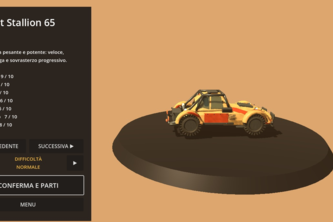
The description states that Desert Velocity is a 3D desert racing game developed in Godot with:
- Endurance races with checkpoints and time management
- Special stages focused on precision, speed, and route completion
- Multiple difficulty levels
- Two playable vehicles with different characteristics
- Dynamic desert environments including canyons, dust, sunset lighting, obstacles, and collectibles
- A custom HUD, timing system, checkpoints, and race progression
- Optimized 3D assets, materials, LODs, and environment elements
The author also notes that the game includes:
- A structured AI-assisted development workflow using Codex and GPT-5.6
- Iterative cycles of implementation, testing, correction, and visual review
Inference: The product is a single-player 3D racing game with multiple game modes and a focus on performance optimization.
Positioning & Claim Evolution
The author describes Desert Velocity as:
- A personal challenge to see how far a non-professional developer could go using AI tools
- An experiment in combining creative vision with AI-assisted development
- A demonstration of what can be achieved within limited time and resources
Claim: The project is positioned as an exploration of AI-assisted game development, not a commercial product.
Inference: The positioning has evolved from a personal learning exercise to a showcase of technical capability and workflow integration.
Target Customer & ICP
Not evidenced. The description does not identify any specific customer segment or target audience beyond the developer's own use and submission to a hackathon.
Business Model & Pricing Evidence
Not evidenced. There is no mention of pricing, monetization strategy, or business model in the provided description.
Technical & Delivery Signals
The author states:
- Built with Godot and GDScript
- Used Codex and GPT-5.6 for development support
- Implemented gameplay systems, debugging, asset creation, code review, performance checks, and milestone organization
- Developed iteratively through cycles of implementation, testing, correction, and visual review
- Optimized for modest hardware with LODs and environment elements
Inference: The project demonstrates a structured approach to development using AI tools, but lacks evidence of scalability or production-level delivery beyond the developer's own use.
Traction & Maturity Signals
Not evidenced. There is no mention of user adoption, downloads, revenue, or any form of traction beyond the developer’s personal completion of the project.
Competitive Context
Not evidenced. No information is provided about competitors, market positioning, or competitive landscape.
Open Questions & Risks
- Single-person development: The entire project was built by one individual (Simone Savelli), which raises questions about scalability and long-term maintenance.
- No commercial traction: There is no evidence of any revenue, users, or monetization strategy.
- Hackathon submission: The project was submitted to a hackathon, suggesting it may be experimental or exploratory rather than production-ready.
- AI dependency: Heavy reliance on AI tools like Codex and GPT-5.6 could pose risks if those tools change or become unavailable.
Questions the description leaves open
- What is the actual scope of your AI tool usage? Are you using Codex for code generation, debugging, or planning?
- Have you considered how this project might scale beyond a single-person effort?
- Is there any plan to monetize or distribute the game beyond the current development phase?
- How do you intend to maintain and update the game post-hackathon submission?
- What is your long-term vision for Desert Velocity, if any?
Overall Assessment
Not evidenced. The description does not provide sufficient information to assess whether this project has investment or partnership potential. It appears to be a personal development experiment with no demonstrated commercial viability or traction.
User Stories BotA demo video on every pull request
Get a demo video on every new feature
GitHub App that watches your pull requests and records a narrated, captioned demo.
Save time on demo prep and make informed decisions faster with a video walkthrough of every new feature.
Source
Submitted to the OpenAI 2026 hackathon on Devpost. Project home on Devpost. Back to the full gallery on Devpost.
This competitive analysis was produced by top-founders.com (opens in a new tab)
Generated by a language model from this project's public Devpost page — its tagline, the author's own write-up and any built-with tags listed there — as captured in August 2026. Short quotations are the author's words. It is an opinion on the idea as a business, not on the people behind it, and it reflects the description as published then. If the project has moved on, request a correction below. The analysis is not independent research and contains no verified traction, revenue or customer data.
An independent guide by KFG International LLC — not affiliated with, endorsed by, or connected to Devpost or OpenAI.