

Archive position — measured, not model output
0 likes on Devpost
2,263 of the 7,850 archived projects have more likes, and 5,587 share exactly 0 — so this project's #3,710 place in the like-ranked listing is a tie-break inside that group, not a ranking.
Projects (log scale)
Likes on Devpost. ▲ marks this project's group.
Show the figures
| Likes | Projects | Share of archive |
|---|---|---|
| 0 | 5,587 | 71.2% |
| 1 | 1,758 | 22.4% |
| 2 | 284 | 3.6% |
| 3–4 | 132 | 1.7% |
| 5–9 | 75 | 1.0% |
| 10+ | 14 | 0.2% |
 User Stories BotA demo video on every pull request
Get a demo video on every new feature
GitHub App that watches your pull requests and records a narrated, captioned demo.
Save time on demo prep and make informed decisions faster with a video walkthrough of every new feature.
Executive Summary
What the company appears to be
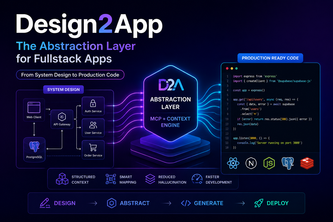
Design2App is a self-reported system design abstraction layer that aims to provide AI coding agents with structured architectural context via a single source of truth (SOT). It allows developers to model applications visually and translates that into executable knowledge for AI agents, aiming to reduce hallucinations and improve synchronization among parallel agents.
What changed
The project was submitted as part of the OpenAI 2026 hackathon. The author describes it as a proof-of-concept built in a short timeframe, focused on solving architectural context problems for AI agents.
Single most important open question
Is there evidence that this concept has traction or adoption beyond the hackathon submission?
What The Product Actually Is
The description states that Design2App is:
- An abstraction layer transforming system design into executable context for AI coding agents.
- A platform with a visual editor for modeling software architecture (services, APIs, databases, events, queues, relationships, business rules, dependencies).
- A knowledge generation pipeline converting diagrams into structured knowledge.
- An MCP server exposing architectural context to coding agents.
- A semantic memory layer enabling fast retrieval of system information.
- A real-time synchronization mechanism ensuring architectural changes are immediately available to AI agents.
Inference The product appears to be a developer tool aimed at improving AI agent reliability and consistency in large-scale software development by grounding them in visual system design.
Positioning & Claim Evolution
The author claims:
- AI coding agents suffer from hallucinations due to lack of architectural context.
- The problem is not with the AI’s coding ability but with its understanding of system structure.
- Design2App enables AI agents to directly understand system design instead of reverse-engineering it from code.
- It introduces a “Single Source of Truth” (SOT) for multiple parallel agents.
Inference This positioning suggests an early-stage attempt to solve a growing challenge in AI-native development where context management becomes critical as systems scale. The claims are aspirational and self-reported, without evidence of prior adoption or validation.
Target Customer & ICP
The description states:
- Developers working on complex software systems.
- Teams struggling with architectural knowledge loss due to team turnover or lack of documentation.
- AI coding agents used in development workflows.
Inference The target customer is likely enterprise developers or engineering teams using AI tools for code generation, particularly those managing large-scale distributed systems where architectural clarity is essential.
Business Model & Pricing Evidence
Not evidenced.
The description does not mention any pricing model, monetization strategy, or business model. It focuses solely on the technical architecture and use case.
Technical & Delivery Signals
The author reports:
- Built using technologies such as convex, css, docker, flow, github, mcp, next.js, node.js, openai, pnpm, react, supermemory, tailwind, typescript, vercel.
- Core components include a visual system design editor, knowledge generation pipeline, MCP server, semantic memory layer, and real-time synchronization.
Inference The stack indicates a modern web-based tool with AI integration and backend orchestration capabilities. However, no evidence of production deployment or scalability is provided.
Traction & Maturity Signals
Not evidenced.
There is no mention of revenue, customers, usage metrics, or product maturity beyond the hackathon submission. The project is described as a prototype built in a short time frame.
Competitive Context
Not evidenced.
No information is given about competitors or existing solutions addressing similar architectural context challenges for AI agents.
Open Questions & Risks
- Unproven concept: No evidence of traction, adoption, or real-world usage beyond the hackathon.
- Limited team size: Only one member (Subhash Nayak) is listed, raising questions about execution capacity.
- Self-reported only: All claims are unverified and based on author's own account.
- No commercial viability signal: No pricing, monetization, or business model discussed.
Questions the description leaves open
- What specific architectural challenges do you observe in your current or past projects that led to this idea?
- Have you tested the system with real AI agents? If so, what were the results?
- How does Design2App handle version control and change tracking of system designs?
- Are there any early adopters or pilot users who have provided feedback?
- What is your plan for scaling beyond a single developer’s prototype?
Overall Assessment
Not evidenced.
There is insufficient evidence to assess the commercial viability, traction, or strategic fit for investment or partnership. The project remains at the concept stage, with no data on performance, user base, or financials.
User Stories BotA demo video on every pull request
Get a demo video on every new feature
GitHub App that watches your pull requests and records a narrated, captioned demo.
Save time on demo prep and make informed decisions faster with a video walkthrough of every new feature.
Source
Submitted to the OpenAI 2026 hackathon on Devpost. Project home on Devpost. Back to the full gallery on Devpost.
This competitive analysis was produced by top-founders.com (opens in a new tab)
Generated by a language model from this project's public Devpost page — its tagline, the author's own write-up and any built-with tags listed there — as captured in August 2026. Short quotations are the author's words. It is an opinion on the idea as a business, not on the people behind it, and it reflects the description as published then. If the project has moved on, request a correction below. The analysis is not independent research and contains no verified traction, revenue or customer data.
An independent guide by KFG International LLC — not affiliated with, endorsed by, or connected to Devpost or OpenAI.