

Archive position — measured, not model output
0 likes on Devpost
2,263 of the 7,850 archived projects have more likes, and 5,587 share exactly 0 — so this project's #7,636 place in the like-ranked listing is a tie-break inside that group, not a ranking.
Projects (log scale)
Likes on Devpost. ▲ marks this project's group.
Show the figures
| Likes | Projects | Share of archive |
|---|---|---|
| 0 | 5,587 | 71.2% |
| 1 | 1,758 | 22.4% |
| 2 | 284 | 3.6% |
| 3–4 | 132 | 1.7% |
| 5–9 | 75 | 1.0% |
| 10+ | 14 | 0.2% |
 User Stories BotA demo video on every pull request
Get a demo video on every new feature
GitHub App that watches your pull requests and records a narrated, captioned demo.
Save time on demo prep and make informed decisions faster with a video walkthrough of every new feature.
Executive Summary
What the company appears to be
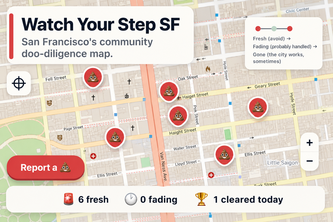
Watch Your Step SF is a self-reported crowdsourced doo-diligence app for San Francisco that allows users to flag human excrement sightings on city streets via a full-screen map interface. The app is described as built using AI tools (Fable, GPT-5.6, Codex) in a single session with no backend or build step.
What changed
The project was submitted to the OpenAI 2026 hackathon and is presented as an experimental civic tool developed by one person (Nicole Collins). It has not been released for public use beyond its hackathon submission, nor does it appear to have any revenue, customers or traction.
Single most important open question
Is there a viable path to scaling this idea into a sustainable product with real user adoption and impact?
What The Product Actually Is
The description states that Watch Your Step SF is a full-screen map of San Francisco where neighbors can flag human excrement sightings. Users can report locations in two taps, with markers fading over 48 hours. It includes features such as:
- Live stats bar
- Locate-me functionality
- Keyboard-accessible reporting
- A 311 pointer for real hazards
The app is described as having been built using AI tools (Fable, GPT-5.6, Codex) in a single session without backend or build steps.
Evidence
- The author states: “A full-screen map of SF where neighbors flag human-excrement sightings so dog walkers and parents of small kids can steer around them.”
- The app is described as having features like "live stats bar", "locate-me", "keyboard-accessible reporting", and a "311 pointer for real hazards".
- The author states: “The idea came from a dog walk... Fable, acting as product lead, wrote the implementation brief, reviewed the code, and browser-tested every flow. GPT-5.6, driven through a handy piece of code, codex exec, built the entire app from that brief.”
Inference This is an experimental civic tool built in a hackathon context, not a production-ready product.
Positioning & Claim Evolution
The project is positioned as a crowdsourced doo-diligence app aimed at keeping San Francisco streets clean and safe for dog walkers and parents. It uses the tagline: “It's a crowdsourced doo-diligence app that keeps SF's streets, and your shoes, poo free!”
Evidence
- The tagline is stated as: “It's a crowdsourced doo-diligence app that keeps SF's streets, and your shoes, poo free!”
- The author states: “I know this isn't allowed, but Fable, acting as product lead, wrote the implementation brief... GPT-5.6, driven through a handy piece of code, codex exec, built the entire app from that brief.”
Inference The positioning is rooted in solving a local civic problem using AI tools, with an emphasis on community-driven reporting and safety.
Target Customer & ICP
The description states that Watch Your Step SF targets:
- Dog walkers
- Parents of small kids
These are the primary users who would benefit from avoiding areas with human excrement.
Evidence
- The author states: “so dog walkers and parents of small kids can steer around them.”
Inference It is unclear whether this is a defined ICP or just a general user group. No further segmentation or targeting data is provided.
Business Model & Pricing Evidence
There is no evidence of a business model or pricing structure in the description. The project is described as a hackathon submission with no mention of monetization, subscriptions, or fees.
Evidence
- The author states: “The idea came from a dog walk...” and describes the app as built in one session.
- No mention of revenue streams, pricing, or business model.
Inference This is an experimental tool without any commercial framework.
Technical & Delivery Signals
The project was built using:
- Fable (as product lead)
- GPT-5.6 (for coding)
- Codex (to execute the code)
It was implemented in a single file with no build step or backend, and only one bug was encountered (a timing issue fixed with setTimeout).
Evidence
- The author states: “Fable, acting as product lead, wrote the implementation brief... GPT-5.6, driven through a handy piece of code, codex exec, built the entire app from that brief.”
- “One hardening fix later (an animation-timing bug), it shipped.”
- “Single file, no build step, no backend.”
Inference It is a minimal prototype with no scalable architecture or infrastructure.
Traction & Maturity Signals
There is no evidence of traction, users, or adoption. The project was submitted to a hackathon and has not been released for public use beyond that context.
Evidence
- The author states: “This project was submitted to the OpenAI 2026 hackathon on Devpost.”
- No mention of users, downloads, or usage metrics.
- No evidence of revenue or customer base.
Inference The product is at a very early stage and lacks any traction or maturity indicators.
Competitive Context
There is no evidence of direct competitors. The project is described as solving a local civic issue using AI tools, without reference to similar apps or platforms in the market.
Evidence
- No mention of competitors or existing solutions.
- The author states: “I learned that the models can work together beautifully and look forward to working with them to solve other impactful global issues very soon.”
Inference It is unclear whether there are existing tools for reporting public hazards or similar civic apps in San Francisco.
Open Questions & Risks
Key risks include:
- Lack of scalability: The app is built as a single-file prototype with no backend.
- No monetization strategy or business model.
- No evidence of traction, users, or adoption.
- Unclear long-term viability or path to product-market fit.
- The project is described as experimental and not yet released for public use.
Evidence
- “Single file, no build step, no backend.”
- “No revenue, customer or traction data is available beyond what they state.”
Inference This is a prototype with no clear path to commercialization or user adoption.
Questions the description leaves open
- What is the intended long-term vision for this app beyond the hackathon?
- Are there any plans to integrate with city services or public data sources?
- How would you monetize or sustain this product if it were to be scaled?
- Have you considered how users will verify or validate reports?
- Is there a plan to move from localStorage to a shared database or backend?
Overall Assessment
Not evidenced.
Evidence
- No financial data, traction, or commercial viability is provided.
- The project is described as a hackathon submission with no evidence of product-market fit or scalability.
Inference This is an experimental idea with no demonstrated commercial potential or path to investment or partnership.
User Stories BotA demo video on every pull request
Get a demo video on every new feature
GitHub App that watches your pull requests and records a narrated, captioned demo.
Save time on demo prep and make informed decisions faster with a video walkthrough of every new feature.
Source
Submitted to the OpenAI 2026 hackathon on Devpost. Project home on Devpost. Back to the full gallery on Devpost.
This competitive analysis was produced by top-founders.com (opens in a new tab)
Generated by a language model from this project's public Devpost page — its tagline, the author's own write-up and any built-with tags listed there — as captured in August 2026. Short quotations are the author's words. It is an opinion on the idea as a business, not on the people behind it, and it reflects the description as published then. If the project has moved on, request a correction below. The analysis is not independent research and contains no verified traction, revenue or customer data.
An independent guide by KFG International LLC — not affiliated with, endorsed by, or connected to Devpost or OpenAI.