

Archive position — measured, not model output
0 likes on Devpost
2,263 of the 7,850 archived projects have more likes, and 5,587 share exactly 0 — so this project's #3,711 place in the like-ranked listing is a tie-break inside that group, not a ranking.
Projects (log scale)
Likes on Devpost. ▲ marks this project's group.
Show the figures
| Likes | Projects | Share of archive |
|---|---|---|
| 0 | 5,587 | 71.2% |
| 1 | 1,758 | 22.4% |
| 2 | 284 | 3.6% |
| 3–4 | 132 | 1.7% |
| 5–9 | 75 | 1.0% |
| 10+ | 14 | 0.2% |
 User Stories BotA demo video on every pull request
Get a demo video on every new feature
GitHub App that watches your pull requests and records a narrated, captioned demo.
Save time on demo prep and make informed decisions faster with a video walkthrough of every new feature.
Executive Summary
Desk Sentinel is a self-reported desktop cleanliness monitoring application built as a hackathon project. The author states it uses local computer vision (TensorFlow.js, COCO-SSD) for real-time tracking and GPT-5.6 via a Codex app-server to identify objects on the desk and trigger interruptions when unnecessary items are detected.
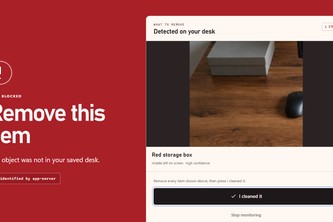
The product is described as an Electron-based desktop app that runs a webcam continuously, compares images with a saved reference, and uses AI to determine if objects should be removed. It includes a full-screen interruption mechanism that requires user confirmation before releasing the screen.
Key change: The author reports building this tool to solve personal desk cleanliness issues, using a combination of local image processing and GPT-5.6 for semantic judgment.
Most important open question: Is there any evidence of real-world usage or adoption beyond the author’s own testing? The description contains no data on customers, revenue, or product-market fit.
What The Product Actually Is
The description states that Desk Sentinel is an app that monitors a desk using a fixed webcam. It compares current images with a saved clean reference and uses two vision layers:
- Local tracking: TensorFlow.js and spatial image differences run locally for responsive tracking.
- Semantic judgment: A Codex app-server uses GPT-5.6 to identify objects, check if they are resting on the desk, and return bounding boxes for actionable items.
When an object remains on the desk, it triggers a full-screen Windows interruption that displays the object name and image, requiring user confirmation ("I cleaned it") before releasing the screen.
The app is built using:
- Electron (for desktop UI)
- Node.js (server-side logic)
- TensorFlow.js (local vision processing)
- GPT-5.6 (via Codex app-server)
Inference: The product appears to be a proof-of-concept or prototype, not a commercial offering.
Positioning & Claim Evolution
The author claims the app addresses a common problem: people who want a clean desk but don’t want to constantly check it themselves.
The tagline is:
“Everybody hates messy desk. So I built this app to keep my desk clean. This app will hit you in the face everytime you leave anything unnecessary on the desk.”
This positioning suggests a personal, somewhat humorous solution to an everyday issue — not a scalable or enterprise-grade product.
Inference: The positioning is self-directed and lacks evidence of market demand or user feedback beyond the author's own experience.
Target Customer & ICP
The description does not state any explicit customer segments or personas. It only mentions that the app was built for someone who wants a clean desk without constantly checking it themselves.
Inference: The target is likely individuals (possibly students, remote workers, or people with cluttered desks), but there is no evidence of segmentation or targeting beyond personal use.
Business Model & Pricing Evidence
There is no mention of pricing, monetization, or business model in the description. The app appears to be a prototype or personal project.
Inference: No commercial business model is evident from the self-reported description.
Technical & Delivery Signals
The author reports:
- Local tracking using TensorFlow.js and COCO-SSD
- GPT-5.6 used via Codex app-server for semantic judgment
- Electron-based desktop application
- Node.js server for validation and interruption logic
- 56 automated tests included in the repository
- Portable Windows build and installer available
The project is described as having:
- Jitter-tolerant tracking
- Identity checks for moving objects
- Recurring verification during movement
- Privacy controls and cleanup confirmation
Inference: The technical stack and delivery approach suggest a functional prototype, but no evidence of production deployment or scalability.
Traction & Maturity Signals
The description contains no evidence of traction, customers, revenue, or adoption. It is presented as a hackathon submission.
The author states:
- The app was built for personal use
- It includes automated tests and visual checks
- A GitHub release is available for download
Inference: No signs of product-market fit, user engagement, or commercial traction are evident.
Competitive Context
There is no mention of competitors in the description. The author does not reference similar tools or platforms.
Inference: No competitive analysis or positioning against existing solutions is provided.
Open Questions & Risks
- No commercial evidence: The project is described as a hackathon submission with no revenue, customers, or adoption.
- Unverified claims: GPT-5.6 is mentioned but not validated; the author may be conflating AI capabilities.
- Limited scope: The app appears to be a personal tool, not a scalable product.
- No feedback loop: No evidence of user testing or iteration beyond the author’s own experience.
Questions the description leaves open
- What is the actual use case for this tool? Is it intended for individuals or organizations?
- Has the app been tested in real-world environments beyond the author's desk?
- Are there any privacy concerns with continuous webcam monitoring, and how are they addressed?
- How does the system handle false positives or misidentifications?
- What is the long-term vision for this product? Is it intended to be commercialized?
Overall Assessment
The description presents Desk Sentinel as a personal hackathon project with no evidence of traction, revenue, or market validation.
Assessment: Not ready for investment or partnership consideration. The product is unproven and lacks any commercial signals.
User Stories BotA demo video on every pull request
Get a demo video on every new feature
GitHub App that watches your pull requests and records a narrated, captioned demo.
Save time on demo prep and make informed decisions faster with a video walkthrough of every new feature.
Source
Submitted to the OpenAI 2026 hackathon on Devpost. Project home on Devpost. Back to the full gallery on Devpost.
This competitive analysis was produced by top-founders.com (opens in a new tab)
Generated by a language model from this project's public Devpost page — its tagline, the author's own write-up and any built-with tags listed there — as captured in August 2026. Short quotations are the author's words. It is an opinion on the idea as a business, not on the people behind it, and it reflects the description as published then. If the project has moved on, request a correction below. The analysis is not independent research and contains no verified traction, revenue or customer data.
An independent guide by KFG International LLC — not affiliated with, endorsed by, or connected to Devpost or OpenAI.