

Archive position — measured, not model output
0 likes on Devpost
2,263 of the 7,850 archived projects have more likes, and 5,587 share exactly 0 — so this project's #5,674 place in the like-ranked listing is a tie-break inside that group, not a ranking.
Projects (log scale)
Likes on Devpost. ▲ marks this project's group.
Show the figures
| Likes | Projects | Share of archive |
|---|---|---|
| 0 | 5,587 | 71.2% |
| 1 | 1,758 | 22.4% |
| 2 | 284 | 3.6% |
| 3–4 | 132 | 1.7% |
| 5–9 | 75 | 1.0% |
| 10+ | 14 | 0.2% |
 User Stories BotA demo video on every pull request
Get a demo video on every new feature
GitHub App that watches your pull requests and records a narrated, captioned demo.
Save time on demo prep and make informed decisions faster with a video walkthrough of every new feature.
Executive Summary
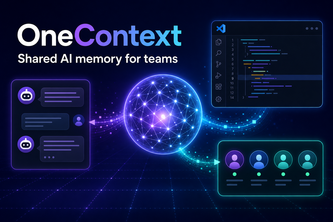
What the company appears to be: OneContext is a self-reported project that aims to create a shared project memory for development teams using AI coding assistants. It allows developers and AI agents to stay aligned around common goals, decisions, tasks, and context without requiring all team members to use the same AI tool.
What changed: The project description indicates this was built as part of an OpenAI 2026 hackathon submission. It represents a self-reported attempt to solve coordination challenges in distributed development workflows involving multiple AI tools.
Single most important open question: Is there evidence of actual usage or traction beyond the hackathon demo, and what is the commercial viability of this concept?
What The Product Actually Is
The description states that OneContext provides:
- A shared project brief, sources, decisions, and handoffs
- Memory Chat for asking questions about the project
- A knowledge graph connecting files, concepts, and decisions
- A Chrome extension for transferring project context between ChatGPT and Claude
- A VS Code extension for Team Codes, task intent, presence, and conflict warnings
- Realtime collaboration across multiple laptops
- An MCP server for Codex, GitHub Copilot, Cursor, and other agents
- A Codex CLI workflow for retrieving project-aware context
The system indexes project sources into searchable chunks and stores decisions, tasks, handoffs, file references, and activity as structured project memory. It retrieves relevant context instead of blindly copying complete conversations.
Evidence: The author's own write-up describes these features in detail.
Positioning & Claim Evolution
The description states that OneContext was inspired by the difficulty of coordinating among teammates using different AI coding assistants (e.g., ChatGPT, Codex, Claude). It aims to reduce repetitive prompts and improve development productivity across all tools.
It positions itself as a solution for teams working on the same application where each person may use a different AI assistant or approach. The goal is to help developers and AI agents stay aligned without forcing everyone to use the same tool.
Evidence: The author's own write-up explains the inspiration and positioning.
Target Customer & ICP
Not evidenced.
The description does not specify target customer segments, personas, or ideal customer profiles beyond general developer teams using AI coding assistants.
Business Model & Pricing Evidence
Not evidenced.
There is no mention of pricing models, monetization strategies, or business model assumptions in the author's write-up.
Technical & Delivery Signals
The project was built with:
- Next.js, React, TypeScript
- PostgreSQL, WebSockets
- Chrome extension using Manifest V3 content scripts
- VS Code extension using the VS Code API
- MCP server exposing tools like
onecontext_get_context,onecontext_check_conflicts, etc. - Codex with GPT-5.6 used for architecture design, implementation, debugging, testing, packaging, and demo preparation
The system retrieves relevant context rather than copying full conversations.
Evidence: The author's own write-up details the technical stack and delivery approach.
Traction & Maturity Signals
Not evidenced.
There is no evidence of revenue, customers, user adoption, or product maturity beyond the hackathon submission. No data on usage, retention, or growth metrics are provided.
Competitive Context
Not evidenced.
The description does not mention competitors, market positioning relative to existing solutions, or competitive landscape analysis.
Open Questions & Risks
- Unverified claims: All statements are self-reported and unverified.
- No traction evidence: No data on users, customers, revenue, or adoption beyond the hackathon.
- Limited team size: Only two members listed; raises questions about scalability and execution capacity.
- Unclear commercial viability: No indication of how this would be monetized or scaled beyond a prototype.
- Privacy concerns: The system handles sensitive project information; unclear how privacy controls are implemented at scale.
- Tool dependency: Relies heavily on specific AI tools (e.g., Codex, GitHub Copilot) and may not be easily extensible to others.
Inference: Given the lack of traction or revenue data, this appears to be a proof-of-concept rather than a product with commercial viability.
Questions the description leaves open
- What specific problems are you solving for developers that existing tools don't address?
- How do you plan to scale beyond the current hackathon prototype?
- Have you validated demand from potential users or organizations?
- What is your go-to-market strategy and pricing model?
- How do you ensure data privacy and security across different AI platforms?
- What are the technical challenges in integrating with various AI coding assistants?
- Are there any partnerships or integrations already in place?
Overall Assessment
Not evidenced.
There is no evidence of funding, valuation, or investment interest beyond the hackathon submission. No indication of whether this project has moved past prototype stage or attracted any commercial attention. The lack of traction data makes it difficult to assess its potential for investment or partnership.
User Stories BotA demo video on every pull request
Get a demo video on every new feature
GitHub App that watches your pull requests and records a narrated, captioned demo.
Save time on demo prep and make informed decisions faster with a video walkthrough of every new feature.
Source
Submitted to the OpenAI 2026 hackathon on Devpost. Project home on Devpost. Back to the full gallery on Devpost.
This competitive analysis was produced by top-founders.com (opens in a new tab)
Generated by a language model from this project's public Devpost page — its tagline, the author's own write-up and any built-with tags listed there — as captured in August 2026. Short quotations are the author's words. It is an opinion on the idea as a business, not on the people behind it, and it reflects the description as published then. If the project has moved on, request a correction below. The analysis is not independent research and contains no verified traction, revenue or customer data.
An independent guide by KFG International LLC — not affiliated with, endorsed by, or connected to Devpost or OpenAI.