

Archive position — measured, not model output
0 likes on Devpost
2,263 of the 7,850 archived projects have more likes, and 5,587 share exactly 0 — so this project's #7,597 place in the like-ranked listing is a tie-break inside that group, not a ranking.
Projects (log scale)
Likes on Devpost. ▲ marks this project's group.
Show the figures
| Likes | Projects | Share of archive |
|---|---|---|
| 0 | 5,587 | 71.2% |
| 1 | 1,758 | 22.4% |
| 2 | 284 | 3.6% |
| 3–4 | 132 | 1.7% |
| 5–9 | 75 | 1.0% |
| 10+ | 14 | 0.2% |
 User Stories BotA demo video on every pull request
Get a demo video on every new feature
GitHub App that watches your pull requests and records a narrated, captioned demo.
Save time on demo prep and make informed decisions faster with a video walkthrough of every new feature.
Executive Summary
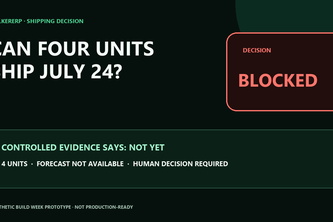
What the company appears to be: VolkerERP is a self-described prototype ERP tool for small manufacturers, built as part of an OpenAI Build Week hackathon project. It uses a deterministic engine to calculate order readiness and a bounded GPT-5.6 model to explain findings without mutating business data. The system isolates AI explanations from transactional authority, requiring human authorization for any action.
What changed: The description does not indicate a prior version or evolution; it is presented as a single prototype built in a short timeframe (a hackathon). No evidence of prior development or product iteration exists in the provided materials.
Single most important open question: Is there any evidence that this system has been tested with real manufacturers, or that its bounded AI approach can be reliably scaled to handle production-level complexity and human workflows?
What The Product Actually Is
The description states that VolkerERP is a bounded, synthetic VX-4 prototype-chassis mission thread. It calculates order readiness across material, engineering revision, quality, and capacity using a deterministic engine. A bounded GPT-5.6 Sol provider path gathers evidence through strict read-only tools and generates operator-ready explanations.
The system:
- Uses TypeScript/Node.js with Fastify
- React/Vite command center
- SQLite database with normalized migrations
- OpenAI Responses API with gpt-5.6-sol
- Five tenant-scoped read-only tools for interaction
- Strict structured output validation including schema, evidence references, and deterministic-status agreement
It is described as a prototype, not a production system.
Inference: The product appears to be an experimental tool designed to explore how AI can assist in manufacturing decision-making while maintaining human control over authoritative actions.
Positioning & Claim Evolution
The tagline states: “See the risk before making the promise: deterministic ERP truth, bounded GPT‑5.6 explanations, and explicit human authority for small manufacturers.”
The description elaborates that VolkerERP:
- Helps underserved manufacturers understand why a complex order cannot ship
- Eliminates AI mutation-authority risk by isolating the data engine from language-model output
- Does not allow AI to change records or authorize actions
- Requires human-controlled transitions with authentication, role authorization, and audit trails
It positions itself as:
- A controlled decision layer across planning, purchasing, engineering, quality, production, and customer promises
- Not a general-purpose ERP but a bounded solution for specific risk classes
- Focused on reducing time spent reconciling blockers while avoiding unsupported delivery promises
Inference: The positioning is focused on risk mitigation in manufacturing, not broad ERP replacement. It emphasizes human authority and deterministic truth over AI autonomy.
Target Customer & ICP
The description states that VolkerERP targets:
- Underserved manufacturers
- Teams making high-consequence delivery decisions from disconnected spreadsheets, notes, supplier records, quality evidence, and capacity calendars
- Shop-floor operators who need a clean interface to understand constraints before committing to dates
It is not described as targeting large enterprises or general-purpose ERP users.
Inference: The ICP likely includes small-to-medium-sized manufacturers with limited digital infrastructure and high reliance on manual coordination.
Business Model & Pricing Evidence
There is no evidence of a business model, pricing structure, or monetization strategy in the description. The project is presented as a prototype for a hackathon.
The authors state:
- No measured savings, pricing, customer adoption, or production deployment is claimed
- Commercial value would come from avoiding preventable scrap, emergency expediting, schedule churn, rework, and damaged trust
Inference: There is no evidence of any revenue model or pricing mechanism. The project is not described as a commercial offering.
Technical & Delivery Signals
The system:
- Is built with TypeScript/Node.js (Fastify), React/Vite
- Uses SQLite with normalized migrations and synthetic seed data
- Implements deterministic BOM, ATP, revision, quality, capacity, and forecast calculations
- Integrates OpenAI Responses API with gpt-5.6-sol
- Employs five tenant-scoped read-only tools for interaction
- Enforces strict structured output validation (schema, evidence references, deterministic status agreement)
- Includes server-side credentials, privacy-preserving identifiers, zero retries, and hard execution limits
- Has deterministic fallback when the provider is disabled or unavailable
- Uses Vitest, static analysis, type checking, build verification, concurrency, and rollback tests
It is described as a live software proof, with:
- Persisted event logs
- Server-side revalidation
- Idempotent commit pipeline
- Append-only audit design
- Second view that updates only after real server commit
Inference: The technical architecture shows a strong focus on security, determinism, and auditability, but lacks evidence of scalability or production-grade deployment.
Traction & Maturity Signals
The description states:
- VolkerERP is a prototype built during OpenAI Build Week
- It is not a general-purpose ERP
- No production deployment is claimed
- No customer adoption, revenue, or traction data is provided
- The demonstration does not substitute fixed JSON or mocked success state for controlled transitions
- It is not connected to real business or manufacturing systems
Inference: There is no evidence of traction, no commercial use, and no production deployment. This is a single prototype with no proven market fit.
Competitive Context
The description does not mention any competitors or direct market positioning against existing ERP tools. It focuses on the unique value proposition of bounded AI and deterministic truth, rather than comparing to other systems.
It is implied that VolkerERP addresses a gap in current ERP systems for small manufacturers who rely on disconnected spreadsheets and manual processes.
Inference: The competitive context is not clearly defined. The project appears to be addressing a niche problem without direct competitor analysis.
Open Questions & Risks
- Prototype only: No evidence of real-world testing or production use
- No commercial viability: No pricing, revenue, or customer data
- Unproven scalability: The system is described as a prototype with synthetic data and limited scope
- AI dependency: While AI is bounded, it still requires integration with a language model (gpt-5.6-sol), which may not be scalable or reliable in production
- Limited scope: The project focuses on one specific risk class (delivery promise) and does not claim to solve broader ERP needs
Inference: The biggest risk is that the prototype is not yet a viable product, and there is no evidence of progress toward commercialization.
Questions the description leaves open
- What real-world manufacturers have you tested this with, if any?
- How does the bounded AI model handle edge cases or unexpected inputs?
- Are there plans to integrate with existing ERP systems or manufacturing tools?
- What is the roadmap for moving from prototype to production-ready system?
- How do you plan to validate the deterministic engine in real-world conditions?
- Is there any evidence of user feedback or usability testing beyond the prototype phase?
Overall Assessment
The description presents VolkerERP as a prototype built during a hackathon, with no evidence of traction, revenue, or production use. It is not described as a commercial product or offering.
Inference: There is no basis for investment or partnership consideration at this stage. The project is experimental and lacks any demonstrated market need, adoption, or scalability.
The authors state clearly: “VolkerERP is an independent Build Week prototype using synthetic data. It is not a general-purpose ERP, not production-ready, not Tier-1 certified, and not connected to real business or manufacturing systems.”
This is a self-reported prototype, not a product with commercial potential.
User Stories BotA demo video on every pull request
Get a demo video on every new feature
GitHub App that watches your pull requests and records a narrated, captioned demo.
Save time on demo prep and make informed decisions faster with a video walkthrough of every new feature.
Source
Submitted to the OpenAI 2026 hackathon on Devpost. Project home on Devpost. Back to the full gallery on Devpost.
This competitive analysis was produced by top-founders.com (opens in a new tab)
Generated by a language model from this project's public Devpost page — its tagline, the author's own write-up and any built-with tags listed there — as captured in August 2026. Short quotations are the author's words. It is an opinion on the idea as a business, not on the people behind it, and it reflects the description as published then. If the project has moved on, request a correction below. The analysis is not independent research and contains no verified traction, revenue or customer data.
An independent guide by KFG International LLC — not affiliated with, endorsed by, or connected to Devpost or OpenAI.