

Archive position — measured, not model output
0 likes on Devpost
2,263 of the 7,850 archived projects have more likes, and 5,587 share exactly 0 — so this project's #7,599 place in the like-ranked listing is a tie-break inside that group, not a ranking.
Projects (log scale)
Likes on Devpost. ▲ marks this project's group.
Show the figures
| Likes | Projects | Share of archive |
|---|---|---|
| 0 | 5,587 | 71.2% |
| 1 | 1,758 | 22.4% |
| 2 | 284 | 3.6% |
| 3–4 | 132 | 1.7% |
| 5–9 | 75 | 1.0% |
| 10+ | 14 | 0.2% |
 User Stories BotA demo video on every pull request
Get a demo video on every new feature
GitHub App that watches your pull requests and records a narrated, captioned demo.
Save time on demo prep and make informed decisions faster with a video walkthrough of every new feature.
Executive Summary
What the company appears to be
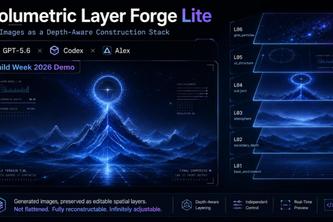
Volumetric Layer Forge Lite is a self-reported prototype tool that aims to treat AI-generated images as editable, depth-aware visual compositions with six distinct layers. The project was built through an iterative collaboration between a human creator (Alex), GPT-5.6, and Codex (a code implementation system). It is described as a proof-of-concept for preserving the construction anatomy of AI-generated images, allowing users to modify individual layers while maintaining coherence across views.
What changed
The project was submitted to the OpenAI 2026 hackathon and represents an experimental approach to how AI image generation might be structured. It does not claim to be a commercial product or have any revenue or customer traction.
Single most important open question — the commercial due-diligence read
Is there evidence that this concept has value beyond a prototype, and whether it can scale into a viable product or service with real-world adoption?
What The Product Actually Is
The description states that Volumetric Layer Forge Lite represents one final AI-generated image as six editable visual layers:
- Base Environment
- Secondary Depth
- Atmosphere
- Subject
- UI Structure
- Glow Particles
Each layer retains:
- identity and visual role
- visibility and lock state
- opacity and blend mode
- depth and thickness
- position and scale
- prompt and negative prompt
- parameters and folder mapping
The tool synchronizes four views:
- Front Output — the final six-layer composite
- Depth Stack — an exploded glass-layer view
- Layer Parameters — live controls for each layer
- VS Code Mapping — prompt, parameter, metadata, and stack.json documents
It includes features such as:
- Hold to Compare
- Restore Hero Preset
- Local project persistence
- JSON and Markdown document generation
- Construction Pack export
- Simulated single-layer regeneration workflow
- Provider-ready architecture for future image API integration
Evidence The author's own write-up.
Inference This is a prototype, not a production-ready tool. It is described as a "simulated" system with no live API connection in v0.1.
Positioning & Claim Evolution
The project positions itself as:
- A depth-aware visual construction tool
- An alternative to flat AI-generated images that lose their editable structure
- A way to preserve the “editable construction anatomy” behind AI-generated visuals
It claims to:
- Preserve layer identities and metadata during generation
- Allow users to edit one part of an image and see effects across multiple views
- Support Codex-ready file mappings for future integration
The project evolved from a simple question:
"What if an AI-generated image preserved the editable spatial stack behind it?"
Evidence The author's own write-up.
Inference This is a conceptual positioning, not a validated market need or product-market fit. It reflects early-stage thinking and experimentation.
Target Customer & ICP
The description does not name specific customers or personas. However, the tool appears to be aimed at:
- AI image creators who want more control over generated visuals
- Developers or designers working with layered visual assets
- Users interested in editing or modifying AI-generated content in a structured way
It is implied that the target audience would benefit from:
- Layered editing capabilities
- Metadata preservation
- Integration-ready formats (e.g., Codex-ready files)
Evidence The author's own write-up.
Inference No explicit ICP defined. The tool seems to be for creators or developers who work with AI-generated visuals and want more control than a flat output provides.
Business Model & Pricing Evidence
There is no evidence of pricing, monetization strategy, or business model in the description.
The project is described as a prototype submitted to a hackathon.
Evidence Not evidenced.
Inference No indication that this has moved beyond experimental or proof-of-concept stage. No commercial intent or revenue model is stated.
Technical & Delivery Signals
The project was built using:
- Next.js
- React
- TypeScript
- CSS 3D Depth Stack
- GitHub and Vercel for deployment
- GPT-5.6 for product reasoning and specification
- Codex for implementation
It includes:
- Iterative human-GPT-Codex workflow
- Simulated generation provider (no live API in v0.1)
- Export capabilities (JSON, Markdown, Construction Pack)
- Local persistence using localStorage
- Responsive layout handling
- Visual consistency across views
Evidence The author's own write-up.
Inference The technical stack is web-based and lightweight. It uses modern frontend tools but lacks real-world scalability or API integration in its current form.
Traction & Maturity Signals
There is no evidence of:
- Revenue
- Customers
- User adoption
- Product usage metrics
- Market traction
The project is described as a prototype submitted to a hackathon. It has no live image-generation API connected, and the system is simulated.
Evidence Not evidenced.
Inference The tool exists only in prototype form with no demonstrated market or user engagement.
Competitive Context
There is no mention of competitors or existing tools in the description.
The project does not reference:
- Similar tools for AI image editing
- Layered visual design platforms
- AI generation platforms with layer support
Evidence Not evidenced.
Inference No competitive landscape is described. The tool may be unique in its approach, but this cannot be confirmed without additional context.
Open Questions & Risks
Key risks and open questions include:
- Prototype-only status: No live API or real-world usage
- No commercial viability: No pricing, monetization or revenue model
- Unproven market need: No evidence of customer demand or adoption
- Dependency on experimental tech: Relies heavily on GPT-5.6 and Codex, which are not yet widely adopted or standardized
- Limited scalability: Built as a lightweight web prototype with no indication of enterprise-grade infrastructure
Evidence The author's own write-up.
Inference This is an early-stage idea with no demonstrated traction or commercial potential.
Questions the description leaves open
- What specific use cases do you envision for this tool beyond the prototype?
- How would you monetize this concept if it were to become a product?
- Have you tested this with real users or designers who work with layered visuals?
- What are the technical limitations of scaling this into a production system?
- Is there any plan to integrate with existing AI image generation APIs (e.g., OpenAI, Midjourney)?
- How do you see the tool evolving beyond the current six-layer structure?
Overall Assessment
The project is described as a prototype submitted to a hackathon and does not show evidence of:
- Revenue
- Customers
- Product-market fit
- Commercial viability
- Scalability or infrastructure readiness
It represents an experimental idea with conceptual merit but no demonstrated traction.
Assessment Not ready for investment or partnership at this time. It is an early-stage concept that may have potential, but further development and validation are required before any strategic move can be considered.
Confidence Level Low — based on self-reported evidence only, with no external corroboration or traction data.
User Stories BotA demo video on every pull request
Get a demo video on every new feature
GitHub App that watches your pull requests and records a narrated, captioned demo.
Save time on demo prep and make informed decisions faster with a video walkthrough of every new feature.
Source
Submitted to the OpenAI 2026 hackathon on Devpost. Project home on Devpost. Back to the full gallery on Devpost.
This competitive analysis was produced by top-founders.com (opens in a new tab)
Generated by a language model from this project's public Devpost page — its tagline, the author's own write-up and any built-with tags listed there — as captured in August 2026. Short quotations are the author's words. It is an opinion on the idea as a business, not on the people behind it, and it reflects the description as published then. If the project has moved on, request a correction below. The analysis is not independent research and contains no verified traction, revenue or customer data.
An independent guide by KFG International LLC — not affiliated with, endorsed by, or connected to Devpost or OpenAI.