

Archive position — measured, not model output
0 likes on Devpost
2,263 of the 7,850 archived projects have more likes, and 5,587 share exactly 0 — so this project's #7,600 place in the like-ranked listing is a tie-break inside that group, not a ranking.
Projects (log scale)
Likes on Devpost. ▲ marks this project's group.
Show the figures
| Likes | Projects | Share of archive |
|---|---|---|
| 0 | 5,587 | 71.2% |
| 1 | 1,758 | 22.4% |
| 2 | 284 | 3.6% |
| 3–4 | 132 | 1.7% |
| 5–9 | 75 | 1.0% |
| 10+ | 14 | 0.2% |
 User Stories BotA demo video on every pull request
Get a demo video on every new feature
GitHub App that watches your pull requests and records a narrated, captioned demo.
Save time on demo prep and make informed decisions faster with a video walkthrough of every new feature.
Executive Summary
What the company appears to be
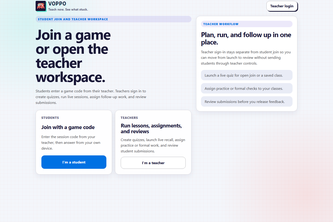
Voppo is a self-reported classroom assessment platform that combines live quizzes, homework, and formal assessments into outcome-linked evidence for teachers. It uses AI to mark short answers meaningfully and supports different learning modes (e.g., quick check, live quiz, homework) with differentiated support. The system is described as local-first, built on React/Vite/Fastify/SQLite, and uses Codex + GPT-5.6 in its development.
What changed
The project evolved from an existing self-hosted classroom quiz tool into a broader outcome-linked assessment platform during OpenAI Build Week. It was rebuilt using AI engineering tools like Codex and GPT-5.6 to support versioned curriculum evidence, immutable attempts, and teacher-controlled release policies.
Single most important open question
Is there any evidence of real-world usage or traction beyond the synthetic demo and pilot claims?
Note: This analysis is based solely on the self-reported description provided by the author. No independent verification, revenue data, customer names, or actual deployment history are available. All findings reflect what the author states, not confirmed facts.
What The Product Actually Is
The description states that Voppo is a classroom assessment platform designed to turn student responses into outcome-linked evidence teachers can act on. It supports multiple modes of assessment:
- Quick Check
- Live Quiz
- Class Quiz
- Homework
- Formal Assessment
Each mode has distinct retry, marking, and feedback policies, but all contribute to a shared versioned curriculum-evidence model.
It uses AI (specifically Codex + GPT-5.6) for semantic marking of short answers against rubrics, focusing on subject meaning rather than spelling or grammar. Uncertain decisions are marked for teacher review instead of being confidently incorrect.
The system is built using:
- Frontend: React, Vite
- Backend: Fastify, TypeScript
- Data storage: SQLite
- Communication: WebSockets
It includes features like:
- Immutable evidence snapshots
- Private differentiation (core/supported/stretch)
- Teacher-controlled release points
- Separation of authority between teacher, student, and projector views
Inference: The product is described as a single-page application with local-first data handling and real-time delivery capabilities. However, no actual deployment or live usage is evidenced.
Positioning & Claim Evolution
The author positions Voppo as a tool that bridges the gap between engaging classroom quizzes and actionable teaching insights. It aims to transform assessment from a record of past performance into information that changes future instruction.
Key claims:
- Teachers often lack time to convert quiz results into useful, outcome-linked evidence.
- Existing tools end with scores; Voppo builds a picture of understanding over time.
- AI marks short answers meaningfully and reveals what learners need next.
- The system supports both formative and summative assessment types within one framework.
Evolution:
- Started as a self-hosted quiz tool
- Expanded into an outcome-linked platform during OpenAI Build Week
- Used Codex + GPT-5.6 to refactor codebase and implement new features
Claim vs Fact: These are self-reported claims about intent, functionality, and impact. No external validation or performance metrics are provided.
Target Customer & ICP
The primary target customer is described as:
- Teachers in K–12 classrooms
- Specifically those who want to use assessment data for immediate instructional decisions
The ICP (Ideal Customer Profile) appears to be:
- A teacher managing a class of students (Year 7 Science, per demo)
- Someone who values formative feedback and wants to respond quickly to learning gaps
- Likely operating within a local-first or small-scale environment (not yet school-wide)
Not evidenced: No mention of specific grade levels, subject areas beyond science, or institutional adoption.
Business Model & Pricing Evidence
The description does not contain any information about:
- Revenue model
- Pricing structure
- Monetization strategy
- Customer acquisition costs
- Sales cycle or go-to-market approach
Not evidenced: There is no indication of how Voppo intends to generate revenue or whether it has begun selling.
Technical & Delivery Signals
Technical stack includes:
- Frontend: React, Vite
- Backend: Fastify, TypeScript
- Database: SQLite
- Communication: WebSockets
- AI tools used: Codex, GPT-5.6
Features mentioned:
- Versioned curriculum-evidence model
- Immutable attempt snapshots
- Teacher-controlled release policies
- Private differentiation paths
- Mode-aware feedback and marking rules
- Scoped agent credentials for authoring vs finalization
The system is described as local-first and pilot-ready on Windows, with no production database or real roster required in the demo.
Inference: The architecture suggests a lightweight, single-user or small-group tool. No scalability or multi-tenant infrastructure is implied.
Traction & Maturity Signals
The description states:
- A synthetic Year 7 Science fixture was used for demonstration
- No production database or real roster was needed
- Pilot testing is planned with one teacher and their classes
- Deployment claim is limited to a local-first Windows pilot, not verified school-wide use
No evidence of:
- Real users or customer base
- Revenue or ARR
- Product adoption metrics
- Customer feedback loops
- Growth trends
Absence of evidence: No traction indicators beyond the synthetic demo and pilot plans.
Competitive Context
The description does not mention any competitors or direct market comparisons. It focuses on how Voppo improves upon traditional quiz tools by providing outcome-linked evidence and AI-assisted marking.
Not evidenced: No competitive landscape, pricing, or differentiation from existing platforms is described.
Open Questions & Risks
- No real-world usage – The only demonstration uses synthetic data; no actual classroom deployment or user feedback.
- Unverified pilot claims – The local-first pilot is described as "controlled" but not yet operational or validated.
- AI dependency without clarity on accuracy – While AI is used for marking, there's no evidence of how often it fails closed or how well it performs in practice.
- Limited scope – The platform seems tailored to a narrow use case (e.g., Year 7 Science), with unclear expansion plans.
- Single-founder team – Only one member listed; no indication of team size, roles, or scalability.
Inference: These risks are based on the lack of evidence for real-world application and operational maturity.
Questions the description leaves open
- What specific learning outcomes are mapped to each quiz question in your pilot?
- How do you ensure that AI marking aligns with teacher expectations and rubrics?
- Can you provide examples of how a teacher would use the outcome-linked evidence to adjust instruction?
- Are there any known edge cases where the system fails to maintain immutability or privacy?
- What are the key differences between your current pilot and what a full-scale rollout might look like?
- How do you plan to scale beyond a single teacher pilot, especially regarding data governance and integration with existing systems?
Overall Assessment
Not evidenced: No financials, traction, or commercial viability data are available.
Based on the self-reported description alone:
- Voppo is a conceptually well-thought-out tool for formative assessment.
- It leverages AI in a way that aligns with current trends in edtech.
- However, it remains largely unproven in real-world settings.
- The lack of revenue, customers, or operational history makes it difficult to assess its commercial potential.
Confidence level: Low. This is a conceptually strong idea, but without evidence of traction or market validation, it cannot be evaluated as a viable investment or partnership opportunity at this stage.
User Stories BotA demo video on every pull request
Get a demo video on every new feature
GitHub App that watches your pull requests and records a narrated, captioned demo.
Save time on demo prep and make informed decisions faster with a video walkthrough of every new feature.
Source
Submitted to the OpenAI 2026 hackathon on Devpost. Project home on Devpost. Back to the full gallery on Devpost.
This competitive analysis was produced by top-founders.com (opens in a new tab)
Generated by a language model from this project's public Devpost page — its tagline, the author's own write-up and any built-with tags listed there — as captured in August 2026. Short quotations are the author's words. It is an opinion on the idea as a business, not on the people behind it, and it reflects the description as published then. If the project has moved on, request a correction below. The analysis is not independent research and contains no verified traction, revenue or customer data.
An independent guide by KFG International LLC — not affiliated with, endorsed by, or connected to Devpost or OpenAI.