

Archive position — measured, not model output
0 likes on Devpost
2,263 of the 7,850 archived projects have more likes, and 5,587 share exactly 0 — so this project's #3,676 place in the like-ranked listing is a tie-break inside that group, not a ranking.
Projects (log scale)
Likes on Devpost. ▲ marks this project's group.
Show the figures
| Likes | Projects | Share of archive |
|---|---|---|
| 0 | 5,587 | 71.2% |
| 1 | 1,758 | 22.4% |
| 2 | 284 | 3.6% |
| 3–4 | 132 | 1.7% |
| 5–9 | 75 | 1.0% |
| 10+ | 14 | 0.2% |
 User Stories BotA demo video on every pull request
Get a demo video on every new feature
GitHub App that watches your pull requests and records a narrated, captioned demo.
Save time on demo prep and make informed decisions faster with a video walkthrough of every new feature.
Executive Summary
What the company appears to be
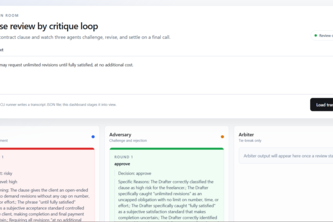
Decision Room is a self-reported tool built as a Codex CLI skill that implements a structured three-role review loop (Drafter, Adversary, Arbiter) for analyzing contract clauses. The system accepts plain text input and outputs structured JSON transcripts of the deliberation process without requiring an API key or direct OpenAI API access.
What changed
The author states they replaced an API-driven architecture with a CLI-based one, using Codex CLI to execute roles locally, while building a static frontend to display results. The tool is described as intended for freelancers and small businesses, not legal professionals.
Single most important open question
Is there any evidence of actual usage or adoption beyond the author’s own development work?
Note: This analysis is based entirely on self-reported information from the project description. No external verification, traction data, revenue figures, customer names, or independent sources are available.
What The Product Actually Is
The description states that Decision Room:
- Accepts a contract clause as plain text.
- Runs a three-role critique loop: Drafter → Adversary → Arbiter.
- Each role is executed via Codex CLI using separate prompts and JSON schemas.
- Outputs structured JSON per round, including original clause, risk assessment, revised wording, objections, approval status, and final summary.
- Includes retry logic for up to three rounds.
- Uses a static Next.js interface to present the transcript visually.
- Does not require an API key or direct OpenAI API calls.
- Operates through a PowerShell orchestration script.
Inference: The product is a local AI workflow tool built with Codex CLI, designed to simulate adversarial legal review in a structured format. It does not appear to be a commercial SaaS offering but rather a prototype or proof-of-concept.
Positioning & Claim Evolution
The author claims:
- The tool addresses the problem of ambiguous contract clauses that cause scope creep and payment disputes.
- It offers a more rigorous alternative than existing tools, which provide only one response.
- It is intended as an analytical aid for freelancers and small businesses, not a replacement for legal advice.
Inference: The positioning appears to be a niche solution targeting non-lawyer users who need structured contract analysis. There is no indication of broader commercial intent or market expansion beyond the author’s own use case.
Target Customer & ICP
The description states:
- The tool is intended for freelancers, consultants, and small agencies.
- It aims to help these users avoid practical risks from ambiguous contract terms.
Inference: The target customer segment is defined as individuals or small teams without dedicated legal resources. No evidence of specific customer personas, buyer personas, or market segmentation beyond this general category.
Business Model & Pricing Evidence
The description does not mention:
- Any pricing model.
- Revenue streams.
- Monetization strategy.
- Subscription plans or usage fees.
Not evidenced: There is no indication of how the tool would be monetized or whether it has a business model beyond personal development.
Technical & Delivery Signals
The description states:
- Built with Codex CLI, PowerShell, Next.js, React, TypeScript, Tailwind CSS, Framer Motion.
- Uses JSON schemas to enforce structured output.
- Implements retry logic and escalation paths.
- Frontend reads JSON from a public directory; no credential storage or API calls.
- No direct OpenAI API integration.
Inference: The tool is built as a local workflow with minimal backend dependencies. It leverages Codex CLI for AI execution and presents results via a static frontend, suggesting low operational complexity but also limited scalability or automation features.
Traction & Maturity Signals
The description states:
- The project was submitted to the OpenAI 2026 hackathon.
- It includes end-to-end testing and TypeScript checks.
- The author claims to have passed linting, production build, and a full Codex run.
Not evidenced: There is no evidence of:
- User adoption or feedback.
- Customer base or usage metrics.
- Product-market fit validation.
- Commercial deployment or integration.
Competitive Context
The description does not mention:
- Competitors in the contract analysis space.
- Existing tools or platforms addressing similar needs.
- Market size or competitive positioning.
Not evidenced: No information is provided about the competitive landscape, including how Decision Room compares to other tools or whether it addresses a unique market gap.
Open Questions & Risks
The description indicates:
- The tool is a prototype or hackathon submission.
- It does not require an API key and avoids direct OpenAI API usage.
- It uses a static frontend and local execution, which may limit scalability or user experience.
Inference:
- Risk of limited adoption due to being a personal project with no commercial traction.
- Lack of API integration could restrict future expansion or advanced features.
- The tool’s reliance on Codex CLI suggests it may not be easily deployable or scalable outside the author's environment.
Questions the description leaves open
- What is your plan for moving from a prototype to a product that can be used by others?
- Have you tested this with actual freelancers or small businesses? If so, what was their feedback?
- How do you intend to monetize the tool if at all?
- Are there any plans to support more complex document formats like .docx or PDFs beyond text input?
- What are your thoughts on integrating with legal platforms or contract management systems?
Overall Assessment
The description states that Decision Room is a self-reported hackathon project built by one person (Abdul Basit). There is no evidence of:
- Revenue.
- Customers.
- Product-market fit.
- Commercial traction.
- Funding or investor interest.
Assessment:
Not evidenced. The tool appears to be an experimental prototype with no demonstrated commercial viability or market demand. It lacks any signs of traction, revenue, or scalable business model. Any investment or partnership consideration would require further evidence of usage, adoption, or product development beyond the author’s own work.
User Stories BotA demo video on every pull request
Get a demo video on every new feature
GitHub App that watches your pull requests and records a narrated, captioned demo.
Save time on demo prep and make informed decisions faster with a video walkthrough of every new feature.
Source
Submitted to the OpenAI 2026 hackathon on Devpost. Project home on Devpost. Back to the full gallery on Devpost.
This competitive analysis was produced by top-founders.com (opens in a new tab)
Generated by a language model from this project's public Devpost page — its tagline, the author's own write-up and any built-with tags listed there — as captured in August 2026. Short quotations are the author's words. It is an opinion on the idea as a business, not on the people behind it, and it reflects the description as published then. If the project has moved on, request a correction below. The analysis is not independent research and contains no verified traction, revenue or customer data.
An independent guide by KFG International LLC — not affiliated with, endorsed by, or connected to Devpost or OpenAI.