

Archive position — measured, not model output
0 likes on Devpost
2,263 of the 7,850 archived projects have more likes, and 5,587 share exactly 0 — so this project's #3,677 place in the like-ranked listing is a tie-break inside that group, not a ranking.
Projects (log scale)
Likes on Devpost. ▲ marks this project's group.
Show the figures
| Likes | Projects | Share of archive |
|---|---|---|
| 0 | 5,587 | 71.2% |
| 1 | 1,758 | 22.4% |
| 2 | 284 | 3.6% |
| 3–4 | 132 | 1.7% |
| 5–9 | 75 | 1.0% |
| 10+ | 14 | 0.2% |
 User Stories BotA demo video on every pull request
Get a demo video on every new feature
GitHub App that watches your pull requests and records a narrated, captioned demo.
Save time on demo prep and make informed decisions faster with a video walkthrough of every new feature.
Executive Summary
What the company appears to be
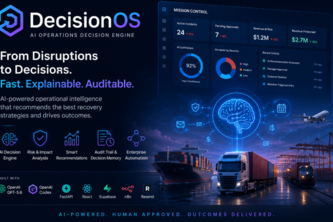
DecisionOS is an AI-powered decision intelligence platform for logistics, described by its author as a "decision engine" that analyzes operational disruptions, recommends recovery actions, explains reasoning, and automates enterprise workflows.
What changed
The project was submitted to the OpenAI 2026 hackathon. It represents a self-reported prototype or proof-of-concept built over a short timeframe using AI tools like GPT-5.6, Codex, and various open-source technologies.
Single most important open question
Is there evidence of any real-world usage, customer feedback, or traction beyond the author’s own development efforts?
What The Product Actually Is
The description states that DecisionOS is an AI Operations Decision Engine for logistics, designed to help operations managers respond to disruptions such as customs holds, weather delays, carrier cancellations, and port congestion.
It claims to:
- Analyze shipment context and operational evidence
- Generate AI-powered recovery recommendations
- Explain the reasoning behind every recommendation
- Compare alternative strategies
- Estimate risk and cost
- Allow human approval or override
- Maintain an audit trail
- Store historical decision memory
- Automate enterprise workflows via n8n after approval
The system is built with:
- Frontend: React, TypeScript, Vite, Tailwind CSS
- Backend: FastAPI with asynchronous Python APIs
- AI: OpenAI GPT (primary), Groq (fallback)
- Database: Supabase
- Notifications: Resend Email API
- Automation: n8n webhooks
Inference The product appears to be a prototype or MVP built in a hackathon setting, not yet validated in production.
Positioning & Claim Evolution
The author positions DecisionOS as:
- An AI-powered decision intelligence platform, not just a tracking dashboard.
- A tool that augments human decision-makers rather than replacing them.
- Focused on operational decision-making, not shipment visibility.
- Designed to reduce decision time while improving consistency, transparency, and operational confidence.
The author also notes:
- It is not intended to replace humans, but to support them with explainable AI.
- It emphasizes enterprise-ready automation through n8n.
- It includes decision memory, which allows reuse of past decisions.
Inference The positioning reflects a clear intent to target enterprise logistics teams looking for smarter, more consistent decision-making tools. However, the claim of being “enterprise-ready” lacks evidence of actual deployment or adoption.
Target Customer & ICP
The description states that DecisionOS targets:
- Operations managers in logistics
- Teams dealing with disruptions like customs holds, weather delays, carrier cancellations, and port congestion
- Users who need to analyze multiple systems, estimate financial impact, notify customers, and document decisions manually
It is implied that the platform is aimed at enterprise-level logistics organizations, given its focus on:
- Enterprise workflow automation (via n8n)
- Audit trails
- Decision memory
- Operational risk estimation
Inference The ICP seems to be mid-to-large enterprise logistics teams, but there is no evidence of actual customers or market validation.
Business Model & Pricing Evidence
There is no evidence in the description of:
- A pricing model
- Revenue streams
- Monetization strategy
- Customer acquisition plans
- Any commercial arrangements
The author only describes the technical architecture and functionality, not how the product would be sold or monetized.
Inference The business model remains undefined. It is unclear whether this will be a SaaS subscription, licensing, or another structure.
Technical & Delivery Signals
The system uses:
- AI: OpenAI GPT (primary), Groq (fallback)
- Backend: FastAPI with Python
- Frontend: React, TypeScript, Vite, Tailwind CSS
- Database: Supabase
- Notifications: Resend Email API
- Automation: n8n webhooks
The author reports:
- Use of OpenAI GPT-5.6 for system design and prompt engineering
- Use of Codex for code generation
- Asynchronous backend workflows
- Integration with multiple cloud services (OpenAI, Groq, Supabase, Resend, n8n)
Inference The technical stack is modern and scalable, suggesting a capable development team. However, no evidence exists that this has been deployed in production or tested under real-world conditions.
Traction & Maturity Signals
The description states:
- This is a hackathon project
- Team size: 0 (no team members listed)
- No revenue, customers, or traction data provided
- The author built the entire system alone using AI tools
Inference There is no evidence of traction, adoption, or commercial viability beyond the author’s own development effort. It is a prototype.
Competitive Context
The description does not mention:
- Direct competitors
- Existing solutions in the logistics decision intelligence space
- Market size or competitive positioning
It implies that current logistics platforms are “excellent at telling operations teams what happened”, but lack support for “what should we do next?”
Inference The author sees a gap in the market, but there is no evidence of competitive analysis or awareness of existing players.
Open Questions & Risks
- No traction or customers: The project is described as a hackathon submission with no real-world usage.
- Unproven AI reasoning: While GPT and Codex are used, there is no demonstration of how the system handles complex or ambiguous decisions in practice.
- Single-person development: No team listed; this raises questions about scalability and long-term maintenance.
- Lack of commercial clarity: No pricing, monetization, or go-to-market strategy.
- Unverified claims: All functionality described is self-reported without independent validation.
Inference The project is in early conceptual or prototyping phase. It lacks any evidence of real-world application or business maturity.
Questions the description leaves open
- What specific logistics disruptions have you tested DecisionOS against?
- Have you conducted any user testing with operations teams?
- How do you plan to integrate with existing TMS/ERP systems?
- Is there a roadmap for moving from prototype to production-ready software?
- What is your strategy for monetization and customer acquisition?
- How do you ensure explainability and trustworthiness of AI recommendations in high-stakes scenarios?
- Can you provide examples of how the system would handle edge cases or ambiguous situations?
Overall Assessment
Not evidenced.
The description provides no information on:
- Revenue
- Customers
- Market traction
- Financials
- Team size or experience
- Commercial strategy
This is a self-reported hackathon project, not a validated business.
Confidence level Low. The author states what they built, but there is no evidence of real-world use, adoption, or commercial viability.
Conclusion
DecisionOS shows potential in concept and technical execution, but it is currently unproven as a product or business. It requires further due diligence to assess whether it has moved beyond prototype into a viable market opportunity.
User Stories BotA demo video on every pull request
Get a demo video on every new feature
GitHub App that watches your pull requests and records a narrated, captioned demo.
Save time on demo prep and make informed decisions faster with a video walkthrough of every new feature.
Source
Submitted to the OpenAI 2026 hackathon on Devpost. Project home on Devpost. Back to the full gallery on Devpost.
This competitive analysis was produced by top-founders.com (opens in a new tab)
Generated by a language model from this project's public Devpost page — its tagline, the author's own write-up and any built-with tags listed there — as captured in August 2026. Short quotations are the author's words. It is an opinion on the idea as a business, not on the people behind it, and it reflects the description as published then. If the project has moved on, request a correction below. The analysis is not independent research and contains no verified traction, revenue or customer data.
An independent guide by KFG International LLC — not affiliated with, endorsed by, or connected to Devpost or OpenAI.