

Archive position — measured, not model output
1 like on Devpost
505 of the 7,850 archived projects have more likes, and 1,758 share exactly 1 — so this project's #1,710 place in the like-ranked listing is a tie-break inside that group, not a ranking.
Projects (log scale)
Likes on Devpost. ▲ marks this project's group.
Show the figures
| Likes | Projects | Share of archive |
|---|---|---|
| 0 | 5,587 | 71.2% |
| 1 | 1,758 | 22.4% |
| 2 | 284 | 3.6% |
| 3–4 | 132 | 1.7% |
| 5–9 | 75 | 1.0% |
| 10+ | 14 | 0.2% |
 User Stories BotA demo video on every pull request
Get a demo video on every new feature
GitHub App that watches your pull requests and records a narrated, captioned demo.
Save time on demo prep and make informed decisions faster with a video walkthrough of every new feature.
Executive Summary
What the company appears to be
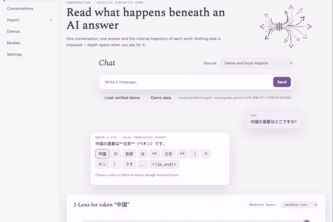
Prismora J-Lens Lab is a self-reported open-source tool for inspecting and comparing internal trajectories of language model responses using J-Lens and logit-lens traces. It is described as a local-first laboratory that enables users to compare model runs layer by layer, generate deterministic explanations, and preserve raw data with SHA-256 traceability.
What changed
The project was updated during OpenAI Build Week 2026, adding features such as deterministic analysis engines, bilingual interfaces, campaign tools, offline demonstrations, and improved coverage contracts. The author states that pre-existing work is preserved under a tagged version (lab-v0.2.1-pre-build-week), and the new features were developed through supervised use of GPT-5.6 and Codex.
The single most important open question
Is there any evidence of real-world usage, adoption or integration by developers or AI researchers beyond the author’s own development and demonstration?
What The Product Actually Is
The description states that Prismora J-Lens Lab is a local-first laboratory for inspecting and comparing internal trajectories behind language-model responses. It imports J-Lens runs from Neuronpedia API, private GPU runners, or local export files.
It can:
- Compare two trajectories layer by layer (including divergence rates, strict divergence, top-1 divergence).
- Preserve raw runs as immutable artifacts with SHA-256 traceability.
- Generate deterministic explanations in English or French.
- Display evidence behind every claim via a “Why?” panel.
- Export measured data as hash-verifiable JSON for further analysis.
The tool does not use LLMs to write summaries; instead, each sentence is produced by deterministic rules linked to templates and measured evidence.
It also explicitly reports:
- Token coverage,
- Requested and captured layers,
- Missing or unknown values,
- Gaps between measured layers.
No interpolation or invented continuity is performed.
Inference The product appears to be a research-grade interpretability tool, not a commercial SaaS offering. It is built for developers or researchers who want to inspect model behavior in detail, rather than for end-users or general-purpose AI consumers.
Positioning & Claim Evolution
The author states that Prismora was built to answer the question:
“Where do ‘ghost words’ come from — everything a model computes but never expresses?”
It evolved from an instrument mapping how an AI system evolves during long conversations, to one focused on comparing internal trajectories of identical outputs.
The tool is positioned as:
- A Rosetta Stone between internal traces and human-readable explanations.
- An explicit contrast to interpretability tools that show what they measured but do not make clear what was not measured.
- A tool for coverage before narrative, rules before generated prose, and silence before interpolation.
It does not claim to explain or fully decode model behavior — rather, it aims to create a reproducible bridge between raw measurements and claims made from them.
Inference The positioning is that of a research tool for AI interpretability, not a commercial product or platform. It is framed as a methodological instrument, not a service or solution.
Target Customer & ICP
The description does not name specific customer segments or personas.
However, the author describes:
- A self-taught French developer and maker.
- The tool’s use case involves inspecting model behavior in long conversations and experimental branches.
- It supports import from Neuronpedia, which is used by AI researchers.
Inference The likely target users are AI researchers, developers, or engineers working with language models, particularly those interested in interpretability and internal trace analysis. The tool is not described as targeting end-users or general consumers.
Business Model & Pricing Evidence
The description does not mention any pricing model, revenue streams, or commercialization plans.
It states that the project is open-source under Apache-2.0 license, and no API key, GPU, or network connection is required for local use.
There is no evidence of:
- Paid subscriptions,
- Freemium tiers,
- Licensing fees,
- SaaS offerings,
- Customer acquisition or monetization strategies.
Inference The project is not commercialized at this stage. It is a self-contained open-source tool, likely intended for research or personal development use.
Technical & Delivery Signals
The tool is built with:
- FastAPI
- Python
- JavaScript
- HTML/CSS
- J-Lens and Neuronpedia integration
- Local-first architecture
- SHA-256 traceability
- Deterministic rule-based explanations
It supports:
- Import of J-Lens runs from Neuronpedia or local files.
- Layer-by-layer comparison with divergence metrics.
- Export in JSON format for external analysis.
- Read-only APIs and offline demonstrations.
The author reports:
- 128 passing automated tests (with one non-blocking warning).
- Development was supervised using GPT-5.6 and Codex.
- All development cycles were reviewed locally.
- The tool includes curated demonstrations and pre-configured artifacts.
Inference The tool is technically mature for a research-grade open-source project, with support for reproducible workflows, deterministic outputs, and traceability. It is not described as a production-ready SaaS or cloud-based platform.
Traction & Maturity Signals
The description does not provide evidence of:
- Customers,
- Revenue,
- Usage metrics,
- Adoption,
- Product-market fit,
- User feedback,
- Community engagement,
- Partnerships,
- Market traction.
It states that the project was submitted to OpenAI Build Week 2026 and includes a demonstration, but no real-world usage or impact is described.
Inference There is no evidence of traction or market adoption beyond the author’s own development and submission. The tool appears to be in an early-stage prototype or research phase.
Competitive Context
The description does not name competitors or reference existing tools in the space.
However, it references:
- J-Lens and Neuronpedia as foundational technologies.
- The goal of comparing internal trajectories.
- A contrast with interpretability tools that “show what they measured” but do not make clear what was not measured.
Inference Prismora operates in a niche within AI interpretability, likely competing with or complementing tools like:
- J-Lens,
- Neuronpedia,
- Other trace and visualization tools for language models.
It is not described as part of a broader ecosystem or platform, but rather as a standalone inspection tool.
Open Questions & Risks
- No commercialization or monetization strategy: The tool is open-source and not described as a product with revenue plans.
- No evidence of real-world use or adoption: It has not been demonstrated in production environments or used by third parties.
- Self-reported only: All claims are unverified, and no independent validation or data exists to support its impact or utility.
- Limited scope: The tool is described as a research instrument, not a scalable platform or service.
- Single developer: The team size is listed as one (Nicolas Morel), which may limit scalability or long-term maintenance.
Inference The project is highly experimental, with no commercial or traction signals. It may be a prototype or proof-of-concept, not a product ready for market deployment.
Questions the description leaves open
- What are the actual use cases or research problems you’ve solved using this tool?
- Have any other researchers or developers used it in practice beyond your own demos?
- How do you plan to scale or commercialize this tool, if at all?
- What is the long-term roadmap for maintaining and evolving the open-source project?
- Are there any known technical limitations or edge cases that have not been addressed?
- How does Prismora handle data privacy or security in its local-first architecture?
Overall Assessment
Not evidenced.
The description provides no evidence of:
- Revenue,
- Customers,
- Traction,
- Market demand,
- Product-market fit,
- Commercial viability,
- Team scalability,
- Strategic partnerships.
It is a self-reported, open-source project with no commercial or adoption signals.
Inference This is not a viable investment or partnership opportunity at this stage. It appears to be an early-stage research tool, not a product in the market. Any future value would depend on whether it evolves into a scalable platform or gains traction in AI interpretability circles.
User Stories BotA demo video on every pull request
Get a demo video on every new feature
GitHub App that watches your pull requests and records a narrated, captioned demo.
Save time on demo prep and make informed decisions faster with a video walkthrough of every new feature.
Source
Submitted to the OpenAI 2026 hackathon on Devpost. Project home on Devpost. Back to the full gallery on Devpost.
This competitive analysis was produced by top-founders.com (opens in a new tab)
Generated by a language model from this project's public Devpost page — its tagline, the author's own write-up and any built-with tags listed there — as captured in August 2026. Short quotations are the author's words. It is an opinion on the idea as a business, not on the people behind it, and it reflects the description as published then. If the project has moved on, request a correction below. The analysis is not independent research and contains no verified traction, revenue or customer data.
An independent guide by KFG International LLC — not affiliated with, endorsed by, or connected to Devpost or OpenAI.