

Archive position — measured, not model output
0 likes on Devpost
2,263 of the 7,850 archived projects have more likes, and 5,587 share exactly 0 — so this project's #5,636 place in the like-ranked listing is a tie-break inside that group, not a ranking.
Projects (log scale)
Likes on Devpost. ▲ marks this project's group.
Show the figures
| Likes | Projects | Share of archive |
|---|---|---|
| 0 | 5,587 | 71.2% |
| 1 | 1,758 | 22.4% |
| 2 | 284 | 3.6% |
| 3–4 | 132 | 1.7% |
| 5–9 | 75 | 1.0% |
| 10+ | 14 | 0.2% |
 User Stories BotA demo video on every pull request
Get a demo video on every new feature
GitHub App that watches your pull requests and records a narrated, captioned demo.
Save time on demo prep and make informed decisions faster with a video walkthrough of every new feature.
Executive Summary
What the company appears to be
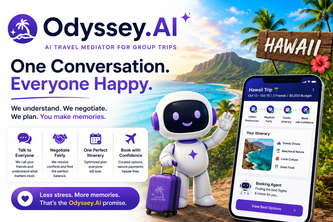
Odyssey.AI is a self-reported voice-first AI Travel Operating System designed for collaborative travel planning. The project claims to coordinate people through natural conversation, negotiate conflicts between travelers, and optimize itineraries using multi-agent AI architecture. It integrates with travel APIs (Sabre), mapping (Google Maps), payment (PayPal Sandbox), and voice platforms (Vocal Bridge).
What changed
This is a hackathon submission. The description indicates an early-stage prototype built in a short timeframe, with no evidence of revenue, customers or product-market fit beyond the authors' claims.
Single most important open question
Is there any evidence that collaborative travel planning—especially around conflict negotiation and real-time coordination—is a problem worth solving at scale? The project makes strong claims about user trust and AI transparency but provides no data on adoption, usage or customer feedback.
Analysis basis
This report is based entirely on the self-reported, unverified description provided by the authors. No external verification or historical data exists for this project.
What The Product Actually Is
The description states that Odyssey.AI is a voice-first AI Travel Operating System for collaborative travel planning. It uses:
- Natural voice conversations
- Multi-agent AI architecture
- GPT-5.6 for conversational intelligence
- OpenAI Codex for engineering acceleration
- Integration with Sabre APIs, Google Maps, PayPal Sandbox, and Vocal Bridge
It is described as a platform that coordinates people rather than simply generating itineraries.
Inference The product appears to be a prototype built during a hackathon. It is not evidenced to have been deployed or tested in production beyond the demo environment.
Positioning & Claim Evolution
The project positions itself as:
- “The World's First AI Travel Mediator”
- A system that coordinates people through conversation
- Not just another itinerary generator, but an operating system for travel planning
Key claims include:
- One conversation captures entire trip briefs
- Negotiates conflicts transparently
- Keeps groups aligned throughout the journey
- Integrates booking, visualization, and real-time adaptation
Inference The positioning reflects a vision of AI as a mediator in group decision-making. However, these are self-stated intentions without evidence of traction or user validation.
Target Customer & ICP
The description does not explicitly define target customers or ideal customer profiles (ICP). It implies usage by:
- Groups planning trips together
- Travelers who want to coordinate preferences and avoid conflict
Not evidenced No specific segment, persona, or use case is detailed. The authors do not describe whether they are targeting families, friends, business travelers, or corporate groups.
Business Model & Pricing Evidence
There is no evidence of a business model or pricing structure in the description.
Not evidenced No mention of monetization strategy, subscription tiers, transaction fees, or any commercial framework.
Technical & Delivery Signals
The project was built using:
- React, TypeScript, Vite, Node.js, Express
- GPT-5.6 and OpenAI Codex for AI reasoning and engineering
- Sabre CERT APIs, Sabre MCP, Google Maps Platform, PayPal Sandbox
- Vocal Bridge for voice integration
It includes:
- Multi-agent architecture (Travel Mediator, Preference Collector, Negotiation Agent, etc.)
- Shared trip state synchronization across agents and UI
- Voice-first experience with live conversation handling
Inference The technical stack suggests a modern full-stack application with AI integration. However, the description does not confirm whether this is production-ready or scalable beyond a hackathon demo.
Traction & Maturity Signals
The project is described as a hackathon submission from the OpenAI 2026 hackathon.
Not evidenced No evidence of revenue, customers, user engagement, or product maturity beyond the prototype stage. The authors note challenges in maintaining shared state and synchronizing conversations, suggesting early-stage development.
Competitive Context
The description does not reference existing competitors or market positioning.
Not evidenced No mention of direct or indirect competition in travel planning tools, AI assistants, or collaborative platforms.
Open Questions & Risks
- Unproven commercial viability: No evidence of revenue, customers, or product-market fit.
- High technical complexity: Real-time coordination across multiple agents and UIs is challenging; no indication of scalability or robustness.
- Unclear user trust mechanisms: While the authors claim users trust AI more when recommendations are transparent, there’s no data to support this.
- Limited integration depth: Only sandboxed integrations with PayPal and APIs from Sabre, Google Maps, etc., suggest incomplete functionality.
- Self-reported claims only: All assertions about product capabilities, user experience, or market need are unverified.
Inference The project is in a very early stage. Without traction or validation, it carries significant risk of misalignment with actual market needs.
Questions the description leaves open
- What specific problem are you solving for travelers? How do you know this is a real pain point?
- Have you tested the product with real users? If so, what feedback did you get?
- Can you explain how the shared trip state works in practice and how it handles edge cases like lost connections or conflicting inputs?
- What are your plans for monetization and scaling beyond the hackathon prototype?
- How do you plan to differentiate from existing travel planning tools or AI assistants?
Overall Assessment
Not evidenced There is no evidence of revenue, customers, or traction to assess commercial viability.
Confidence level Low. This is a self-reported hackathon project with no external validation or proof of concept beyond the authors’ own account.
Assessment At this stage, Odyssey.AI appears to be an ambitious idea in early development. It lacks evidence of product-market fit, customer traction, or commercial viability. Any investment or partnership consideration should be contingent on further demonstration of real-world utility and user engagement before proceeding.
User Stories BotA demo video on every pull request
Get a demo video on every new feature
GitHub App that watches your pull requests and records a narrated, captioned demo.
Save time on demo prep and make informed decisions faster with a video walkthrough of every new feature.
Source
Submitted to the OpenAI 2026 hackathon on Devpost. Project home on Devpost. Back to the full gallery on Devpost.
This competitive analysis was produced by top-founders.com (opens in a new tab)
Generated by a language model from this project's public Devpost page — its tagline, the author's own write-up and any built-with tags listed there — as captured in August 2026. Short quotations are the author's words. It is an opinion on the idea as a business, not on the people behind it, and it reflects the description as published then. If the project has moved on, request a correction below. The analysis is not independent research and contains no verified traction, revenue or customer data.
An independent guide by KFG International LLC — not affiliated with, endorsed by, or connected to Devpost or OpenAI.