

Archive position — measured, not model output
0 likes on Devpost
2,263 of the 7,850 archived projects have more likes, and 5,587 share exactly 0 — so this project's #7,594 place in the like-ranked listing is a tie-break inside that group, not a ranking.
Projects (log scale)
Likes on Devpost. ▲ marks this project's group.
Show the figures
| Likes | Projects | Share of archive |
|---|---|---|
| 0 | 5,587 | 71.2% |
| 1 | 1,758 | 22.4% |
| 2 | 284 | 3.6% |
| 3–4 | 132 | 1.7% |
| 5–9 | 75 | 1.0% |
| 10+ | 14 | 0.2% |
 User Stories BotA demo video on every pull request
Get a demo video on every new feature
GitHub App that watches your pull requests and records a narrated, captioned demo.
Save time on demo prep and make informed decisions faster with a video walkthrough of every new feature.
Executive Summary
Company: VoiceScene
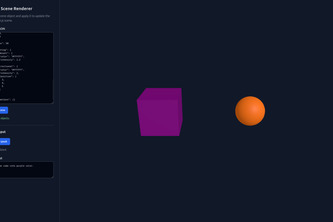
Self-reported purpose: A voice-controlled 3D scene builder that allows users to create and edit 3D environments by speaking commands.
Key technical elements: Uses Whisper for transcription, GPT-5.6 (gpt-5.6-luna) for interpreting commands, three.js for rendering, and a JSON-based scene graph as the source of truth.
Team size: 1 person (Abhijna DS).
Project context: Submitted to the OpenAI 2026 hackathon.
What changed: The project description is a self-reported account of a hackathon submission. It does not indicate any commercial traction, revenue, or customer adoption beyond the author’s own development effort.
Single most important open question: Is there evidence of product-market fit or early user feedback that would suggest a viable commercial opportunity beyond a proof-of-concept?
What The Product Actually Is
The description states that VoiceScene is a tool for building and editing 3D scenes using only voice commands. It uses:
- Voice input via push-to-talk with MediaRecorder API
- Transcription via OpenAI's Whisper API
- Command interpretation via GPT-5.6 (gpt-5.6-luna) with a fixed set of tools: add_object, modify_object, remove_object, set_camera, animate, stop_animate
- Rendering via three.js, with a diff-renderer that updates only changed elements
- Scene state management through a JSON scene graph
The system is described as being built in Codex CLI, using GPT-5.6 as the coding agent.
Inference: The product appears to be a prototype or proof-of-concept for voice-driven 3D scene editing, not a production-ready tool.
Positioning & Claim Evolution
The author states that VoiceScene was inspired by the desire to make 3D scene creation feel like "directing rather than programming." It positions itself as an alternative to traditional GUI or code-based workflows.
Claim: The system allows users to describe what they want out loud and see it appear in real time.
Inference: This is a self-described, unverified claim about user experience and workflow innovation.
The author also notes that the system was built with constraints (e.g., fixed tool schema) to improve reliability over raw LLM code generation.
Claim: Voice commands are interpreted using a constrained LLM agent loop.
Inference: This is a self-reported design decision, not validated in practice.
Target Customer & ICP
The description does not identify any specific customer segments or personas. It does not state who would use this tool or how it would be monetized.
Not evidenced: No indication of target user types, industries, or use cases beyond the author’s own development context.
Business Model & Pricing Evidence
There is no mention of pricing, monetization, or business model in the description. The project is presented as a hackathon submission with no commercial intent or structure described.
Not evidenced: No evidence of revenue streams, pricing models, or customer acquisition strategies.
Technical & Delivery Signals
The system uses:
- Codex CLI for development
- GPT-5.6 (gpt-5.6-luna) as the coding agent
- OpenAI Whisper API for transcription
- three.js for rendering
- MediaRecorder API for voice input
- A JSON scene graph as the single source of truth
- A diff-renderer to update only changed elements
The author describes building the system in stages, including scaffolding, integrating voice input, and implementing a tool-calling loop.
Inference: The technical stack suggests a prototype built for experimentation rather than scalability or production use.
Traction & Maturity Signals
There is no evidence of traction, adoption, or user feedback. The project is described as a hackathon submission with no mention of users, customers, or usage metrics.
Not evidenced: No data on user engagement, retention, or product-market fit.
Competitive Context
The description does not reference any competitors or market positioning beyond the author’s own innovation claims. It does not describe how VoiceScene compares to existing tools for 3D scene creation or voice-controlled interfaces.
Not evidenced: No competitive analysis or market differentiation described.
Open Questions & Risks
- Unverified claims: All descriptions are self-reported and unverified.
- Prototype nature: The project is a hackathon submission, not a product with traction or commercial viability.
- No evidence of user feedback or iteration: No indication that the tool was tested or refined beyond the author’s own development.
- Limited team size: Only one person built it, suggesting limited scalability or business development.
- Unproven commercial model: No evidence of monetization or customer base.
Questions the description leaves open
- What is the intended user persona for VoiceScene?
- Have you tested this with real users beyond your own use case?
- How do you plan to scale beyond a single developer’s prototype?
- What are the technical limitations of using GPT-5.6 in constrained tool mode?
- Are there any plans to integrate with existing 3D tools or platforms?
Overall Assessment
Not evidenced: No commercial traction, revenue, or customer data is available. The project is described as a hackathon submission with no indication of product-market fit or business viability.
Confidence level: Low — based entirely on self-reported author description with no external validation or evidence of adoption or monetization.
Assessment: This is a prototype with no demonstrated commercial opportunity or traction. It may be an interesting idea for future development, but it does not meet the criteria for due-diligence readiness or investment consideration at this stage.
User Stories BotA demo video on every pull request
Get a demo video on every new feature
GitHub App that watches your pull requests and records a narrated, captioned demo.
Save time on demo prep and make informed decisions faster with a video walkthrough of every new feature.
Source
Submitted to the OpenAI 2026 hackathon on Devpost. Project home on Devpost. Back to the full gallery on Devpost.
This competitive analysis was produced by top-founders.com (opens in a new tab)
Generated by a language model from this project's public Devpost page — its tagline, the author's own write-up and any built-with tags listed there — as captured in August 2026. Short quotations are the author's words. It is an opinion on the idea as a business, not on the people behind it, and it reflects the description as published then. If the project has moved on, request a correction below. The analysis is not independent research and contains no verified traction, revenue or customer data.
An independent guide by KFG International LLC — not affiliated with, endorsed by, or connected to Devpost or OpenAI.