

Archive position — measured, not model output
0 likes on Devpost
2,263 of the 7,850 archived projects have more likes, and 5,587 share exactly 0 — so this project's #7,596 place in the like-ranked listing is a tie-break inside that group, not a ranking.
Projects (log scale)
Likes on Devpost. ▲ marks this project's group.
Show the figures
| Likes | Projects | Share of archive |
|---|---|---|
| 0 | 5,587 | 71.2% |
| 1 | 1,758 | 22.4% |
| 2 | 284 | 3.6% |
| 3–4 | 132 | 1.7% |
| 5–9 | 75 | 1.0% |
| 10+ | 14 | 0.2% |
 User Stories BotA demo video on every pull request
Get a demo video on every new feature
GitHub App that watches your pull requests and records a narrated, captioned demo.
Save time on demo prep and make informed decisions faster with a video walkthrough of every new feature.
Executive Summary
What the company appears to be
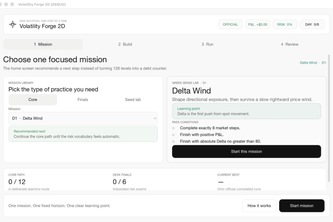
Volatility Forge 2D is a self-reported 2D options-risk training game built in Godot, designed for education and simulation of market regimes through portfolio building, risk management, and P&L attribution. It is described as a native desktop application with no live brokerage integration.
What changed
The project was submitted to the OpenAI 2026 hackathon on Devpost. The author states that it was built using Godot 4.7, GDScript, and AI tools like Codex and GPT-5.6. It includes a structured gameplay loop involving missions, forecasting, hedging, and replayable market paths.
Single most important open question
Is there any evidence of traction, revenue, or user adoption beyond the author's own development and submission to a hackathon?
What The Product Actually Is
The description states that Volatility Forge 2D is a native 2D options-risk training game built in Godot. It includes:
- A structured gameplay loop: Mission → Build → Run → Review.
- Simulated market data with deterministic seeds and fixed horizons.
- Portfolio construction and Greeks-based payoff analysis.
- Forecasting before market reveal, with Brier scoring.
- Replayable P&L attribution across Greeks, volatility, carry, costs, and residual.
- 12 core missions, 6 desk finals, and reproducible seeded challenges.
- No live brokerage or real financial data integration.
Inference The product is a simulation-based educational tool, not a commercial trading platform. It is described as a self-contained desktop application with no connection to live markets or financial services.
Positioning & Claim Evolution
The author states that options education often stops at formulas and aims to turn risk concepts like Delta, Gamma, Theta, Vega, volatility, liquidity, and event risk into decisions that can be felt, tested, and explained. The core game mechanic is explainability, which is treated as a learning tool.
Inference The positioning is educational and simulation-based, not commercial or production-grade. It is framed as a training tool for understanding options risk, not as a platform for actual trading or investment.
Target Customer & ICP
The description states that the product is designed to teach options risk through gameplay, with a focus on explainability and calibration of forecasts. It includes features like:
- Forecasting before market reveal.
- P&L attribution by Greeks.
- Risk limits and transaction costs.
- Replayable simulations.
Inference The target customer appears to be individuals or students interested in learning options trading, possibly in finance, quantitative analysis, or risk management. No specific ICP is defined beyond the educational use case.
Business Model & Pricing Evidence
There is no evidence of a business model or pricing structure. The description states that:
- All market data is simulated.
- No brokerage account is connected.
- It is a self-contained desktop application.
Inference The product is not monetized in the description, and there is no indication of any revenue-generating mechanism, subscription, or paid features.
Technical & Delivery Signals
The project was built using:
- Godot 4.7
- GDScript
- Black-Scholes engine for European option pricing and Greeks
- Codex and GPT-5.6 for development assistance (code generation, refactoring, UI design)
- Native Control nodes, custom-drawn charts, modular systems
It includes:
- Market simulation with spot and implied-volatility moves.
- Event shocks, liquidity, customer flow, transaction costs.
- Deterministic challenge generation.
- Headless tests covering rules, pricing, integration, and gameplay flow.
Inference The technical stack is self-contained and native. The use of AI tools like Codex and GPT-5.6 suggests a developer-assisted build process, but no evidence of production-level tooling or scalability.
Traction & Maturity Signals
There is no evidence of traction, revenue, customers, or adoption beyond the author's own development and submission to a hackathon. The project is described as:
- A single-person effort.
- Submitted to a hackathon.
- Not monetized.
- No live user base or usage metrics.
Inference The product is in an early stage of development, likely a prototype or proof-of-concept. There are no signs of commercial traction or market validation.
Competitive Context
There is no evidence of competitors or market context. The description does not mention:
- Existing options education platforms.
- Similar simulation tools.
- Market positioning or differentiation from other tools.
Inference The competitive landscape is unknown, and there is no indication that this product is part of an existing ecosystem or addresses a known gap in the market.
Open Questions & Risks
- No commercial traction or revenue: The project is described as a hackathon submission with no evidence of monetization.
- Single-person development: No team, no external validation, and limited scalability.
- Unverified claims: All features are self-reported without independent verification.
- No live data or real-world integration: The simulation is entirely synthetic, limiting its practical use.
- AI dependency: Heavy reliance on AI tools for development raises questions about reproducibility and long-term viability.
Questions the description leaves open
- What is the intended audience beyond personal learning?
- Are there any plans to monetize or scale this beyond a prototype?
- How does the product differentiate from existing educational platforms in options trading?
- Is there any user feedback or testing beyond the author’s own experience?
- What are the long-term goals for the project, and how do they align with commercial viability?
Overall Assessment
Not evidenced.
There is no evidence of revenue, traction, or commercial readiness to support an investment or partnership decision. The product is described as a single-person hackathon submission with no monetization strategy, live users, or market validation.
Confidence Low. This is a self-reported prototype with no external corroboration or signs of commercial development.
User Stories BotA demo video on every pull request
Get a demo video on every new feature
GitHub App that watches your pull requests and records a narrated, captioned demo.
Save time on demo prep and make informed decisions faster with a video walkthrough of every new feature.
Source
Submitted to the OpenAI 2026 hackathon on Devpost. Project home on Devpost. Back to the full gallery on Devpost.
This competitive analysis was produced by top-founders.com (opens in a new tab)
Generated by a language model from this project's public Devpost page — its tagline, the author's own write-up and any built-with tags listed there — as captured in August 2026. Short quotations are the author's words. It is an opinion on the idea as a business, not on the people behind it, and it reflects the description as published then. If the project has moved on, request a correction below. The analysis is not independent research and contains no verified traction, revenue or customer data.
An independent guide by KFG International LLC — not affiliated with, endorsed by, or connected to Devpost or OpenAI.