

Archive position — measured, not model output
0 likes on Devpost
2,263 of the 7,850 archived projects have more likes, and 5,587 share exactly 0 — so this project's #3,670 place in the like-ranked listing is a tie-break inside that group, not a ranking.
Projects (log scale)
Likes on Devpost. ▲ marks this project's group.
Show the figures
| Likes | Projects | Share of archive |
|---|---|---|
| 0 | 5,587 | 71.2% |
| 1 | 1,758 | 22.4% |
| 2 | 284 | 3.6% |
| 3–4 | 132 | 1.7% |
| 5–9 | 75 | 1.0% |
| 10+ | 14 | 0.2% |
 User Stories BotA demo video on every pull request
Get a demo video on every new feature
GitHub App that watches your pull requests and records a narrated, captioned demo.
Save time on demo prep and make informed decisions faster with a video walkthrough of every new feature.
Executive Summary
What the company appears to be
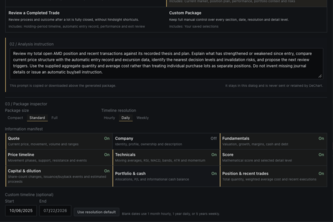
DeChart is a self-reported local-first stock research and trading journal application. The author describes it as an AI-aided tool that summarizes price movements, integrates portfolio context, and generates structured prompts for AI models to analyze market data. It is built using modern web technologies (FastAPI, React, TypeScript) with AI assistance from ChatGPT and Codex.
What changed
The project was developed over a short timeframe (likely a hackathon) as a proof-of-concept. The author states that it includes a working prototype with a demo mode, Docker setup, tests, documentation, and a modular development process guided by AI tools. It is not described as having launched or monetized.
Single most important open question
Is there evidence of real-world usage or traction beyond the developer's own workflow? The description lacks any data on users, adoption, revenue, or customer feedback — all of which are critical for assessing commercial viability.
Note: This analysis is based entirely on the self-reported, unverified project description provided by the author. No external corroboration exists.
What The Product Actually Is
The description states that DeChart is a local-first stock research and trading journal application. It integrates:
- Candlestick and volume charts
- Stock fundamentals
- Price-movement summaries
- Position and portfolio context
- Trading notes
- Plan and Review workflows
- AI-ready analysis exports
Its main feature is the movement narrative, which summarizes key price events (spikes, drops, rebounds) and combines them with fundamentals and user assumptions to generate a structured prompt for AI models.
It does not automatically decide what to buy or sell — instead, it supports human decision-making by providing better context.
Claim: DeChart is an AI-enhanced personal stock research tool.
Evidence: The author’s own write-up.
Inference: It may be used in a personal trading workflow but no evidence of external usage or adoption.
Positioning & Claim Evolution
The author positions DeChart as:
- A local-first solution, implying privacy and control over private data
- An AI-ready tool, designed to improve AI analysis by structuring input
- A reviewable journal, where users can document and reflect on their trades
- A structured prompt generator, not an automated trading system
The evolution of claims appears to be from a personal hackathon project to a potential personal research environment, with future plans for native app development.
Claim: DeChart helps traders make better decisions by structuring data for AI.
Evidence: The author’s own write-up.
Inference: The positioning suggests a niche, high-value use case for individual traders — but no evidence of market validation or demand beyond the developer's own workflow.
Target Customer & ICP
The description does not name specific customers or personas. However, it implies:
- Individual stock traders who use AI tools to analyze markets
- Users who value local ownership of their data and reviewable AI context
- Traders who want to structure their own analysis workflows
Claim: The target is individual traders using AI for stock research.
Evidence: The author’s write-up.
Inference: No evidence of segmentation, user interviews, or market research.
Business Model & Pricing Evidence
There is no mention of pricing, monetization, or business model in the description. The project is described as a prototype built during a hackathon and not yet launched for public use.
Claim: No commercial model or pricing structure is evident.
Evidence: The author’s own write-up.
Inference: If this becomes a product, it may be freemium or subscription-based, but no evidence supports this.
Technical & Delivery Signals
The project was built using:
- Backend: FastAPI
- Frontend: React, TypeScript
- Database: SQLite
- Infrastructure: Docker Compose, nginx
- AI tools: ChatGPT, Codex (with GPT-5.6)
Development was modular and iterative, with clear phases and review steps. The author used AI to implement most of the codebase but retained control over design and architecture.
Claim: The product is technically sound for a prototype.
Evidence: The author’s own write-up.
Inference: The use of AI tools suggests rapid development, but no evidence of scalability or production readiness beyond demo mode.
Traction & Maturity Signals
The project is described as a working prototype, with:
- Demo mode
- Production Docker setup
- Tests and documentation
- Modular phases
However, there is no evidence of real-world usage, user feedback, or adoption. It was built for a hackathon and not yet launched.
Claim: The product is a working prototype.
Evidence: The author’s own write-up.
Inference: No traction signals (users, revenue, engagement) are evident.
Competitive Context
The description does not mention competitors or market positioning. It implies DeChart is unique in its approach to combining AI-ready prompts with structured journaling and local data control.
Claim: No direct competitors are named.
Evidence: The author’s own write-up.
Inference: This may be a niche product, but no evidence of market analysis or competitive landscape.
Open Questions & Risks
- No traction or user base — the project is described as a prototype with no external adoption
- High reliance on AI tools — this raises questions about scalability and control over development
- Single-founder model — limits team capacity for growth or product iteration
- Unproven commercial viability — no evidence of monetization, pricing, or market demand
Claim: Risks include lack of traction, dependency on AI tools, and unvalidated market need.
Evidence: The author’s own write-up.
Inference: These are inferred from the lack of any real-world data or commercial signals.
Questions the description leaves open
- What is your actual usage of DeChart in your personal trading workflow?
- Have you tested how different AI models respond to the structured prompts generated by DeChart?
- Are there any plans for monetization or user onboarding beyond the demo mode?
- How do you plan to scale beyond a single developer and prototype?
- What is the long-term vision for data ownership, privacy, and integration with other platforms?
Overall Assessment
Not evidenced — No financials, revenue, or customer data are provided. The project is described as a hackathon prototype with no commercial traction.
Claim: No investment or partnership potential is evident from the description.
Evidence: The author’s own write-up.
Inference: If this evolves into a product with real users and adoption, it may warrant further consideration — but that is not yet demonstrated.
User Stories BotA demo video on every pull request
Get a demo video on every new feature
GitHub App that watches your pull requests and records a narrated, captioned demo.
Save time on demo prep and make informed decisions faster with a video walkthrough of every new feature.
Source
Submitted to the OpenAI 2026 hackathon on Devpost. Project home on Devpost. Back to the full gallery on Devpost.
This competitive analysis was produced by top-founders.com (opens in a new tab)
Generated by a language model from this project's public Devpost page — its tagline, the author's own write-up and any built-with tags listed there — as captured in August 2026. Short quotations are the author's words. It is an opinion on the idea as a business, not on the people behind it, and it reflects the description as published then. If the project has moved on, request a correction below. The analysis is not independent research and contains no verified traction, revenue or customer data.
An independent guide by KFG International LLC — not affiliated with, endorsed by, or connected to Devpost or OpenAI.