

Archive position — measured, not model output
1 like on Devpost
505 of the 7,850 archived projects have more likes, and 1,758 share exactly 1 — so this project's #2,198 place in the like-ranked listing is a tie-break inside that group, not a ranking.
Projects (log scale)
Likes on Devpost. ▲ marks this project's group.
Show the figures
| Likes | Projects | Share of archive |
|---|---|---|
| 0 | 5,587 | 71.2% |
| 1 | 1,758 | 22.4% |
| 2 | 284 | 3.6% |
| 3–4 | 132 | 1.7% |
| 5–9 | 75 | 1.0% |
| 10+ | 14 | 0.2% |
 User Stories BotA demo video on every pull request
Get a demo video on every new feature
GitHub App that watches your pull requests and records a narrated, captioned demo.
Save time on demo prep and make informed decisions faster with a video walkthrough of every new feature.
Executive Summary
What the company appears to be
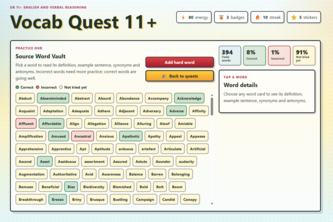
Vocab Quest 11+ is a browser-based learning game for children aged 9–11 preparing for UK 11+ English and Verbal Reasoning exams, built as a self-contained project by one individual (Laura - LJ Libra) over a weekend using AI tools like Codex/ChatGPT. The product combines short vocabulary adventure quests with adaptive feedback from an AI tutor, rewards-based progression (energy, badges, stickers), and a parent-editable word bank.
What changed
The author states that she built this tool to address her own personal challenge in helping her daughter build vocabulary for the 11+ exam. It is presented as a working prototype developed quickly using AI assistance, with no prior commercial or product history.
Single most important open question — the commercial due-diligence read
Is there evidence of real traction, usage, or demand beyond the creator's personal experience? The description does not indicate any external users, revenue, or adoption metrics. Without data on actual learners or parents using the tool, it is unclear whether the product has moved beyond a proof-of-concept.
What The Product Actually Is
The description states that Vocab Quest 11+ is:
- A browser-based learning game
- Designed for children aged 9 to 11 preparing for UK 11+ exams
- Focused on vocabulary building through short adventure quests
- Includes features such as:
- Vocabulary questions (definitions, synonyms, antonyms)
- Rewards system (energy, streaks, badges, sticker book)
- Word Vault with editable vocabulary cards
- AI tutor that provides child-friendly feedback on incorrect answers
- Local word bank managed via Excel and converted to JSON
The product is built using:
- Node.js server
- Browser front end
- OpenAI integration for adaptive tutoring
- Codex/ChatGPT for rapid prototyping during a hackathon
Not evidenced: The actual gameplay mechanics, interface design, or technical architecture beyond the tools used.
Positioning & Claim Evolution
The author positions Vocab Quest 11+ as:
- A solution to a specific educational problem: making vocabulary practice engaging and effective for children preparing for UK 11+ exams
- An alternative to flashcards or reading-based methods, which are described as slow or indirect
- A game that feels like play but delivers focused learning
The claim evolution shows:
- Initial motivation was personal (helping her daughter)
- The product evolved into a complete, runnable experience in one weekend
- It is presented as useful for real family situations, not just a prototype
- The author emphasizes adaptability and integration with real-life revision habits
Inferred: The positioning implies a niche market within UK 11+ exam prep, but no evidence of broader market positioning or competitive differentiation.
Target Customer & ICP
The description states:
- Primary users are children aged 9–11 preparing for UK 11+ English and Verbal Reasoning exams
- Parents or tutors who help guide the child’s learning
- The game is designed to be played by children, with support from adults
Not evidenced: No data on actual user base, parental demographics, or how many families might use it. The ICP is inferred from the stated age group and exam focus.
Business Model & Pricing Evidence
The description does not provide any evidence of:
- Revenue model
- Pricing strategy
- Monetization approach
- Subscription plans or in-app purchases
Inferred: Since this is a hackathon submission and no commercial structure is described, it appears to be a prototype with no known business model at this stage.
Technical & Delivery Signals
The description states:
- Built in one weekend using Codex/ChatGPT
- Uses Node.js for backend, HTML/CSS/JS for frontend
- Integrates OpenAI API for adaptive tutoring
- Falls back to deterministic local tutor feedback if no API key is available
- Vocabulary library managed via Excel → JSON conversion
- No technical or developer experience required by the creator
Not evidenced: Performance metrics, scalability, security measures, or long-term maintainability.
Traction & Maturity Signals
The description states:
- The author’s daughter uses it regularly and enjoys it
- It was built in one weekend as a working prototype
- It includes setup instructions and full game loop functionality
- Future improvements are planned (multiple profiles, difficulty settings, etc.)
Not evidenced: Any external users, usage statistics, retention rates, or performance data. No evidence of product-market fit beyond the creator’s personal experience.
Competitive Context
The description does not mention:
- Competitors in the 11+ vocabulary space
- Existing tools for children's exam prep
- Market size or competitive landscape
Inferred: The product targets a specific niche within UK education, but no evidence of existing solutions or competitive positioning is provided.
Open Questions & Risks
Key risks and open questions based on the description:
- No verified users or adoption beyond the creator’s family
- Product is described as a hackathon prototype with no commercial traction
- Reliance on AI integration (OpenAI) may introduce dependency or cost concerns
- No evidence of scalability, long-term sustainability, or monetization strategy
- The single-person team raises questions about execution capacity for growth
Not evidenced: Any risk assessments, financials, or market validation.
Questions the description leaves open
- How many children are currently using the product outside of your family?
- What is the current level of engagement among those users?
- Are there any plans to monetize the product, and how do you intend to do so?
- Have you tested the AI tutor with other children or in different contexts?
- What are the technical limitations or scalability concerns of the current architecture?
- How do you plan to expand beyond the 9–11 age group or 11+ exams?
- Do you have any data on how often users return to the app?
Overall Assessment
The description presents Vocab Quest 11+ as a self-contained prototype built by one person in a short timeframe, with no evidence of commercial traction, revenue, or customer adoption.
Assessment This is an early-stage idea with limited commercial due-diligence evidence. It shows potential for solving a real problem within a niche market but lacks any indication of scalability, product-market fit, or business viability beyond the creator’s personal use case.
Confidence: Low. The project is described as a working prototype, not a product in active use or development.
User Stories BotA demo video on every pull request
Get a demo video on every new feature
GitHub App that watches your pull requests and records a narrated, captioned demo.
Save time on demo prep and make informed decisions faster with a video walkthrough of every new feature.
Source
Submitted to the OpenAI 2026 hackathon on Devpost. Project home on Devpost. Back to the full gallery on Devpost.
This competitive analysis was produced by top-founders.com (opens in a new tab)
Generated by a language model from this project's public Devpost page — its tagline, the author's own write-up and any built-with tags listed there — as captured in August 2026. Short quotations are the author's words. It is an opinion on the idea as a business, not on the people behind it, and it reflects the description as published then. If the project has moved on, request a correction below. The analysis is not independent research and contains no verified traction, revenue or customer data.
An independent guide by KFG International LLC — not affiliated with, endorsed by, or connected to Devpost or OpenAI.