

Archive position — measured, not model output
1 like on Devpost
505 of the 7,850 archived projects have more likes, and 1,758 share exactly 1 — so this project's #2,199 place in the like-ranked listing is a tie-break inside that group, not a ranking.
Projects (log scale)
Likes on Devpost. ▲ marks this project's group.
Show the figures
| Likes | Projects | Share of archive |
|---|---|---|
| 0 | 5,587 | 71.2% |
| 1 | 1,758 | 22.4% |
| 2 | 284 | 3.6% |
| 3–4 | 132 | 1.7% |
| 5–9 | 75 | 1.0% |
| 10+ | 14 | 0.2% |
 User Stories BotA demo video on every pull request
Get a demo video on every new feature
GitHub App that watches your pull requests and records a narrated, captioned demo.
Save time on demo prep and make informed decisions faster with a video walkthrough of every new feature.
Executive Summary
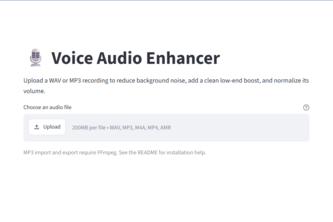
The description states that Voice Audio Enhancer is an AI-powered web app built by one developer (Sande Denis) for content creators to clean up background noise, add bass boost, and normalize voice recordings. It was submitted as a hackathon project to the OpenAI 2026 hackathon on Devpost.
The author claims it processes audio files uploaded from desktop or mobile devices using Python, Pydub, FFmpeg, and Streamlit, with deployment on Streamlit Community Cloud. The app supports multiple file formats and handles cross-platform compatibility issues during cloud deployment.
Key commercial due-diligence question: Is there evidence of user demand or product-market fit beyond the single developer's prototype?
The description is self-reported and unverified — no revenue, customers, or traction data are provided. This analysis is based entirely on the author’s own account.
What The Product Actually Is
- The description states that Voice Audio Enhancer is a web-based audio editing tool.
- It allows users to upload audio files (from desktop or mobile) and applies:
- Background noise reduction
- Bass boost
- Volume normalization
- It uses:
- Python
- Pydub library
- FFmpeg for decoding
- Streamlit for UI and deployment
- The application is hosted on Streamlit Community Cloud.
- It supports multiple file formats, including mobile-recorded formats like .amr.
Note: The description does not state whether the tool uses AI models beyond basic audio processing or if it includes features such as speech isolation or real-time recording. These are mentioned in "What's next for Voice Audio Enhancer" but not implemented yet.
Positioning & Claim Evolution
- The author positions the product as a simple, effective tool for content creators.
- It is described as an alternative to complicated desktop audio editing software, targeting ease-of-use and accessibility.
- The tagline: “An AI-powered web app that cleans up background noise, adds a clean bass boost, and normalizes voice recordings for a professional sound” — this is a claim about functionality rather than proof of traction or adoption.
Inference: The positioning suggests a move from niche audio tools to broader content creation support. However, the claim lacks evidence of market validation or competitive differentiation beyond basic features.
Target Customer & ICP
- The description states that the tool is intended for content creators.
- No further segmentation or persona details are provided.
- It supports uploads from both desktop and mobile, implying a broad user base across devices.
Not evidenced: There is no indication of specific customer types, usage frequency, or target verticals (e.g., podcasters, YouTubers, corporate trainers).
Business Model & Pricing Evidence
- The description does not mention any pricing model or monetization strategy.
- No information on whether the tool will be free, freemium, subscription-based, or one-time purchase.
Not evidenced: There is no evidence of a business model or pricing structure beyond the fact that it's a web app built for personal use.
Technical & Delivery Signals
- Built with:
- Python
- Pydub
- FFmpeg
- Streamlit
- Deployed on Streamlit Community Cloud
- Handles cross-platform audio processing and file format compatibility issues.
- The author notes challenges related to:
- Python version compatibility
- File uploader limits
- Mobile formats (.amr)
- Syntax bugs in expanding support
Inference: The technical stack shows a lightweight, developer-focused approach using open-source libraries. Deployment on Streamlit Cloud suggests ease of development but may limit scalability or customization.
Traction & Maturity Signals
- Submitted to the OpenAI 2026 hackathon.
- The app is described as having been taken from a local script to a live cloud application.
- No evidence of:
- Users
- Revenue
- Customer acquisition
- Product usage metrics
- Market feedback or adoption
Not evidenced: There are no signs of traction, growth, or user engagement beyond the single developer’s prototype.
Competitive Context
- The description does not name competitors.
- It implies a niche in audio enhancement for content creators.
- No mention of existing tools or platforms that offer similar features (e.g., Audacity, Adobe Audition, Descript, ElevenLabs).
Not evidenced: No competitive landscape is described. The author makes no claims about differentiation or competitive advantage.
Open Questions & Risks
- Single developer team — increases risk of project abandonment or slow iteration.
- Hackathon prototype — not a validated product with real users or revenue.
- No pricing or monetization strategy — unclear path to profitability.
- Limited scope in current version — only basic audio enhancements, no AI-driven features yet.
- Cloud deployment on Streamlit Community Cloud — may not scale for production use or advanced features.
Inference: The lack of traction, revenue, and clear business model raises questions about commercial viability. The tool is currently a proof-of-concept with no evidence of market demand.
Questions the description leaves open
- What specific problems are you solving for content creators?
- Have you tested the app with real users or gathered feedback?
- How do you plan to monetize this tool?
- Are there any existing tools in this space that you're competing against?
- What is your roadmap beyond the current features (e.g., AI speech isolation)?
- Do you have a plan for scaling beyond Streamlit Community Cloud?
Overall Assessment
- Not evidenced: No data on revenue, customers, or traction to support an investment or partnership decision.
- The project is described as a hackathon prototype by one developer with no commercial history or product-market fit evidence.
- It has no demonstrated business model, pricing strategy, or user base.
Assessment: Based solely on the self-reported description, this is a pre-product concept with no commercial due-diligence signal. It does not meet criteria for investment or partnership at this stage.
User Stories BotA demo video on every pull request
Get a demo video on every new feature
GitHub App that watches your pull requests and records a narrated, captioned demo.
Save time on demo prep and make informed decisions faster with a video walkthrough of every new feature.
Source
Submitted to the OpenAI 2026 hackathon on Devpost. Project home on Devpost. Back to the full gallery on Devpost.
This competitive analysis was produced by top-founders.com (opens in a new tab)
Generated by a language model from this project's public Devpost page — its tagline, the author's own write-up and any built-with tags listed there — as captured in August 2026. Short quotations are the author's words. It is an opinion on the idea as a business, not on the people behind it, and it reflects the description as published then. If the project has moved on, request a correction below. The analysis is not independent research and contains no verified traction, revenue or customer data.
An independent guide by KFG International LLC — not affiliated with, endorsed by, or connected to Devpost or OpenAI.