

Archive position — measured, not model output
0 likes on Devpost
2,263 of the 7,850 archived projects have more likes, and 5,587 share exactly 0 — so this project's #4,161 place in the like-ranked listing is a tie-break inside that group, not a ranking.
Projects (log scale)
Likes on Devpost. ▲ marks this project's group.
Show the figures
| Likes | Projects | Share of archive |
|---|---|---|
| 0 | 5,587 | 71.2% |
| 1 | 1,758 | 22.4% |
| 2 | 284 | 3.6% |
| 3–4 | 132 | 1.7% |
| 5–9 | 75 | 1.0% |
| 10+ | 14 | 0.2% |
 User Stories BotA demo video on every pull request
Get a demo video on every new feature
GitHub App that watches your pull requests and records a narrated, captioned demo.
Save time on demo prep and make informed decisions faster with a video walkthrough of every new feature.
Executive Summary
What the company appears to be
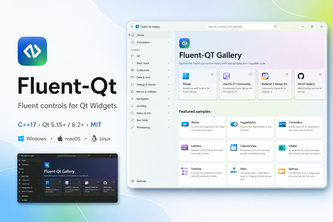
Fluent-Qt is a self-reported open-source C++ component library for Qt Widgets that implements a Fluent-style UI design. The author states it provides reusable native UI components, a gallery application with live samples, and cross-platform support for Windows, macOS, and Linux.
What changed
During Build Week, the author used Codex and GPT-5.6 to refactor the project into a more complete developer tool. Changes included separating library from Gallery dependencies, improving integration paths, publishing reduced source packages, redesigning documentation and website, and refining release workflows.
The single most important open question
Is this a viable product for developers or just a proof-of-concept? The description states it's an open-source project with no evidence of commercial traction, revenue, or customer adoption.
What The Product Actually Is
The description states that Fluent-Qt is:
- A cross-platform C++17 UI component library for Qt Widgets
- Implemented as reusable Qt Widgets components
- Includes a Gallery application with live component samples and integration information
- Supports Qt 5.15+ and Qt 6.2+
- Provides light and dark visual experiences
- Offers CMake integration through multiple methods (FetchContent, add_subdirectory, find_package)
- Contains prebuilt Gallery packages for Windows, macOS, and Linux
- Covers x64 and ARM64 release architectures
The product is described as a native C++ component library that brings Fluent-inspired visual design to Qt Widgets applications while preserving existing Qt functionality.
Positioning & Claim Evolution
The description states the author's positioning:
- Qt Widgets still powers many reliable native desktop applications
- Building modern interfaces with Qt Widgets often requires extensive styling or costly migration
- Fluent-Qt provides "another option" - a reusable, native C++ component library that brings Fluent-style UI to existing Qt Widgets apps
- It preserves signals, slots, layouts, event loop, native window behavior, and performance characteristics that Qt developers rely on
The claim evolution shows:
- Initial positioning as a solution for Qt developers wanting modern UI without migration costs
- Build Week work transformed it from an existing open-source project into a more complete developer tool
- The author emphasizes the library's reusability and integration capabilities
Target Customer & ICP
The description states that Fluent-Qt targets:
- Qt Widgets developers who want to add modern Fluent-style UI to existing applications
- Developers working with native desktop applications built on Qt
- Teams wanting to maintain existing Qt functionality while improving visual design
The author's own write-up indicates the primary customer is developers building Qt-based desktop applications who need modern UI components without migrating away from Qt Widgets.
Business Model & Pricing Evidence
Not evidenced. The description does not contain information about pricing, revenue models, or commercial arrangements beyond stating it's an open-source project.
Technical & Delivery Signals
The description states:
- Core library written in C++17 with Qt Widgets and CMake
- Uses Qt Test, GTest, and CTest labels for validation
- CMake targets and package exports for integration
- vcpkg manifests for development dependencies
- CPack for Windows, macOS, and Linux packages
- NSIS for Windows installer, DMG packaging for macOS, DEB packaging for Ubuntu
- GitHub Actions for CI, compatibility testing, releases, and GitHub Pages
- HTML, CSS, and JavaScript for static project website
- CI design separates fast pull-request validation from broader platform validation
- Release system covers Windows, macOS, and Ubuntu across x64 and ARM64 architectures
Traction & Maturity Signals
Not evidenced. The description contains no information about revenue, customers, user adoption, or business traction beyond stating it's an open-source project.
Competitive Context
Not evidenced. The description does not contain information about competitors, market positioning, or competitive landscape.
Open Questions & Risks
- The project is described as self-reported and unverified
- No evidence of commercial traction, revenue, or customer adoption
- The author states it's an open-source project with no indication of monetization strategy
- The project appears to be a developer tool rather than a product with end-users
- The description lacks any mention of market size, competitive dynamics, or business model validation
Questions the description leaves open
- What is the actual market need this solves and how do you know?
- How many developers are currently using Fluent-Qt in production?
- What is your monetization strategy if any?
- How do you plan to scale beyond a single developer?
- What are the technical challenges with maintaining cross-platform compatibility at scale?
- How do you plan to build community adoption and engagement?
- What are the key performance indicators for success in this space?
Overall Assessment
Not evidenced. The description contains no information about funding rounds, valuations, or investment interest beyond stating it's an open-source project submitted to a hackathon.
The author states that Fluent-Qt is an open-source project with no evidence of commercial traction, revenue, or customer adoption. The project appears to be a developer tool built during a hackathon rather than a commercial product with market validation.
User Stories BotA demo video on every pull request
Get a demo video on every new feature
GitHub App that watches your pull requests and records a narrated, captioned demo.
Save time on demo prep and make informed decisions faster with a video walkthrough of every new feature.
Source
Submitted to the OpenAI 2026 hackathon on Devpost. Project home on Devpost. Back to the full gallery on Devpost.
This competitive analysis was produced by top-founders.com (opens in a new tab)
Generated by a language model from this project's public Devpost page — its tagline, the author's own write-up and any built-with tags listed there — as captured in August 2026. Short quotations are the author's words. It is an opinion on the idea as a business, not on the people behind it, and it reflects the description as published then. If the project has moved on, request a correction below. The analysis is not independent research and contains no verified traction, revenue or customer data.
An independent guide by KFG International LLC — not affiliated with, endorsed by, or connected to Devpost or OpenAI.