

Archive position — measured, not model output
1 like on Devpost
505 of the 7,850 archived projects have more likes, and 1,758 share exactly 1 — so this project's #2,165 place in the like-ranked listing is a tie-break inside that group, not a ranking.
Projects (log scale)
Likes on Devpost. ▲ marks this project's group.
Show the figures
| Likes | Projects | Share of archive |
|---|---|---|
| 0 | 5,587 | 71.2% |
| 1 | 1,758 | 22.4% |
| 2 | 284 | 3.6% |
| 3–4 | 132 | 1.7% |
| 5–9 | 75 | 1.0% |
| 10+ | 14 | 0.2% |
 User Stories BotA demo video on every pull request
Get a demo video on every new feature
GitHub App that watches your pull requests and records a narrated, captioned demo.
Save time on demo prep and make informed decisions faster with a video walkthrough of every new feature.
Executive Summary
What the company appears to be
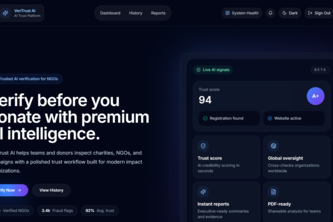
VeriTrust AI is an AI-powered platform that analyzes publicly available website information to evaluate the credibility of NGOs and donation campaigns. The description states it validates URLs, examines trust indicators such as HTTPS security, website metadata, contact information, and organizational details, then generates an explainable trust score along with confidence levels and verification insights.
What changed
This is a hackathon project submitted to the OpenAI 2026 hackathon. It was built in a short timeframe (a hackathon) and has no evidence of revenue, customers or traction beyond its own self-description.
The single most important open question
Is there any evidence that VeriTrust AI has moved beyond a prototype or proof-of-concept stage? The description states it is a working prototype but does not indicate whether it has been deployed for real-world use or tested with actual users.
What The Product Actually Is
The description states:
- VeriTrust AI is an AI-powered platform that verifies NGO and donation campaign credibility using website analysis.
- It analyzes publicly available website information to evaluate the credibility of NGOs and donation campaigns.
- It validates URLs, examines trust indicators such as HTTPS security, website metadata, contact information, and organizational details.
- It generates an explainable trust score along with confidence levels and verification insights.
Inference: The product appears to be a web-based tool that uses AI to assess the legitimacy of online donation platforms or NGOs by analyzing publicly accessible data from their websites.
Positioning & Claim Evolution
The description states:
- VeriTrust AI was created to help donors make safer and more informed decisions through AI-assisted credibility analysis.
- It helps users donate with confidence by verifying NGO and donation campaign credibility.
- The platform is described as an AI-powered verification system that provides explainable trust scoring.
Inference: The positioning is centered on trust and safety in online donations, using AI to provide a credible assessment of NGOs or campaigns. The claim evolution appears to be from a hackathon prototype to a potential full product with future integrations (e.g., government registries, WHOIS verification).
Target Customer & ICP
The description states:
- The target audience is donors who want to make safer and more informed decisions when donating online.
- It helps users donate with confidence by verifying NGO and donation campaign credibility.
Inference: The primary customer is an individual donor or a group of donors who are concerned about fraud in online fundraising. The ICP (Ideal Customer Profile) likely includes people who regularly donate to NGOs or campaigns online, particularly those who may be skeptical or cautious due to past experiences with fraudulent sites.
Business Model & Pricing Evidence
Not evidenced.
The description does not mention any pricing model, monetization strategy, or business model. It only describes the product's functionality and purpose.
Technical & Delivery Signals
The description states:
- Built with React, Vite, Tailwind CSS for frontend; FastAPI and Python for backend.
- OpenAI Codex was used extensively during development for frontend implementation, backend development, debugging, API integration, and rapid feature iteration.
- The platform integrates website metadata analysis and trust scoring logic.
- It is described as a complete AI-powered verification platform with a modern interface.
Inference: The technical stack suggests a full-stack web application built in a short timeframe (hackathon). The use of OpenAI Codex implies a focus on rapid development, but no evidence of scalability or production-grade infrastructure is provided.
Traction & Maturity Signals
Not evidenced.
The description states that VeriTrust AI was built within a hackathon timeframe and is a working prototype. There is no mention of users, customers, revenue, or any traction beyond its own self-reporting.
Competitive Context
Not evidenced.
There is no mention in the description of competitors or market positioning relative to existing solutions for verifying NGO credibility or donation safety.
Open Questions & Risks
- The product is described as a hackathon prototype with no evidence of real-world deployment or user adoption.
- No information on how trust scores are calculated or validated, raising questions about accuracy and reliability.
- The use of OpenAI Codex during development may indicate a lack of deep technical control or long-term scalability.
- No mention of data privacy, compliance, or regulatory considerations in handling donor or NGO data.
Questions the description leaves open
- What is the current stage of development beyond the hackathon prototype?
- How are trust scores calculated and validated?
- Has the platform been tested with real users or donors?
- Are there any partnerships or integrations planned with NGOs, governments, or financial institutions?
- What is the plan for monetization or scaling the business model?
- How does the product handle edge cases in website metadata extraction or API integration?
- Is there a roadmap for integrating government registries or WHOIS verification?
Overall Assessment
Not evidenced.
The description provides no information on funding, valuation, or any investment or partnership activity. It is unclear whether this is a solo founder project or part of a larger initiative. The lack of traction, revenue, or customer data makes it difficult to assess its commercial viability or potential for investment or partnership.
User Stories BotA demo video on every pull request
Get a demo video on every new feature
GitHub App that watches your pull requests and records a narrated, captioned demo.
Save time on demo prep and make informed decisions faster with a video walkthrough of every new feature.
Source
Submitted to the OpenAI 2026 hackathon on Devpost. Project home on Devpost. Back to the full gallery on Devpost.
This competitive analysis was produced by top-founders.com (opens in a new tab)
Generated by a language model from this project's public Devpost page — its tagline, the author's own write-up and any built-with tags listed there — as captured in August 2026. Short quotations are the author's words. It is an opinion on the idea as a business, not on the people behind it, and it reflects the description as published then. If the project has moved on, request a correction below. The analysis is not independent research and contains no verified traction, revenue or customer data.
An independent guide by KFG International LLC — not affiliated with, endorsed by, or connected to Devpost or OpenAI.