

Archive position — measured, not model output
1 like on Devpost
505 of the 7,850 archived projects have more likes, and 1,758 share exactly 1 — so this project's #2,166 place in the like-ranked listing is a tie-break inside that group, not a ranking.
Projects (log scale)
Likes on Devpost. ▲ marks this project's group.
Show the figures
| Likes | Projects | Share of archive |
|---|---|---|
| 0 | 5,587 | 71.2% |
| 1 | 1,758 | 22.4% |
| 2 | 284 | 3.6% |
| 3–4 | 132 | 1.7% |
| 5–9 | 75 | 1.0% |
| 10+ | 14 | 0.2% |
 User Stories BotA demo video on every pull request
Get a demo video on every new feature
GitHub App that watches your pull requests and records a narrated, captioned demo.
Save time on demo prep and make informed decisions faster with a video walkthrough of every new feature.
Executive Summary
What the company appears to be
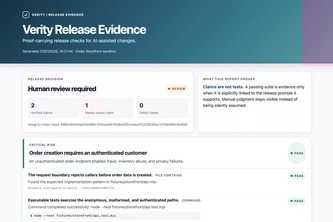
The description states that Verity is a "proof-carrying release gate for AI-assisted code changes." It is described as a tool that links critical claims in software releases—such as “order creation requires an authenticated customer”—to reproducible evidence, including source checks, test commands, and manual review. The system generates HTML and JSON reports to support this linkage.
What changed
The author states that Verity was built during OpenAI Build Week using GPT-5.6 and Codex. It is presented as a local-first CLI tool with no dependencies or network requirements for its demo version, and it integrates with GitHub Actions for validation and publishing.
Single most important open question
Is there any evidence of real-world usage, adoption, or traction beyond the hackathon submission? The description does not indicate whether Verity has been used in production environments or by teams outside of the hackathon context.
What The Product Actually Is
The description states that Verity is a proof-carrying release gate for AI-assisted code changes. It allows teams to write important release claims (e.g., “order creation requires an authenticated customer”) and attach reproducible evidence to each claim. This evidence can include:
- Source-pattern checks
- Executable test commands
- Explicit manual review
Verity generates a standalone HTML report and a portable JSON evidence record, both of which are ordered and SHA-256 hash-chained for integrity verification.
The system is described as treating human sign-off as a first-class REVIEW state, rather than silently passing when tests pass.
Inferred Verity appears to be a tool designed to improve trust in AI-generated code changes by ensuring that each release promise is backed by verifiable evidence. It is not a general-purpose testing framework but a specific mechanism for linking claims to proof.
Positioning & Claim Evolution
The description states that Verity was inspired by the challenge of verifying AI-assisted pull requests: “AI coding agents can create a convincing, multi-file pull request in minutes. The difficult question is not only ‘do the tests pass?’ but ‘which real release promise do these tests prove?’”
Claim
Verity turns AI-assisted release promises into reproducible proof—linking every critical claim to tests, source checks, and explicit human review.
Inferred The positioning is that Verity addresses a gap in trust between automated code generation and the actual business or security intent behind changes. It is not positioned as a general-purpose CI/CD tool but as a mechanism for traceability and accountability in release gates.
Target Customer & ICP
The description does not state who the target customer is, nor does it define an ideal customer profile (ICP). It implies that Verity is aimed at teams working with AI-assisted code changes and needing to validate those changes against release claims.
Inferred The likely users are software development teams or engineering organizations using AI agents in their workflows who want to ensure that automated changes align with product, security, or compliance promises. The tool may appeal to teams with CI/CD pipelines and a need for auditability.
Business Model & Pricing Evidence
There is no evidence of pricing, business model, or monetization strategy in the description. The project is presented as a hackathon submission with no indication of commercial intent or revenue streams.
Not evidenced No information on how Verity would be sold, licensed, or priced.
Technical & Delivery Signals
The description states that Verity was built using:
- GPT-5.6
- Codex
- Node.js 20+
- GitHub Actions
- CLI interface
It is described as a local-first tool with no dependencies, API keys, or network connections required for the demo.
The system supports:
- Executable test commands
- Source-pattern checks
- Manual review (REVIEW state)
- SHA-256 hash-chained evidence records
- Standalone HTML and JSON artifacts
Inferred Verity is a lightweight, self-contained CLI tool with a focus on integrity and traceability. It is designed to integrate into existing CI/CD pipelines and GitHub workflows.
Traction & Maturity Signals
The description states that this project was submitted to the OpenAI 2026 hackathon and was built during OpenAI Build Week. It includes a demo that runs via npm test and npm run demo.
There is no evidence of:
- Real-world usage
- Customer adoption
- Revenue or funding
- Product maturity beyond the demo
Not evidenced No data on traction, product usage, or market validation.
Competitive Context
The description does not mention any competitors. It does not reference tools or systems that perform similar functions in release gates or traceability for AI-assisted code changes.
Not evidenced No competitive landscape or comparison to existing tools is provided.
Open Questions & Risks
- No real-world usage or adoption: The project is presented as a hackathon submission with no indication of production use.
- No pricing or business model: No evidence of monetization strategy.
- Limited scope: The tool appears to be a proof-of-concept, not a full product.
- Self-reported maturity: The system is described as local-first and demo-only, with no indication of scalability or enterprise readiness.
Questions the description leaves open
- What specific use cases have you identified for Verity beyond the hackathon?
- Have any teams or organizations begun using Verity in production or CI/CD workflows?
- How does Verity integrate with existing CI/CD tools and platforms (e.g., Jenkins, GitLab, GitHub Actions)?
- What are your plans for expanding beyond the current CLI-based demo to a full product?
- Are there any specific release claims or compliance requirements that Verity is designed to support?
Overall Assessment
The description states that this project was submitted as part of a hackathon and is not independently verified. It is presented as an early-stage idea or prototype, not a mature product or business.
Not evidenced No evidence of traction, revenue, or customer adoption exists beyond the hackathon submission.
Inference If Verity were to evolve into a product, it would likely appeal to engineering teams looking for accountability and traceability in AI-assisted workflows. However, as presented, it is not yet a commercial product with clear market demand or business model.
User Stories BotA demo video on every pull request
Get a demo video on every new feature
GitHub App that watches your pull requests and records a narrated, captioned demo.
Save time on demo prep and make informed decisions faster with a video walkthrough of every new feature.
Source
Submitted to the OpenAI 2026 hackathon on Devpost. Project home on Devpost. Back to the full gallery on Devpost.
This competitive analysis was produced by top-founders.com (opens in a new tab)
Generated by a language model from this project's public Devpost page — its tagline, the author's own write-up and any built-with tags listed there — as captured in August 2026. Short quotations are the author's words. It is an opinion on the idea as a business, not on the people behind it, and it reflects the description as published then. If the project has moved on, request a correction below. The analysis is not independent research and contains no verified traction, revenue or customer data.
An independent guide by KFG International LLC — not affiliated with, endorsed by, or connected to Devpost or OpenAI.