

Archive position — measured, not model output
0 likes on Devpost
2,263 of the 7,850 archived projects have more likes, and 5,587 share exactly 0 — so this project's #7,510 place in the like-ranked listing is a tie-break inside that group, not a ranking.
Projects (log scale)
Likes on Devpost. ▲ marks this project's group.
Show the figures
| Likes | Projects | Share of archive |
|---|---|---|
| 0 | 5,587 | 71.2% |
| 1 | 1,758 | 22.4% |
| 2 | 284 | 3.6% |
| 3–4 | 132 | 1.7% |
| 5–9 | 75 | 1.0% |
| 10+ | 14 | 0.2% |
 User Stories BotA demo video on every pull request
Get a demo video on every new feature
GitHub App that watches your pull requests and records a narrated, captioned demo.
Save time on demo prep and make informed decisions faster with a video walkthrough of every new feature.
Executive Summary
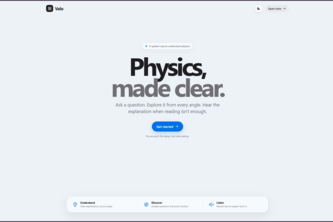
What the company appears to be: Velo-Physics Simulation is a self-reported local-first AI physics tutor built as a hackathon project. The description states it supports three learning modes—Explain, Guide, and Visualize—and integrates with AI models (Ollama, OpenAI, Anthropic) and an animation pipeline from MotionForge.
What changed: This is a new project submitted to the OpenAI 2026 hackathon. No prior version or evolution is described; it is presented as a prototype built in a short timeframe.
Single most important open question: Is there any evidence of traction, revenue, or user adoption beyond the self-reported project description?
What The Product Actually Is
The description states that Velo-Physics Simulation is a local-first AI physics tutor. It supports three learning modes:
- Explain: Breaks concepts into structured explanations and equations.
- Guide: Teaches through step-by-step questions and interactive lessons.
- Visualize: Uses MotionForge’s Prompt Animator to turn physics prompts into rendered animations.
It works without an account, offers credential-free local responses, and supports optional AI model providers (Ollama, OpenAI, Anthropic). Cloud API keys are stored in the operating system’s secure credential vault.
The backend is built with Node.js, the frontend with React and Vite. It connects to a packaged Prompt Animator from MotionForge for animation rendering.
Inference: The product appears to be a prototype or proof-of-concept built during a hackathon, not a commercial offering.
Positioning & Claim Evolution
The description states that Velo is positioned as an AI physics tutor that brings together equations, diagrams, and motion in one place. It aims to help learners move from a question to a clear explanation, guided lesson, or visual animation.
It claims to be local-first, meaning it does not require an account or cloud-based interaction for basic functionality.
Inference: The positioning is based on the authors’ stated intent to solve a problem in physics education by integrating AI and visualization. No evidence of prior positioning or evolution is provided.
Target Customer & ICP
The description states that Velo targets learners who struggle with physics because equations, diagrams, and motion are taught separately. It aims to help users move from a question to a clear explanation, guided lesson, or visual animation.
Inference: The target customer appears to be students or self-learners in physics education, but no specific ICP (Ideal Customer Profile) is defined beyond this general audience.
Business Model & Pricing Evidence
The description does not state anything about pricing, monetization, or a business model. It only describes the product’s features and functionality.
Not evidenced: No evidence of revenue streams, pricing tiers, or commercialization plans.
Technical & Delivery Signals
- Built with React + Vite for frontend.
- Backend is Node.js.
- Integrates with MotionForge’s Prompt Animator, which uses Python, Manim, and physics libraries.
- AI models supported: Ollama, OpenAI, Anthropic.
- API keys are stored in the OS credential vault.
- The animation pipeline is packaged as a self-contained executable for cross-platform distribution.
Inference: The technical stack suggests a lightweight, local-first application with some complexity in integrating AI and animation pipelines. No evidence of production deployment or scalability beyond the prototype.
Traction & Maturity Signals
The project was submitted to the OpenAI 2026 hackathon, indicating it is a prototype or proof-of-concept built over a short time.
No evidence of traction, user adoption, revenue, or customer data is provided. The description does not mention any users, usage metrics, or product maturity beyond its development stage.
Not evidenced: No signs of real-world use, growth, or commercial traction.
Competitive Context
The description does not provide any information about competitors or the competitive landscape in AI-powered physics education or tutoring tools.
Not evidenced: No evidence of existing players or market positioning relative to others.
Open Questions & Risks
- The project is a hackathon prototype, not a commercial product.
- No evidence of revenue, customers, or traction.
- The animation pipeline relies on a third-party tool (MotionForge), which may introduce dependency risks.
- The use of GPT-5.6 for development suggests a high level of automation but no clarity on how this impacts product quality or control.
- No mention of data privacy, security, or compliance measures beyond credential handling.
Inference: The lack of commercial traction and the prototype nature raise significant questions about viability and scalability.
Questions the description leaves open
- What is the intended path to market for Velo?
- Are there any plans to monetize or scale this product beyond its current prototype stage?
- How does Velo plan to handle user data, especially in a local-first model?
- Has the team considered how to integrate with existing educational platforms or LMS systems?
- What are the long-term plans for animation quality and rendering speed improvements?
- Are there any partnerships or integrations with educational institutions or content creators?
Overall Assessment
Not evidenced: No evidence of revenue, customers, or traction to support an investment or partnership decision.
The project is a self-reported hackathon prototype, not a commercial product. It lacks any indication of market demand, user adoption, or business model viability.
Inference: At this stage, Velo appears to be a proof-of-concept with no demonstrated commercial potential. Any investment or partnership would require further evidence of traction and product-market fit.
User Stories BotA demo video on every pull request
Get a demo video on every new feature
GitHub App that watches your pull requests and records a narrated, captioned demo.
Save time on demo prep and make informed decisions faster with a video walkthrough of every new feature.
Source
Submitted to the OpenAI 2026 hackathon on Devpost. Project home on Devpost. Back to the full gallery on Devpost.
This competitive analysis was produced by top-founders.com (opens in a new tab)
Generated by a language model from this project's public Devpost page — its tagline, the author's own write-up and any built-with tags listed there — as captured in August 2026. Short quotations are the author's words. It is an opinion on the idea as a business, not on the people behind it, and it reflects the description as published then. If the project has moved on, request a correction below. The analysis is not independent research and contains no verified traction, revenue or customer data.
An independent guide by KFG International LLC — not affiliated with, endorsed by, or connected to Devpost or OpenAI.