

Archive position — measured, not model output
1 like on Devpost
505 of the 7,850 archived projects have more likes, and 1,758 share exactly 1 — so this project's #1,623 place in the like-ranked listing is a tie-break inside that group, not a ranking.
Projects (log scale)
Likes on Devpost. ▲ marks this project's group.
Show the figures
| Likes | Projects | Share of archive |
|---|---|---|
| 0 | 5,587 | 71.2% |
| 1 | 1,758 | 22.4% |
| 2 | 284 | 3.6% |
| 3–4 | 132 | 1.7% |
| 5–9 | 75 | 1.0% |
| 10+ | 14 | 0.2% |
 User Stories BotA demo video on every pull request
Get a demo video on every new feature
GitHub App that watches your pull requests and records a narrated, captioned demo.
Save time on demo prep and make informed decisions faster with a video walkthrough of every new feature.
Executive Summary
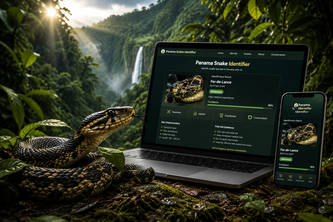
The description states that Panama Snake Identifier is an AI-powered web app designed to identify snake species in Panama from photos and provide educational and safety information. The author, Dean Williams, built a prototype using Python, machine learning, computer vision, and GPT-5.6. It is presented as a tool for biodiversity education, conservation, and public safety.
The project appears to be an early-stage prototype with no evidence of revenue, customers, or traction. The author describes it as a functional prototype but does not report any actual deployment, user base, or monetization. The single most important open question is whether the system has achieved sufficient accuracy and reliability for practical use in real-world snake encounters.
What The Product Actually Is
The description states that Panama Snake Identifier is an AI-powered web application that analyzes photographs of snakes to suggest likely species found in Panama. It provides:
- Common name
- Scientific name
- Venomous or non-venomous status
- Taxonomy
- Physical characteristics
- Habitat
- Geographic distribution
- Conservation information
- Medical importance
- Basic first-aid and safety guidance
The system uses an image-classification model trained on real snake photographs, with GPT-5.6 supporting educational content generation. It is described as a web app built using Python, computer vision, machine learning, and Codex.
Positioning & Claim Evolution
The description states that the project combines technology, biodiversity education, conservation, and public safety. It positions itself as an educational and safety-support tool that does not replace emergency services or professionals.
The author claims it makes snake identification more accessible through artificial intelligence. The project is described as a prototype demonstrating how AI can support environmental education, wildlife conservation, and public safety in Panama.
Target Customer & ICP
The description states that the target audience includes people who encounter snakes in Panama and need to identify them for safety or educational purposes. It is designed as an educational tool for the general public, particularly those who may not be familiar with local snake species.
The system is described as being simple enough for non-technical users, suggesting a broad consumer base rather than specialized professionals.
Business Model & Pricing Evidence
Not evidenced. The description does not mention any pricing structure, monetization strategy, or business model beyond the educational and safety support function.
Technical & Delivery Signals
The description states that the application was built using:
- Python
- Computer vision
- Machine learning
- Codex (for development assistance)
- GPT-5.6 (for content generation)
- HTML, CSS, JavaScript (frontend)
It uses a structured catalog of snake species found in Panama and a trained image-classification model that compares visual patterns with trained classes to return identifications.
Traction & Maturity Signals
Not evidenced. The description states that this is a prototype, not a deployed product. There is no evidence of revenue, customers, user base, or actual deployment. The author mentions challenges in dataset collection and model accuracy but does not report any metrics on performance or adoption.
Competitive Context
Not evidenced. The description does not mention competitors, market analysis, or competitive positioning beyond stating that it's a tool for snake identification in Panama.
Open Questions & Risks
- Accuracy of the AI model is unproven; the author notes challenges with dataset quality and visually similar species
- No evidence of real-world testing or validation
- Single-person development team (1 person)
- Prototype status with no reported deployment or user base
- Reliance on GPT-5.6 for content generation raises questions about consistency and scalability
- Limited dataset collection may affect model reliability
Questions the description leaves open
- What is the current accuracy rate of the snake identification model?
- How many verified photographs were used to train the model per species?
- What validation methods have been used to test the system's performance?
- Are there any partnerships with local biologists or wildlife organizations?
- What are the specific technical limitations that prevent full deployment?
- How will the system handle edge cases or incorrect identifications?
- What is the plan for expanding the dataset and adding new species?
- How does the team plan to ensure content accuracy and safety guidance?
Overall Assessment
Not evidenced. The description provides no information about funding, valuation, or investment status. It is presented as a hackathon submission with no indication of commercial viability or strategic value beyond its educational function.
User Stories BotA demo video on every pull request
Get a demo video on every new feature
GitHub App that watches your pull requests and records a narrated, captioned demo.
Save time on demo prep and make informed decisions faster with a video walkthrough of every new feature.
Source
Submitted to the OpenAI 2026 hackathon on Devpost. Project home on Devpost. Back to the full gallery on Devpost.
This competitive analysis was produced by top-founders.com (opens in a new tab)
Generated by a language model from this project's public Devpost page — its tagline, the author's own write-up and any built-with tags listed there — as captured in August 2026. Short quotations are the author's words. It is an opinion on the idea as a business, not on the people behind it, and it reflects the description as published then. If the project has moved on, request a correction below. The analysis is not independent research and contains no verified traction, revenue or customer data.
An independent guide by KFG International LLC — not affiliated with, endorsed by, or connected to Devpost or OpenAI.