

Archive position — measured, not model output
1 like on Devpost
505 of the 7,850 archived projects have more likes, and 1,758 share exactly 1 — so this project's #2,159 place in the like-ranked listing is a tie-break inside that group, not a ranking.
Projects (log scale)
Likes on Devpost. ▲ marks this project's group.
Show the figures
| Likes | Projects | Share of archive |
|---|---|---|
| 0 | 5,587 | 71.2% |
| 1 | 1,758 | 22.4% |
| 2 | 284 | 3.6% |
| 3–4 | 132 | 1.7% |
| 5–9 | 75 | 1.0% |
| 10+ | 14 | 0.2% |
 User Stories BotA demo video on every pull request
Get a demo video on every new feature
GitHub App that watches your pull requests and records a narrated, captioned demo.
Save time on demo prep and make informed decisions faster with a video walkthrough of every new feature.
Executive Summary
What the company appears to be: Veil is a self-reported tool designed for developers using Codex (presumably OpenAI's code generation model) that aims to prevent exposure of Git history or publishing credentials during code generation workflows.
What changed: The project was submitted to the OpenAI 2026 hackathon, indicating it is early-stage and likely prototypical in nature. No evidence of prior development or commercial traction exists.
Single most important open question: Is there a genuine market need for this specific workflow enhancement, or is this a speculative solution to an undefined problem?
Analysis basis: This report is based entirely on the self-reported project description provided by the caller — including name, tagline, author’s own write-up (which is minimal), and declared technology stack. No external verification or historical data are available.
What The Product Actually Is
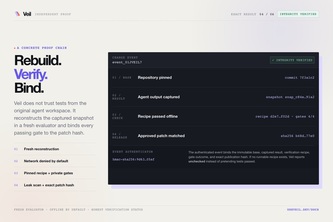
The description states that Veil "lets you use Codex without exposing Git history or publishing credentials." It also says it "checks the exact result and publishes only when you approve it."
- Claimed function: A tool that interfaces with Codex to mediate code generation, filtering outputs before publication.
- Inferred purpose: To provide a secure interface between developers and AI-assisted coding tools, particularly in environments where Git history or credentials must be protected.
Evidence strength: The description is minimal. It does not define how the tool works technically beyond its interaction with Codex and approval mechanism. No screenshots, diagrams, or functional details are provided.
Positioning & Claim Evolution
The tagline reads: “Veil lets you use Codex without exposing Git history or publishing credentials.”
- Positioning claim: Veil positions itself as a privacy-preserving layer for AI-assisted development workflows.
- Evolution of claims: There is no evidence of prior versions, iterations, or claimed improvements. The project appears to be a single submission with no stated evolution.
Evidence strength: Only one statement exists; it is self-reported and does not indicate any positioning strategy beyond the tagline.
Target Customer & ICP
The description makes no mention of specific customer segments or personas.
- Inferred target: Likely developers working in secure environments where Git history or credentials are sensitive.
- ICP inference: Possibly enterprise developers using AI tools within regulated or private codebases.
Evidence strength: Not evidenced. No indication of who uses Veil, how many users exist, or whether there is a defined customer journey.
Business Model & Pricing Evidence
There is no evidence in the description regarding pricing, monetization strategy, or business model.
- Claimed commercial aspect: None.
- Inference: If this were to become a product, it might be offered as a SaaS tool or plugin, but there is no indication of such plans.
Evidence strength: Not evidenced. No mention of revenue streams, pricing tiers, or monetization logic.
Technical & Delivery Signals
The author declares the project was built with “gpt-5.6,” which may be a typo or misattribution (as of 2026, GPT-5.6 is not a known model). The project was submitted to a hackathon.
- Technology stack: gpt-5.6 (self-reported)
- Delivery signal: Submitted to OpenAI 2026 hackathon — implies prototype or proof-of-concept stage.
- Inference: Likely early-stage, experimental code with no production-ready delivery.
Evidence strength: Minimal. No technical architecture, API details, or deployment information provided.
Traction & Maturity Signals
There is no evidence of traction, adoption, or maturity.
- Maturity claim: Submitted to a hackathon — indicates prototype or early-stage development.
- Traction signal: None reported.
Evidence strength: Not evidenced. No metrics, user feedback, or usage data are present.
Competitive Context
The description does not mention any competitors or market context.
- Inference: Likely operates in the space of AI-assisted coding tools with security or compliance concerns.
- Competitive landscape: Unknown — no reference to existing solutions or differentiation.
Evidence strength: Not evidenced. No competitive analysis, positioning against other tools, or market awareness shown.
Open Questions & Risks
- Risk 1: The project is a hackathon submission with no evidence of prior development or traction.
- Risk 2: The declared tech stack (gpt-5.6) appears inaccurate or speculative — raises questions about technical depth or accuracy.
- Open question: No customer validation, pricing model, or commercial viability indicated.
Evidence strength: Inferences drawn from lack of evidence and self-reported claims.
Questions the description leaves open
- What specific use cases does Veil address that existing tools do not?
- How does the approval mechanism work technically — is it manual or automated?
- Is there a plan to move beyond the hackathon prototype stage?
- What are the actual security or privacy risks this tool aims to mitigate?
- Are there any early adopters or feedback from developers?
Note: These questions are based on the thin evidence provided and aim to probe for clarity, depth, and commercial viability.
Overall Assessment
The description does not support a conclusion about investment or partnership potential.
- Assessment: Not evidenced. The project is described as a hackathon submission with no signs of traction, revenue, or commercial readiness.
- Inference: If this evolves into a product, it may have relevance in secure AI-assisted development workflows — but that is speculative without further evidence.
Confidence level: Low. This is a self-reported, unverified, and minimally described project with no demonstrated market need or business model.
User Stories BotA demo video on every pull request
Get a demo video on every new feature
GitHub App that watches your pull requests and records a narrated, captioned demo.
Save time on demo prep and make informed decisions faster with a video walkthrough of every new feature.
Source
Submitted to the OpenAI 2026 hackathon on Devpost. Project home on Devpost. Back to the full gallery on Devpost.
This competitive analysis was produced by top-founders.com (opens in a new tab)
Generated by a language model from this project's public Devpost page — its tagline and any built-with tags listed there, since the author published no write-up — as captured in August 2026. Short quotations are the author's words. It is an opinion on the idea as a business, not on the people behind it, and it reflects the description as published then. If the project has moved on, request a correction below. The analysis is not independent research and contains no verified traction, revenue or customer data.
An independent guide by KFG International LLC — not affiliated with, endorsed by, or connected to Devpost or OpenAI.