

Archive position — measured, not model output
0 likes on Devpost
2,263 of the 7,850 archived projects have more likes, and 5,587 share exactly 0 — so this project's #4,122 place in the like-ranked listing is a tie-break inside that group, not a ranking.
Projects (log scale)
Likes on Devpost. ▲ marks this project's group.
Show the figures
| Likes | Projects | Share of archive |
|---|---|---|
| 0 | 5,587 | 71.2% |
| 1 | 1,758 | 22.4% |
| 2 | 284 | 3.6% |
| 3–4 | 132 | 1.7% |
| 5–9 | 75 | 1.0% |
| 10+ | 14 | 0.2% |
 User Stories BotA demo video on every pull request
Get a demo video on every new feature
GitHub App that watches your pull requests and records a narrated, captioned demo.
Save time on demo prep and make informed decisions faster with a video walkthrough of every new feature.
Executive Summary
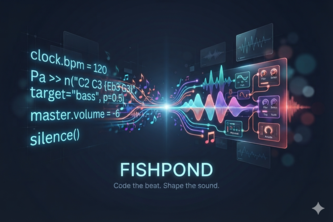
Fishpond is a self-reported live-coding DAW built as a native macOS desktop application using JUCE/C++ with an embedded CPython runtime. The project allows musicians to write and evaluate Python code in real-time while controlling VST3 instruments, using Sardine-style syntax for pattern generation and musical timing. It supports asynchronous plugin loading and replacement without audio interruption.
The author states Fishpond enables live-coding workflows where musicians perform with Python, improvising patterns through their own VST3 instruments and effects. The system separates real-time audio processing from Python evaluation, using thread-safe queues to manage musical events.
Key commercial due-diligence question: Is there evidence of a market need or user traction beyond the single developer's prototype? There is no evidence of revenue, customers, or adoption beyond the author’s own account.
What The Product Actually Is
The description states Fishpond is:
- A native JUCE/C++ desktop application with an embedded CPython runtime
- Designed as a live-coding DAW
- Built to allow musicians to write and evaluate Python in real-time
- Capable of routing notes directly to named instrument channels
- Supporting Sardine-style players, pattern strings, timing, and quantized replacement
- Enabling loading and replacing VST3 instruments while audio continues playing
- Providing control over tempo, master volume, transport state, errors, and execution feedback
It is described as a standalone live-coding DAW where musicians can use Sardine-style Python patterns to control VST3 instruments they already own.
Inference: Fishpond appears to be a technical prototype for a creative coding environment that bridges audio production and programming. It does not appear to have any commercial product or marketplace features beyond its own codebase.
Positioning & Claim Evolution
The author states:
- Fishpond started with the idea of making the code editor a musical instrument
- It is positioned as a standalone live-coding DAW where musicians can use Python to control VST3 instruments
- The system supports Sardine-style patterns, which implies alignment with existing live-coding communities
The claim evolution shows:
- Initial inspiration: code editor as musical instrument
- Core functionality: Python-based live-coding of audio
- Technical approach: JUCE/C++ + embedded CPython + VST3 hosting
Inference: The positioning is rooted in the intersection of live-coding and music technology, with a focus on empowering musicians to perform using code. No evidence suggests this has evolved into a broader commercial or community platform.
Target Customer & ICP
The description states:
- Fishpond targets musicians who perform with Python
- It allows users to improvise Sardine-style patterns through their own VST3 instruments and effects
Inference: The primary customer is likely musician-developers or live-coders who are already familiar with Python and audio tools. There is no evidence of a defined ICP beyond this self-described user group.
Business Model & Pricing Evidence
The description does not state:
- Any pricing model
- Revenue streams
- Commercial licensing or monetization strategy
Inference: No evidence of a business model or pricing structure exists in the provided description. The project is presented as a prototype, not a commercial offering.
Technical & Delivery Signals
The description states:
- Fishpond is built with JUCE/C++, an embedded CPython runtime
- It uses thread-safe queues to manage musical events
- Python execution does not occur on the audio callback
- Musical events are delivered to hosted plugins at correct audio-block boundaries
- The system supports asynchronous plugin loading and replacement
- It uses a specification-driven workflow with requirements, traceability IDs, and validation
Inference: Technical delivery signals suggest a highly technical prototype, likely built for performance and concurrency. There is no evidence of production deployment or scalability beyond the single developer's environment.
Traction & Maturity Signals
The description states:
- The system supports Sardine-style player replacement, pattern strings, brace-based chord groups, quantized changes
- It has 39/39 deterministic tests and 51/51 embedded-Python tests
- Manual macOS testing confirms audible VST3 playback, multi-instrument loading, and uninterrupted replacement
Inference: The project shows technical maturity in prototype form, but there is no evidence of:
- User adoption
- Revenue
- Customer feedback or usage metrics
- Product-market fit beyond the developer’s own use
Competitive Context
The description does not mention:
- Competitors
- Market positioning relative to other live-coding tools or DAWs
- Existing tools in the audio + Python space
Inference: No evidence of competitive analysis or market context is provided. The project appears to be self-contained, without reference to existing products or ecosystems.
Open Questions & Risks
Key risks and open questions based on the description:
- Single developer team (1 person) — raises questions about scalability, maintenance, and long-term development
- No revenue or customer data — indicates no commercial traction or market validation
- Prototype-only status — no evidence of production deployment or user feedback loops
- Limited platform support (macOS only) — may limit adoption in broader markets
- High technical complexity — real-time audio + Python integration is challenging and risky
Inference: The project is a technical demonstration, not a validated commercial product. Risks include lack of traction, limited team capacity, and unproven market demand.
Questions the description leaves open
- What is the intended user base beyond the developer?
- Are there any users or early adopters who have provided feedback?
- How does Fishpond plan to monetize or scale beyond a prototype?
- What are the technical limitations of the current macOS-only build?
- Is there an existing community or ecosystem around Sardine-style live-coding that Fishpond intends to integrate with?
- What is the roadmap for platform support beyond macOS?
Overall Assessment
The description states:
- Fishpond is a self-reported prototype built by one developer
- It is not independently verified or validated
- No evidence of revenue, customers, or traction exists
Inference: This is a technical prototype, not a commercial product. There is no evidence of market demand, user adoption, or business model viability.
Assessment: Not ready for investment or partnership. The project shows technical capability but lacks commercial signals. A follow-up with the founder to assess traction, roadmap and scalability would be required before any further consideration.
User Stories BotA demo video on every pull request
Get a demo video on every new feature
GitHub App that watches your pull requests and records a narrated, captioned demo.
Save time on demo prep and make informed decisions faster with a video walkthrough of every new feature.
Source
Submitted to the OpenAI 2026 hackathon on Devpost. Project home on Devpost. Back to the full gallery on Devpost.
This competitive analysis was produced by top-founders.com (opens in a new tab)
Generated by a language model from this project's public Devpost page — its tagline, the author's own write-up and any built-with tags listed there — as captured in August 2026. Short quotations are the author's words. It is an opinion on the idea as a business, not on the people behind it, and it reflects the description as published then. If the project has moved on, request a correction below. The analysis is not independent research and contains no verified traction, revenue or customer data.
An independent guide by KFG International LLC — not affiliated with, endorsed by, or connected to Devpost or OpenAI.