

Archive position — measured, not model output
0 likes on Devpost
2,263 of the 7,850 archived projects have more likes, and 5,587 share exactly 0 — so this project's #7,449 place in the like-ranked listing is a tie-break inside that group, not a ranking.
Projects (log scale)
Likes on Devpost. ▲ marks this project's group.
Show the figures
| Likes | Projects | Share of archive |
|---|---|---|
| 0 | 5,587 | 71.2% |
| 1 | 1,758 | 22.4% |
| 2 | 284 | 3.6% |
| 3–4 | 132 | 1.7% |
| 5–9 | 75 | 1.0% |
| 10+ | 14 | 0.2% |
 User Stories BotA demo video on every pull request
Get a demo video on every new feature
GitHub App that watches your pull requests and records a narrated, captioned demo.
Save time on demo prep and make informed decisions faster with a video walkthrough of every new feature.
Executive Summary
What the company appears to be
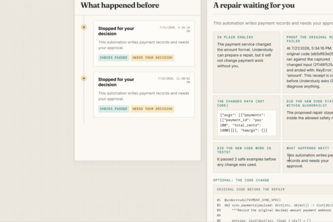
Understudy is a self-healing automation system built by one developer (Navneet Ajmera) that monitors automations, diagnoses failures, patches code, and applies fixes automatically — with safety guards around high-risk changes like payments. It is described as a tool for developers or technical users who build and maintain automations.
What changed
The project was submitted to the OpenAI 2026 hackathon by a solo developer. It is presented as an experimental, self-contained system built using AI tools (e.g., GPT-5.6, Codex) and Python-based technologies. The author describes it as a proof-of-concept with no real-world deployment yet.
Single most important open question
Is there a viable commercial opportunity in building a self-healing automation layer for developers or enterprises? The project is not evidenced to have traction, revenue, or even deployed automations — only mock systems and a prototype.
What The Product Actually Is
The description states that Understudy:
- Watches automations built by the user.
- Diagnoses when an automation breaks.
- Writes patches to fix the issue.
- Tests the patch before applying it.
- Never edits original code; stores repairs separately.
- Has a safety layer: refuses to repair anything involving payments or amounts without human approval.
- Currently only connects to mock automations, not real ones.
It is built using:
- AI tools (GPT-5.6, Codex)
- Python-based stack (FastAPI, Pydantic, SQLite, BeautifulSoup, etc.)
- A dashboard for monitoring and repair steps
Inference The system appears to be a prototype or proof-of-concept that uses AI to automate debugging and patching of broken automations.
Positioning & Claim Evolution
The author states:
- The product is designed for developers who build automations.
- It aims to reduce the need for manual intervention when small issues arise.
- It distinguishes itself by not just alerting but actively fixing, with safety controls.
- It was built in a hackathon environment and is described as experimental.
Inference The positioning seems to be that of a developer tool or internal automation assistant. The claim evolution shows a shift from a simple alert system to an autonomous repair system — though it’s not clear if this is a new category or just an enhancement to existing systems.
Target Customer & ICP
The description states:
- The product is for developers who build and maintain automations.
- It is built by one developer (Navneet Ajmera), suggesting a solo-user or small-team use case.
- It is not described as targeting enterprise customers or large organizations.
Inference The initial ICP appears to be individual developers or small technical teams managing their own automations. No evidence of B2B or enterprise targeting.
Business Model & Pricing Evidence
Not evidenced.
The description does not mention:
- Revenue model
- Pricing strategy
- Monetization approach
- Subscription plans or licensing
Inference No business model is evident from the self-reported description.
Technical & Delivery Signals
The author states:
- Built using AI tools (GPT-5.6, Codex) and Python stack.
- System was built in batches with Codex generating code and running tests.
- A dashboard was added to show repair steps clearly.
- The system can diagnose, patch, test, and decide whether to apply a fix.
Inference The technical approach is AI-assisted development with a focus on autonomous repair. The delivery process involved iterative AI coding followed by manual review and refinement.
Traction & Maturity Signals
Not evidenced.
The description states:
- Only mock automations are connected.
- Real-world deployment is the next step.
- No customers, users, or adoption data are mentioned.
- It was built for a hackathon.
Inference No traction or maturity signals are evident. The system is described as a prototype with no live usage.
Competitive Context
Not evidenced.
The description does not mention:
- Competitors
- Market landscape
- Existing tools in the automation or self-healing space
Inference No competitive positioning or market context is provided.
Open Questions & Risks
- Solo developer team: The project is built by one person, which raises questions about scalability and long-term maintenance.
- Prototype only: No real-world deployment or live automations are mentioned.
- Unproven safety controls: While the system has a "safety layer," it's unclear how well this would work in practice.
- No commercial viability shown: There is no evidence of revenue, customers, or a monetization strategy.
- AI dependency: Heavy reliance on AI tools (Codex, GPT) may not be scalable or reliable for enterprise use.
Questions the description leaves open
- What are the actual technical limitations of the current system in handling real-world automation failures?
- How does the safety layer prevent false positives or missed critical issues?
- Is there a plan to scale beyond a single developer’s use case?
- What is the intended business model for monetizing this tool?
- Are there any existing customers or users who are willing to validate its utility?
- How would you handle edge cases where AI-generated patches fail or introduce new bugs?
Overall Assessment
Not evidenced.
The description does not provide:
- Financials
- Traction data
- Customer feedback
- Market opportunity size
- Founders’ track record
Inference This is a solo-developer hackathon project with no evidence of commercial viability or traction. It is too early to assess investment or partnership potential. The idea has conceptual merit but lacks validation in real-world usage or market demand.
User Stories BotA demo video on every pull request
Get a demo video on every new feature
GitHub App that watches your pull requests and records a narrated, captioned demo.
Save time on demo prep and make informed decisions faster with a video walkthrough of every new feature.
Source
Submitted to the OpenAI 2026 hackathon on Devpost. Project home on Devpost. Back to the full gallery on Devpost.
This competitive analysis was produced by top-founders.com (opens in a new tab)
Generated by a language model from this project's public Devpost page — its tagline, the author's own write-up and any built-with tags listed there — as captured in August 2026. Short quotations are the author's words. It is an opinion on the idea as a business, not on the people behind it, and it reflects the description as published then. If the project has moved on, request a correction below. The analysis is not independent research and contains no verified traction, revenue or customer data.
An independent guide by KFG International LLC — not affiliated with, endorsed by, or connected to Devpost or OpenAI.