

Archive position — measured, not model output
0 likes on Devpost
2,263 of the 7,850 archived projects have more likes, and 5,587 share exactly 0 — so this project's #7,451 place in the like-ranked listing is a tie-break inside that group, not a ranking.
Projects (log scale)
Likes on Devpost. ▲ marks this project's group.
Show the figures
| Likes | Projects | Share of archive |
|---|---|---|
| 0 | 5,587 | 71.2% |
| 1 | 1,758 | 22.4% |
| 2 | 284 | 3.6% |
| 3–4 | 132 | 1.7% |
| 5–9 | 75 | 1.0% |
| 10+ | 14 | 0.2% |
 User Stories BotA demo video on every pull request
Get a demo video on every new feature
GitHub App that watches your pull requests and records a narrated, captioned demo.
Save time on demo prep and make informed decisions faster with a video walkthrough of every new feature.
Executive Summary
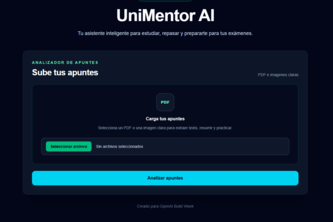
UniMentor AI is a self-reported educational tool built as a hackathon project that allows students to upload PDF study materials and receive AI-generated summaries, key concepts, practice questions by difficulty level, and personalized feedback. The platform was developed using Next.js, React, TypeScript, Tailwind CSS, and OpenAI APIs, with fallback to local processing if the AI service is unavailable.
The author states this is a functional MVP that processes real PDFs, generates structured educational content, evaluates responses, and provides immediate feedback. It is deployed on Vercel and designed for public browser use.
Key commercial due-diligence question: Does the author’s self-reported functionality reflect actual user adoption or product-market fit beyond the hackathon context?
What The Product Actually Is
The description states that UniMentor AI is a tool that:
- Accepts PDF uploads from students.
- Uses AI (via OpenAI) to extract content and generate:
- Summaries
- Key concepts
- Practice questions categorized by difficulty (basic, intermediate, advanced)
- Personalized feedback on student answers
- Includes a local fallback mechanism if the AI service fails.
- Is built with Next.js, React, TypeScript, Tailwind CSS, and deployed via Vercel.
This is described as an educational platform for students to convert study materials into structured learning experiences.
Inference: Based on the technical stack and process flow described, it appears to be a web-based application that integrates server-side PDF processing with AI-generated content. However, no evidence of actual users or usage metrics are provided.
Positioning & Claim Evolution
The author positions UniMentor AI as:
- An AI-powered study assistant.
- A tool that makes studying more active, personalized, and easy to use.
- Designed to help students organize large volumes of notes and documents into digestible formats.
It is described as a solution for students who have extensive materials but lack time to process them effectively, aiming to improve learning outcomes through structured practice and feedback.
Claim vs. Fact: These are self-reported claims about intent, not evidence of traction or impact.
Target Customer & ICP
The description states that UniMentor AI targets:
- Students who have extensive study materials (PDFs, slides, documents).
- Students who want to organize and review content efficiently.
- Users looking for personalized feedback and practice questions.
There is no explicit mention of specific demographics, grade levels, or educational institutions. The ICP appears to be broad — general students — without a defined segment.
Not evidenced: No indication of target audience segmentation beyond "students".
Business Model & Pricing Evidence
The description does not state any business model or pricing structure.
It is unclear whether the tool will be offered free, paid, or through a freemium model. There are no references to monetization plans or revenue streams.
Not evidenced: No information on how the product would generate value for users or the company.
Technical & Delivery Signals
The author reports:
- Built with Next.js, React, TypeScript, Tailwind CSS
- Uses OpenAI API for content generation and evaluation
- Implements server-side routes to process PDFs
- Includes a local fallback mechanism when AI is unavailable
- Deployed on Vercel
- Uses environment variables for API key security
Technical challenges mentioned include:
- Ensuring PDF extraction works in both local and production environments.
- Reducing API consumption through caching, limiting context, and reusing results.
- Validating structured AI outputs and handling failures gracefully.
Inference: The technical implementation suggests a functional MVP with some optimization efforts. However, no evidence of scalability or performance data is provided.
Traction & Maturity Signals
The description states:
- UniMentor AI is a functional MVP
- It can process real PDFs
- Generates educational content
- Evaluates answers and gives feedback
- Works publicly in a browser
- Continues functioning with local backup if AI fails
It was submitted to the OpenAI 2026 hackathon, indicating it was built within a short timeframe.
Not evidenced: No data on user engagement, retention, or adoption beyond the initial prototype. No evidence of customer acquisition or usage metrics.
Competitive Context
The description does not mention any competitors or existing tools in the educational AI space.
It is unclear whether similar tools already exist — such as platforms that offer summarization, flashcards, quizzes, or adaptive learning systems.
Not evidenced: No competitive landscape analysis or differentiation strategy described.
Open Questions & Risks
Key risks and open questions based on self-reported information:
- No traction or revenue data: The tool is described only as a hackathon MVP.
- Unverified claims: All features are self-reported without independent validation.
- Limited scope: Only supports PDFs; lacks support for other formats like images, presentations, or audio.
- Dependency on OpenAI API: If the API becomes unavailable or expensive, functionality may degrade.
- Single-founder team: The project is built by one person (Cristian Coaquira), which may limit scalability and long-term development capacity.
- No monetization strategy: No indication of how the product would be monetized or scaled.
Inference: Without external validation or user data, this remains a speculative idea rather than a proven product.
Questions the description leaves open
- What is your definition of success for UniMentor AI beyond the MVP?
- Have you tested the tool with real students? If so, what were their reactions?
- How do you plan to scale beyond a single developer and a hackathon project?
- Are there any plans to integrate with existing LMS or educational platforms?
- What is your long-term vision for monetization and user acquisition?
- How do you intend to handle content quality control, especially when AI outputs are imperfect?
- What are the main technical limitations of the current MVP that would need addressing before launch?
Overall Assessment
The description indicates UniMentor AI is a functional MVP built as part of a hackathon project. It demonstrates basic functionality in processing PDFs, generating educational content, and offering feedback.
However, there is no evidence of traction, revenue, or user adoption beyond the author’s own claims. The tool lacks clear commercial viability indicators, including pricing models, target segments, or competitive positioning.
This project appears to be an early-stage idea with potential, but it has not yet demonstrated product-market fit or a sustainable business model.
Confidence level: Low — based entirely on self-reported evidence and no external validation.
User Stories BotA demo video on every pull request
Get a demo video on every new feature
GitHub App that watches your pull requests and records a narrated, captioned demo.
Save time on demo prep and make informed decisions faster with a video walkthrough of every new feature.
Source
Submitted to the OpenAI 2026 hackathon on Devpost. Project home on Devpost. Back to the full gallery on Devpost.
This competitive analysis was produced by top-founders.com (opens in a new tab)
Generated by a language model from this project's public Devpost page — its tagline, the author's own write-up and any built-with tags listed there — as captured in August 2026. Short quotations are the author's words. It is an opinion on the idea as a business, not on the people behind it, and it reflects the description as published then. If the project has moved on, request a correction below. The analysis is not independent research and contains no verified traction, revenue or customer data.
An independent guide by KFG International LLC — not affiliated with, endorsed by, or connected to Devpost or OpenAI.