

Archive position — measured, not model output
0 likes on Devpost
2,263 of the 7,850 archived projects have more likes, and 5,587 share exactly 0 — so this project's #7,453 place in the like-ranked listing is a tie-break inside that group, not a ranking.
Projects (log scale)
Likes on Devpost. ▲ marks this project's group.
Show the figures
| Likes | Projects | Share of archive |
|---|---|---|
| 0 | 5,587 | 71.2% |
| 1 | 1,758 | 22.4% |
| 2 | 284 | 3.6% |
| 3–4 | 132 | 1.7% |
| 5–9 | 75 | 1.0% |
| 10+ | 14 | 0.2% |
 User Stories BotA demo video on every pull request
Get a demo video on every new feature
GitHub App that watches your pull requests and records a narrated, captioned demo.
Save time on demo prep and make informed decisions faster with a video walkthrough of every new feature.
Executive Summary
What the company appears to be
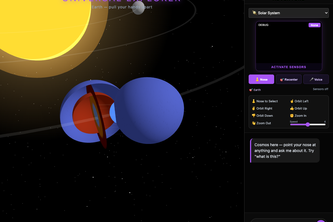
Universal Life Explorer is a self-reported 3D science learning environment built as a hackathon project. It uses webcam-based gesture control (nose, hands, full-body pose) and an OpenAI Realtime voice assistant to guide users through interactive exploration of scientific concepts across six worlds: solar system, molecules, atoms, Egyptian pyramid, flower, and human anatomy.
What changed
This is a single-person hackathon project with no evidence of prior development or commercial traction. The author describes it as a proof-of-concept for multimodal interaction in education, not a product ready for market.
The single most important open question — the commercial due-diligence read
Is there any evidence that this concept has been validated with users beyond the author’s own experimentation? There is no evidence of customer feedback, user testing, or adoption metrics. The description is entirely self-reported and unverified.
What The Product Actually Is
The description states that Universal Life Explorer is a webcam-driven 3D learning environment built using HTML5, JavaScript, Three.js, MediaPipe, OpenAI APIs, and Python. It includes:
- Six interactive worlds: solar system, molecules, atoms, Egyptian pyramid, flower, and human anatomy.
- Nose-based cursor control via MediaPipe FaceLandmarker.
- Hand gestures for orbiting, zooming, and manipulating objects (e.g., “rip a planet open”).
- Avatar mirroring of the user’s body movements using pose tracking.
- An OpenAI Realtime voice assistant that narrates and controls the app.
- Procedural generation of all 3D content (no external assets).
- A single-file Python server to proxy API keys and manage performance.
The product is described as a single HTML application with embedded logic, built for offline use, without CDN dependencies or third-party hosting.
Claim
The author states the app runs locally from one Python file.
Evidence Yes — “everything runs locally from one Python file” and “models vendored, no CDNs needed at runtime”.
Positioning & Claim Evolution
The author positions Universal Life Explorer as a hands-free, immersive science learning tool that allows users to explore scientific concepts through physical interaction with their own body and environment.
Key claims in the description include:
- Users can "look" at something and ask “what is this?”
- They can "grab" planets or organs and manipulate them.
- The app uses a mirrored avatar to connect physical touch to virtual explanation.
- The voice assistant drives the app, not just narrates it — e.g., “take me to the flower” or “show me what is inside”.
- It supports multimodal input: head, hand, body, and voice.
Claim
The author says the app allows users to interact with science in a way that feels like touching real objects.
Evidence Yes — “you LOOK at something and ask 'what is this?'”, “you GRAB a planet... and rip it open like an orange”.
Claim
The voice assistant is not just a narrator but also acts within the app.
Evidence Yes — “the voice DRIVES the app (function calling)”, “seven tools let the model act”.
Target Customer & ICP
The description does not state any explicit target customer or ideal customer profile (ICP). However, based on the content and use case, it appears aimed at:
- Educational institutions or educators looking for immersive science tools.
- Students aged 10–18, especially those interested in STEM.
- Self-directed learners who prefer experiential over traditional instruction.
Claim
The app is designed for science education.
Evidence Yes — “A hands-free 3D science universe”, “the human body”, “molecules”, “atoms”, etc.
Claim
It targets users who want to interact with scientific content through physical gestures.
Evidence Yes — “you LOOK at something and ask 'what is this?'”, “touch your own chest and a mirrored avatar touches its heart”.
Business Model & Pricing Evidence
There is no evidence of any business model or pricing strategy in the description. The project is described as a hackathon submission with no mention of monetization, licensing, or distribution plans.
Claim
No business model or pricing information provided.
Evidence Not evidenced — the author does not describe how this would be sold, licensed, or used commercially.
Technical & Delivery Signals
The project is built using:
- Frontend: HTML5, JavaScript, Three.js, MediaPipe Tasks (FaceLandmarker, PoseLandmarker, GestureRecognizer), WebRTC
- Backend: Python server to proxy OpenAI API keys and manage performance
- Tools: Perlin noise for procedural geometry, canvas-generated textures, function calling via OpenAI Realtime API
The author notes several technical challenges overcome:
- Nose pointer stabilization using filters and dwell logic.
- Avatar hand positioning with inverse kinematics (IK) and touch detection.
- Camera sharing between modules to avoid conflicts.
- Voice agent coordination across multiple scenes.
- Performance engineering including memory disposal, adaptive rendering, idle shutdown.
Claim
The app runs entirely locally without external dependencies.
Evidence Yes — “everything runs locally from one Python file”, “models vendored, no CDNs needed”.
Claim
It uses multimodal inputs (head, hand, body, voice) and integrates them into a cohesive experience.
Evidence Yes — “multimodal input (head pose + two hands + full-body pose + voice)” and “who owns the camera, who owns the microphone, and who speaks”.
Traction & Maturity Signals
There is no evidence of traction, revenue, customers, or adoption beyond the author’s own development. The project is described as a single-person hackathon effort, with no prior iterations or user feedback.
Claim
No traction or maturity data provided.
Evidence Not evidenced — the description says this is a hackathon submission and does not mention any users, usage stats, or product evolution.
Competitive Context
The author does not reference competitors or similar products. However, based on the described functionality (3D science exploration, gesture-based interaction, voice guidance), it may relate to:
- Educational apps like Khan Academy, National Geographic’s 3D Earth, or Google Arts & Culture.
- Immersive learning platforms such as Labster, Mystery Science, or Z-space.
- Developer tools for AR/VR interaction, such as MediaPipe, Three.js, or OpenAI’s API integrations.
Claim
No competitive analysis provided.
Evidence Not evidenced — the description does not mention any existing products or markets.
Open Questions & Risks
Several risks and open questions are present in the self-reported description:
- No validation with users beyond author’s own experience.
- Single-person development implies limited scalability or long-term support.
- Unproven commercial viability — no evidence of demand, monetization, or market fit.
- Technical complexity without external testing or feedback.
- Highly experimental features (e.g., avatar mirroring, function calling via voice) may not be stable or usable at scale.
Inference The lack of user data or product iteration suggests the concept is untested in real-world conditions.
Evidence Not evidenced — no mention of testing, feedback loops, or product development beyond the hackathon.
Questions the description leaves open
- What was the purpose of this project? Was it intended to be a prototype for further development?
- Have you tested this with real users (students, teachers)? If so, what were their reactions?
- How do you plan to scale beyond the current single-file implementation?
- Is there any intention to monetize or distribute this product?
- What are your thoughts on integrating this into existing educational platforms or curricula?
- Are there plans for multi-language support or accessibility features?
- What is the long-term vision for the app? Is it meant to be a standalone tool or part of a larger platform?
Overall Assessment
There is no evidence that Universal Life Explorer has reached any stage beyond a hackathon prototype. The description makes no claims about revenue, customers, traction, or even a clear go-to-market strategy.
Inference This is likely an experimental idea with potential for future development but currently lacks commercial viability or market validation.
Evidence Not evidenced — the project is described as a single-person hackathon effort with no signs of product-market fit or business traction.
Assessment Summary
- Not ready for investment or partnership.
- Potential exists if further developed with user feedback and clear commercial intent.
- Requires significant due diligence before any strategic move.
User Stories BotA demo video on every pull request
Get a demo video on every new feature
GitHub App that watches your pull requests and records a narrated, captioned demo.
Save time on demo prep and make informed decisions faster with a video walkthrough of every new feature.
Source
Submitted to the OpenAI 2026 hackathon on Devpost. Project home on Devpost. Back to the full gallery on Devpost.
This competitive analysis was produced by top-founders.com (opens in a new tab)
Generated by a language model from this project's public Devpost page — its tagline, the author's own write-up and any built-with tags listed there — as captured in August 2026. Short quotations are the author's words. It is an opinion on the idea as a business, not on the people behind it, and it reflects the description as published then. If the project has moved on, request a correction below. The analysis is not independent research and contains no verified traction, revenue or customer data.
An independent guide by KFG International LLC — not affiliated with, endorsed by, or connected to Devpost or OpenAI.