

Archive position — measured, not model output
0 likes on Devpost
2,263 of the 7,850 archived projects have more likes, and 5,587 share exactly 0 — so this project's #3,529 place in the like-ranked listing is a tie-break inside that group, not a ranking.
Projects (log scale)
Likes on Devpost. ▲ marks this project's group.
Show the figures
| Likes | Projects | Share of archive |
|---|---|---|
| 0 | 5,587 | 71.2% |
| 1 | 1,758 | 22.4% |
| 2 | 284 | 3.6% |
| 3–4 | 132 | 1.7% |
| 5–9 | 75 | 1.0% |
| 10+ | 14 | 0.2% |
 User Stories BotA demo video on every pull request
Get a demo video on every new feature
GitHub App that watches your pull requests and records a narrated, captioned demo.
Save time on demo prep and make informed decisions faster with a video walkthrough of every new feature.
Executive Summary
What the company appears to be
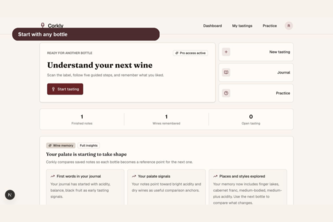
Corkly is an AI-powered wine-tasting coaching tool built as a mobile application. The author states it uses GPT-5.6 to guide users through a structured tasting process, enabling them to form their own sensory judgments rather than simply receiving expert reviews or recommendations. It aims to teach users how to taste wine by adapting instruction based on user input.
What changed
The project was submitted as part of the OpenAI 2026 hackathon. The author describes it as a functional prototype with a focus on structured memory, deterministic boundaries, and adaptive teaching logic using GPT-5.6. It includes features like mobile scanning, editable tasting notes, and atomic persistence.
Single most important open question
Is there evidence of any real-world usage or user feedback beyond the hackathon submission? The description does not indicate whether the product has moved beyond prototype status or if it has been tested with actual users.
What The Product Actually Is
The description states that Corkly is an AI sommelier app designed to teach users how to taste wine. It allows users to capture a bottle label and then guides them through structured sensory evaluation (appearance, aroma, palate, finish) using conversational language. The system uses GPT-5.6 for reasoning and teaching decisions, with strict output validation and deterministic guardrails to prevent fabricating observations.
It also includes:
- A mobile pipeline for capturing labels
- Structured intent and task actions from the AI
- Editable WSET-style tasting notes at the end of a session
- Atomic persistence into Supabase
- Support for uncertain or vague inputs
The product is described as being built with codex, GPT-5.6, Next.js, OpenAI API, Supabase, and TypeScript.
Evidence
- The author states: “Corkly turns a bottle into an adaptive tasting lesson.”
- “GPT-5.6 Sol decides whether to teach, clarify, answer, or advance based on the learner's own words.”
- “The coach uses GPT-5.6 Sol through Chat Completions with strict JSON Schema output.”
- “At the end, Corkly creates an editable WSET-style note and a durable memory of what the learner enjoyed.”
Inference This is a self-contained tasting coaching experience that integrates AI reasoning with structured data persistence.
Positioning & Claim Evolution
The author positions Corkly as an alternative to traditional wine apps that rely on expert scores or recommendations. Instead, it focuses on helping users develop their own sensory understanding through adaptive coaching.
Key claims:
- “What if an AI sommelier helped people form their own judgment instead of supplying one?”
- “We built Corkly around a different question: what if an AI sommelier helped people form their own judgment instead of supplying one?”
The positioning evolves from a general idea (helping users understand wine) to a specific approach (adaptive coaching with structured memory).
Evidence
- The author states: “Most wine apps begin with an expert score, a generated review, or a recommendation. That can help someone choose a bottle, but it does not teach them how to understand the glass in front of them.”
- “We built Corkly around a different question: what if an AI sommelier helped people form their own judgment instead of supplying one?”
Inference This is a shift from product recommendation to personal learning — a niche positioning within the wine education space.
Target Customer & ICP
The description does not explicitly define a target customer or ideal customer profile (ICP). However, it implies that the intended audience includes individuals who are interested in wine but lack confidence in describing or understanding what they taste. The product is framed as teaching users to form their own judgments rather than providing expert opinions.
Evidence
- “People often know that they enjoyed a wine without knowing why, lack confidence describing it, and lose their observations after the moment passes.”
- “We built Corkly around a different question: what if an AI sommelier helped people form their own judgment instead of supplying one?”
Inference The target is likely amateur or intermediate wine drinkers who want to improve their sensory awareness and retention.
Business Model & Pricing Evidence
There is no evidence in the description regarding pricing, monetization strategy, or business model. The author does not mention any revenue streams, subscriptions, or paid features.
Evidence
- No mention of pricing.
- No indication of monetization plans.
- No reference to B2B or consumer sales models.
Inference The project is currently in prototype form and has no commercial traction or business model yet.
Technical & Delivery Signals
The product uses GPT-5.6 as the core reasoning engine, with structured output validation via JSON schema. It includes:
- Chat Completions with strict output contracts
- Semantic guards to prevent fabrication of observations
- Atomic persistence using Supabase
- Mobile scanning pipeline with camera lifecycle handling
- V3 decision contract and conversational UI
Codex was used for auditing and implementing safety checks, including rubber-stamping failure modes.
Evidence
- “The coach uses GPT-5.6 Sol through Chat Completions with strict JSON Schema output.”
- “Each turn produces a structured intent, teaching answer, task action, optional observation, and learning signal.”
- “Application code validates that contract, enforces task and evidence boundaries, and commits the accepted turn atomically to Supabase.”
- “Codex first audited the existing experience and identified a rubber-stamping failure mode...”
Inference The technical architecture shows deliberate attention to safety, structure, and data integrity — especially for a learning-based system.
Traction & Maturity Signals
There is no evidence of traction or maturity beyond the hackathon submission. The author does not provide any data on user numbers, usage frequency, retention, or product adoption. The project is described as a functional prototype with no indication of real-world deployment or feedback loops.
Evidence
- “A coherent bottle-to-lesson-to-memory experience rather than a proof of concept.”
- “The long-term goal is a taste memory that becomes more valuable every time someone opens a bottle.”
Inference It remains in early-stage development, likely post-hackathon prototype phase.
Competitive Context
The description does not mention competitors or existing players in the wine education or tasting app space. It also lacks any reference to market size, competitive dynamics, or positioning relative to other tools.
Evidence
- No competitor names or references.
- No discussion of similar products or platforms.
Inference No competitive landscape is evident from this description alone.
Open Questions & Risks
Key risks and open questions include:
- No commercial traction: The project appears to be a prototype with no evidence of real-world usage or adoption.
- Unclear monetization path: No indication of how the product will generate revenue.
- Limited scope: The focus is on wine education, which may limit scalability or appeal.
- Dependency on GPT-5.6: Reliance on a single AI model without fallbacks or alternative approaches.
- Lack of user feedback: No mention of testing with real users beyond the hackathon.
Evidence
- “Everything above is the authors' own account. It is not independently verified, and no revenue, customer or traction data is available beyond what they state.”
- “The project was submitted to the OpenAI 2026 hackathon.”
Inference This raises concerns about viability and scalability without further development or market validation.
Questions the description leaves open
- Has the product been tested with real users outside of the hackathon?
- What is the plan for monetization and scaling beyond a prototype?
- How does the team intend to validate the effectiveness of the AI coaching in improving user tasting skills?
- Are there any plans to expand beyond wine into other sensory domains (e.g., coffee, spirits)?
- What are the technical limitations or bottlenecks currently faced with GPT-5.6 integration?
- How is the mobile scanning pipeline optimized for performance and reliability?
Overall Assessment
Not evidenced.
There is insufficient evidence to assess whether Corkly represents a viable investment opportunity or partnership candidate. The project is described as a hackathon prototype with no commercial traction, revenue, or user data. While the technical architecture shows promise in terms of structure and safety, there is no indication that it has progressed beyond the experimental stage.
The author’s own write-up indicates this is a functional prototype but does not suggest any real-world usage or product-market fit. Without additional evidence of adoption, monetization strategy, or user engagement, no conclusion can be drawn about its investment potential.
Confidence level Low
Reasoning
The description is entirely self-reported and lacks any verifiable commercial data or user feedback.
User Stories BotA demo video on every pull request
Get a demo video on every new feature
GitHub App that watches your pull requests and records a narrated, captioned demo.
Save time on demo prep and make informed decisions faster with a video walkthrough of every new feature.
Source
Submitted to the OpenAI 2026 hackathon on Devpost. Project home on Devpost. Back to the full gallery on Devpost.
This competitive analysis was produced by top-founders.com (opens in a new tab)
Generated by a language model from this project's public Devpost page — its tagline, the author's own write-up and any built-with tags listed there — as captured in August 2026. Short quotations are the author's words. It is an opinion on the idea as a business, not on the people behind it, and it reflects the description as published then. If the project has moved on, request a correction below. The analysis is not independent research and contains no verified traction, revenue or customer data.
An independent guide by KFG International LLC — not affiliated with, endorsed by, or connected to Devpost or OpenAI.