

Archive position — measured, not model output
0 likes on Devpost
2,263 of the 7,850 archived projects have more likes, and 5,587 share exactly 0 — so this project's #3,530 place in the like-ranked listing is a tie-break inside that group, not a ranking.
Projects (log scale)
Likes on Devpost. ▲ marks this project's group.
Show the figures
| Likes | Projects | Share of archive |
|---|---|---|
| 0 | 5,587 | 71.2% |
| 1 | 1,758 | 22.4% |
| 2 | 284 | 3.6% |
| 3–4 | 132 | 1.7% |
| 5–9 | 75 | 1.0% |
| 10+ | 14 | 0.2% |
 User Stories BotA demo video on every pull request
Get a demo video on every new feature
GitHub App that watches your pull requests and records a narrated, captioned demo.
Save time on demo prep and make informed decisions faster with a video walkthrough of every new feature.
Executive Summary
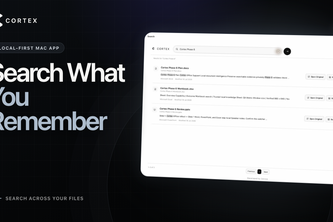
What the company appears to be: Cortex is a self-reported macOS desktop application that indexes and makes searchable local files on a user's machine without moving or altering them. The author describes it as a "native macOS application for Apple Silicon" designed to create a "connected memory" from an ordinary folder, using local full-text search and preview capabilities.
What changed: The project evolved from an experimental foundation into a polished, functional native macOS app during Build Week. It included redesigning the core experience, improving onboarding, building robust document previews, strengthening indexing, creating a guided tutorial, and implementing secure session restoration and an updater.
Single most important open question: Is there evidence of user adoption or market demand beyond the solo founder's own use case?
This analysis is based entirely on the self-reported description provided by the author. No third-party verification, revenue data, customer information or traction metrics are available. All claims are stated by the author and not independently confirmed.
What The Product Actually Is
- The description states Cortex is a native macOS desktop application for Apple Silicon.
- It is built with Tauri 2, Rust, React, TypeScript, SQLite with FTS5, Supabase Auth, and macOS Keychain.
- Cortex turns an ordinary local folder into a "continuously updated knowledge workspace".
- It indexes supported documents locally, searches filenames, paths and extracted document content, provides live search suggestions and highlighted result excerpts.
- It previews TXT, Markdown, PDF, DOCX, PPTX and XLSX files.
- It preserves source provenance so results can be opened in Finder or located inside the Library.
- It monitors the vault for additions, edits and removals.
- It records indexing and workspace events through Activity.
- It supports local workflows after authenticated session restoration.
Positioning & Claim Evolution
- The description states Cortex is built around the premise: "Your files. Your machine. One connected memory."
- It positions itself as an alternative to searching folders, guessing filenames or moving everything into cloud platforms.
- Cortex is described as not asking users to rebuild their knowledge base inside a proprietary cloud library.
- It does not intend to replace Finder or turn every workflow into a chatbot.
- The current release uses local full-text search, and does not include semantic retrieval, OCR, Neural Map rendering or in-app AI inference.
- The author notes that Codex and GPT-5.6 were used during Build Week for analysis, implementation, debugging and design.
- The author states they deliberately removed features like Ask Cortex and Neural Map to keep the core product coherent and reliable.
Target Customer & ICP
- Not evidenced. The description does not state who the target customer is or how they are identified (ICP).
Business Model & Pricing Evidence
- Not evidenced. There is no mention of pricing, monetization strategy, or business model in the self-reported description.
Technical & Delivery Signals
- Cortex is a native macOS desktop application built with Tauri 2, Rust, React, TypeScript.
- It uses SQLite with FTS5 for local catalogue and full-text search.
- It integrates with macOS Keychain for secure session persistence.
- It supports local document extraction and preview pipelines for PDF, DOCX, PPTX and XLSX.
- It includes a recursive filesystem watcher that reconciles changes into the catalogue.
- Sensitive filesystem operations are exposed through narrow Rust and Tauri commands rather than unrestricted frontend access.
- The application has a strict, task-gated guided tutorial.
- It implements a signed updater with replace-in-place installation and automatic relaunch.
- The author reports 294 passing frontend tests and 136 passing Rust tests in the final verified release.
Traction & Maturity Signals
- Not evidenced. No data on users, customers, revenue or adoption is provided beyond the solo founder's own account.
Competitive Context
- Not evidenced. The description does not mention competitors or competitive positioning.
Open Questions & Risks
- Solo founder: The team size is listed as 1, which raises questions about scalability and execution risk.
- Unverified claims: All statements are self-reported and unverified; no third-party validation of functionality or traction exists.
- Limited scope: The current release focuses on local full-text search and does not include semantic retrieval, OCR, or AI inference features that may be expected in similar tools.
- No pricing or monetization strategy: There is no indication of how the product will generate revenue.
- Build Week submission: The project was submitted to a hackathon, suggesting it may still be in early development stages.
Questions the description leaves open
- What specific user problems are you solving, and how do you know?
- How do you plan to monetize this product?
- Have you validated the need for this tool with potential users beyond yourself?
- What is your go-to-market strategy?
- Are there any technical limitations or trade-offs in the current implementation that could affect long-term scalability?
- What are the key assumptions behind your product design choices?
Overall Assessment
- Not evidenced. No information on valuation, funding rounds, or investment interest is available.
This analysis is based entirely on the self-reported description provided by the author. No third-party verification, revenue data, customer information or traction metrics are available beyond what was stated. All claims are attributed to the author and not independently confirmed.
User Stories BotA demo video on every pull request
Get a demo video on every new feature
GitHub App that watches your pull requests and records a narrated, captioned demo.
Save time on demo prep and make informed decisions faster with a video walkthrough of every new feature.
Source
Submitted to the OpenAI 2026 hackathon on Devpost. Project home on Devpost. Back to the full gallery on Devpost.
This competitive analysis was produced by top-founders.com (opens in a new tab)
Generated by a language model from this project's public Devpost page — its tagline, the author's own write-up and any built-with tags listed there — as captured in August 2026. Short quotations are the author's words. It is an opinion on the idea as a business, not on the people behind it, and it reflects the description as published then. If the project has moved on, request a correction below. The analysis is not independent research and contains no verified traction, revenue or customer data.
An independent guide by KFG International LLC — not affiliated with, endorsed by, or connected to Devpost or OpenAI.