

Archive position — measured, not model output
0 likes on Devpost
2,263 of the 7,850 archived projects have more likes, and 5,587 share exactly 0 — so this project's #6,084 place in the like-ranked listing is a tie-break inside that group, not a ranking.
Projects (log scale)
Likes on Devpost. ▲ marks this project's group.
Show the figures
| Likes | Projects | Share of archive |
|---|---|---|
| 0 | 5,587 | 71.2% |
| 1 | 1,758 | 22.4% |
| 2 | 284 | 3.6% |
| 3–4 | 132 | 1.7% |
| 5–9 | 75 | 1.0% |
| 10+ | 14 | 0.2% |
 User Stories BotA demo video on every pull request
Get a demo video on every new feature
GitHub App that watches your pull requests and records a narrated, captioned demo.
Save time on demo prep and make informed decisions faster with a video walkthrough of every new feature.
Executive Summary
What the company appears to be
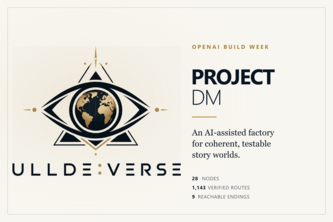
Project DM: ULLDE:VERSE is an AI-assisted narrative engine that transforms human-defined premises into structured, testable interactive worlds. It is described as a factory for creating short, coherent, consequence-driven experiences — such as historical investigations or educational case studies — using generative AI tools like Codex and GPT-5.6.
What changed
The project evolved from an experimental private engine to a public vertical slice (ULLDE:VERSE) during a Build Week hackathon. This version includes a playable browser-based mobile dossier, automated QA gates, and a deterministic runtime that works without external dependencies or API calls.
Single most important open question
Is there evidence of traction, revenue, or adoption beyond the author’s own prototype and demo? The description does not indicate any customers, users, or monetization activity — only a self-reported product identity and technical demonstration.
Note: This analysis is based entirely on the self-reported project description provided by the author. No external verification, archived data, or third-party sources are available. All claims are labeled as "the description states" or "inferred from". Confidence is low due to limited evidence.
What The Product Actually Is
- The description states that Project DM is a system for turning human-defined premises into structured interactive worlds.
- It produces a “canonical, testable case state” through a factory process involving narrative design, code, and runtime behavior.
- ULLDE:VERSE is presented as the first complete vertical slice of this system — a mobile-first historical investigation with 28 nodes, 88 actions, and nine endings.
- The system uses AI tools like Codex and GPT-5.6 to assist in reasoning across narrative contracts, code, interface, QA, and documentation.
- It includes automated quality gates that explore the world graph and reject structural or causal failures.
- The runtime is browser-based, deterministic, and requires no account, API key, or model calls for playthroughs.
Inference: The product appears to be a narrative engine with AI-assisted authoring and QA capabilities. It targets creators, educators, and cultural institutions who want to build interactive experiences without managing complex branching logic manually.
Positioning & Claim Evolution
- The description states that Project DM aims to make generative narrative systems more reproducible, debuggable, and shippable.
- It positions itself as a tool for independent creators, educators, and cultural organizations to produce interactive worlds without maintaining fragile branching structures.
- The author notes that before Build Week, they explored the system with separate AI tools but could not reliably connect narrative design, code, world state, and testing.
- During Build Week, the system was restructured into a cohesive vertical slice using Codex and GPT-5.6 to support a unified workflow across product identity, interface, QA, and deployment.
Inference: The positioning evolved from an experimental idea to a functional prototype with clear use cases (e.g., historical investigations, educational case studies). It is not yet positioned as a commercial platform or SaaS offering.
Target Customer & ICP
- The description identifies three main user groups:
- Independent creators
- Educators
- Cultural institutions
- These users are described as wanting to turn a premise into an interactive experience without hand-maintaining complex branching logic.
- ULLDE:VERSE is framed as a tool for local-history educators, museums, writers, and small creative teams.
Inference: The ICP likely centers on individuals or small teams who create narrative-based content and need tools to manage complexity in consequence-driven storytelling. No evidence of enterprise customers or large-scale adoption is provided.
Business Model & Pricing Evidence
- Not evidenced.
- The description does not mention pricing, licensing, subscriptions, or monetization strategies.
- There is no indication that the system is offered as a service, product, or platform for sale.
Absence of evidence: No business model or pricing information is included in the self-reported description.
Technical & Delivery Signals
- The system uses:
- Cloudflare Workers
- Codex
- GPT-5.6
- Express.js
- Node.js
- HTML/CSS/JS
- JSON
- Graph-based world architecture
- It includes automated QA gates that check for causal consistency, presentation errors, and deployment issues.
- The runtime is deterministic and runs entirely in the browser with no external dependencies.
- A single command (
npm test) verifies hygiene, playthroughs, and packaging. - Visual assets are resolved through stable identifiers.
- The system supports a “guided experience” that works locally or publicly without credentials.
Inference: Technical delivery shows strong engineering discipline around modularity, QA, and reproducibility. The use of AI tools suggests integration with generative workflows.
Traction & Maturity Signals
- Not evidenced.
- No mention of users, customers, revenue, or usage metrics.
- The project is described as a vertical slice built during a hackathon.
- ULLDE:VERSE is presented as a public demo with no indication of ongoing engagement or adoption.
- The author mentions future steps like reducing authoring time and piloting new worlds — suggesting it’s still in early development.
Absence of evidence: No traction, user base, or product maturity beyond the initial demo is reported.
Competitive Context
- Not evidenced.
- The description does not name competitors or describe how Project DM compares to existing tools for narrative design or interactive storytelling.
- It is unclear whether similar systems exist in the market or what their features are.
Absence of evidence: No competitive landscape or differentiation strategy is described.
Open Questions & Risks
- The system is described as a single-person project with no team beyond the author.
- There is no evidence of scalability, performance testing, or long-term maintenance plans.
- The product is presented as a demo and vertical slice — not a full platform or service.
- The use of AI tools like Codex and GPT-5.6 raises questions about reproducibility, cost, and dependency on proprietary models.
- No evidence of IP protection, security practices, or data governance beyond local storage.
Inference: Risk factors include lack of team, limited traction, potential reliance on proprietary AI infrastructure, and absence of a clear roadmap for commercial viability.
Questions the description leaves open
- What is the long-term vision for Project DM? Is it intended to be a platform or a tool for individual creators?
- How does the system handle scalability or multi-user environments?
- Are there plans to integrate with other tools or platforms (e.g., LMS, museum systems)?
- What are the technical and financial costs of running this system at scale?
- Has the author considered how to ensure consistency in AI-generated content across different use cases?
- Is there any plan for monetization or commercial licensing?
- How is data privacy handled, especially if future versions include user inputs or tracking?
Overall Assessment
- Not evidenced.
- No financials, valuation, funding rounds, or investor interest are mentioned.
- The project is described as a personal experiment and hackathon demo with no indication of commercial traction or strategic partnerships.
Absence of evidence: No basis for evaluating investment potential or partnership opportunities. The author’s description does not suggest any current or planned commercial activity beyond the demo.
User Stories BotA demo video on every pull request
Get a demo video on every new feature
GitHub App that watches your pull requests and records a narrated, captioned demo.
Save time on demo prep and make informed decisions faster with a video walkthrough of every new feature.
Source
Submitted to the OpenAI 2026 hackathon on Devpost. Project home on Devpost. Back to the full gallery on Devpost.
This competitive analysis was produced by top-founders.com (opens in a new tab)
Generated by a language model from this project's public Devpost page — its tagline, the author's own write-up and any built-with tags listed there — as captured in August 2026. Short quotations are the author's words. It is an opinion on the idea as a business, not on the people behind it, and it reflects the description as published then. If the project has moved on, request a correction below. The analysis is not independent research and contains no verified traction, revenue or customer data.
An independent guide by KFG International LLC — not affiliated with, endorsed by, or connected to Devpost or OpenAI.