

Archive position — measured, not model output
0 likes on Devpost
2,263 of the 7,850 archived projects have more likes, and 5,587 share exactly 0 — so this project's #6,086 place in the like-ranked listing is a tie-break inside that group, not a ranking.
Projects (log scale)
Likes on Devpost. ▲ marks this project's group.
Show the figures
| Likes | Projects | Share of archive |
|---|---|---|
| 0 | 5,587 | 71.2% |
| 1 | 1,758 | 22.4% |
| 2 | 284 | 3.6% |
| 3–4 | 132 | 1.7% |
| 5–9 | 75 | 1.0% |
| 10+ | 14 | 0.2% |
 User Stories BotA demo video on every pull request
Get a demo video on every new feature
GitHub App that watches your pull requests and records a narrated, captioned demo.
Save time on demo prep and make informed decisions faster with a video walkthrough of every new feature.
Executive Summary
What the company appears to be
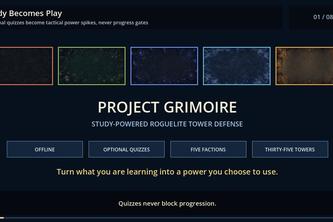
Project Grimoire is an offline roguelite tower-defense game for Windows x86_64 that integrates optional educational mechanics into gameplay. The author states it is a self-contained game where studying becomes a tactical choice, activated via a “Grimoire” interface during gameplay. Correct answers provide temporary bonuses (e.g., Haste or Aegis), while incorrect or unknown answers have no penalty.
What changed
The project was built as part of a hackathon submission. The author reports using AI tools like Codex and GPT-5.6 for development support, but not as runtime dependencies. It includes a data-driven architecture, local-only quiz packs, and a focus on privacy and deterministic behavior.
Single most important open question
Is there any evidence of traction, revenue, or user adoption beyond the author’s own submission? The description states no such data exists.
Note: This analysis is based entirely on the self-reported, unverified project description provided by the caller. All claims are stated by the author and not independently verified.
What The Product Actually Is
- The description states that Project Grimoire is an offline roguelite tower-defense game for Windows x86_64.
- Players choose one of five factions, build from 35 faction-specific towers, draft traits after each wave, and evolve max-level towers.
- Once per wave, players may open the Grimoire to answer a question from a local JSON or CSV quiz pack.
- Correct answers activate temporary bonuses (Haste or Aegis), while wrong or unknown answers have no default penalty.
- After a run, answer history becomes a review notebook, an LLM-ready Markdown study prompt, or a retry pack.
- Five sample packs cover biology, English vocabulary, mathematics, world history, and computer science.
- Custom quiz packs are detected locally without uploading learning data.
Inference: The product is described as a hybrid game-learning system with optional educational integration. It is not a traditional educational tool nor a pure game — rather, it attempts to merge both in one experience.
Positioning & Claim Evolution
- The description states that Project Grimoire "reverses" the typical relationship between practice and reward by making studying an optional tactical ability.
- It positions itself as a way to make studying feel like a useful choice rather than an obligation.
- The author claims the game remains fully playable without quizzes, and that quiz data stays local.
- AI tools were used for development but not in runtime or gameplay logic.
Inference: The positioning is centered on voluntary learning within a game framework. It does not claim to be a mainstream educational platform or a commercial product — it is framed as a prototype or proof-of-concept.
Target Customer & ICP
- Not evidenced.
- The description does not name specific customer segments, target demographics, or personas.
- No evidence of user research, market segmentation, or intended audience beyond general gamers and students.
Finding: Absence of evidence for target customer or ideal customer profile (ICP).
Business Model & Pricing Evidence
- Not evidenced.
- The description does not mention pricing models, monetization strategies, or business model assumptions.
- No indication of whether the project intends to sell, license, or distribute the product commercially.
Finding: Absence of evidence for business model or pricing structure.
Technical & Delivery Signals
- Built with Godot 4.7 stable Mono and GDScript.
- Gameplay, quiz scheduling, review/export, and desktop file access are separated into explicit modules.
- Factions, towers, enemies, traits, waves, and quiz packs are data-driven for independent validation and testing.
- The Windows release includes executable, sample packs, setup instructions, and MIT license.
- Public repository documents quiz-pack schema, validation behavior, build steps, privacy model, asset provenance, and release evidence.
- Uses Codex and GPT-5.6 as development collaborators, not runtime dependencies.
- Includes 942 automated checks passing, 183 validated gameplay PNG assets, and a 150-enemy FPS test on Windows x86_64.
Inference: The technical architecture is modular and data-driven, with strong emphasis on local-first design and reproducibility. AI was used for development assistance but not embedded in the product.
Traction & Maturity Signals
- Not evidenced.
- No evidence of revenue, customers, user engagement, or adoption metrics.
- The project is described as a hackathon submission, with no indication of post-submission traction or usage.
Finding: Absence of evidence for traction or maturity indicators.
Competitive Context
- Not evidenced.
- The description does not mention competitors, market positioning, or competitive landscape.
- No reference to existing educational games, productivity tools, or game genres that this might compete with.
Finding: Absence of evidence for competitive context.
Open Questions & Risks
- The project is described as a hackathon submission — no commercial viability or scalability implied.
- The author notes several compromises due to time constraints (e.g., lack of animation, limited playtesting).
- No evidence of monetization, distribution plans, or long-term product strategy.
- The optional quiz mechanic may not be compelling enough for sustained engagement without further development.
- AI tools were used for development but are not part of the final product, which could limit future scalability or innovation.
Inference: Risk of limited commercial viability due to prototype nature and lack of traction or monetization strategy. Optional learning mechanics may not drive long-term user retention.
Questions the description leaves open
- What is the intended path from this hackathon prototype to a commercial product?
- Are there any plans for monetization, distribution, or user acquisition beyond the current demo?
- How does the author plan to scale quiz content and maintain quality across more subjects or difficulty levels?
- What are the long-term goals for the educational integration — is it meant to be optional, or will it evolve into a core feature?
- Has the author considered how to validate gameplay balance at scale, given the lack of extensive playtesting in the current version?
Note: These questions are based on the self-reported description and aim to probe beyond what was stated.
Overall Assessment
- Not evidenced.
- No information is provided about funding history, valuation, or investment interest.
- The project is described as a personal hackathon submission with no indication of commercial intent or investor appeal.
Finding: Absence of evidence for investment or partnership readiness. The project appears to be an experimental prototype without demonstrated traction or business model.
User Stories BotA demo video on every pull request
Get a demo video on every new feature
GitHub App that watches your pull requests and records a narrated, captioned demo.
Save time on demo prep and make informed decisions faster with a video walkthrough of every new feature.
Source
Submitted to the OpenAI 2026 hackathon on Devpost. Project home on Devpost. Back to the full gallery on Devpost.
This competitive analysis was produced by top-founders.com (opens in a new tab)
Generated by a language model from this project's public Devpost page — its tagline, the author's own write-up and any built-with tags listed there — as captured in August 2026. Short quotations are the author's words. It is an opinion on the idea as a business, not on the people behind it, and it reflects the description as published then. If the project has moved on, request a correction below. The analysis is not independent research and contains no verified traction, revenue or customer data.
An independent guide by KFG International LLC — not affiliated with, endorsed by, or connected to Devpost or OpenAI.