

Archive position — measured, not model output
0 likes on Devpost
2,263 of the 7,850 archived projects have more likes, and 5,587 share exactly 0 — so this project's #6,088 place in the like-ranked listing is a tie-break inside that group, not a ranking.
Projects (log scale)
Likes on Devpost. ▲ marks this project's group.
Show the figures
| Likes | Projects | Share of archive |
|---|---|---|
| 0 | 5,587 | 71.2% |
| 1 | 1,758 | 22.4% |
| 2 | 284 | 3.6% |
| 3–4 | 132 | 1.7% |
| 5–9 | 75 | 1.0% |
| 10+ | 14 | 0.2% |
 User Stories BotA demo video on every pull request
Get a demo video on every new feature
GitHub App that watches your pull requests and records a narrated, captioned demo.
Save time on demo prep and make informed decisions faster with a video walkthrough of every new feature.
Executive Summary
What the company appears to be
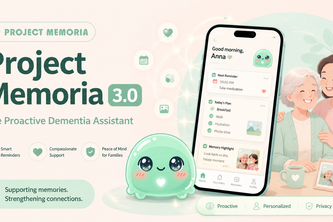
Project Memoria 3.0: The Dementia Assistant is a self-reported AI-powered home assistant for people with dementia and their caregivers. It uses video capture, audio transcription, and LLMs to create a grounded memory system that answers questions based on actual events in the home, provides proactive reminders, and alerts caregivers to safety hazards like falls.
What changed
The project description indicates this is a rebuild during an OpenAI hackathon (Build Week), integrating GPT-5.6 as the primary conversational reasoning engine, evolving from a request-driven prototype into a bounded memory system with durable conversations, summaries, profile facts, reminders, and alerts. It also introduces a caregiver dashboard and patient PWA.
The single most important open question
Is there any evidence of real-world usage or testing with people living with dementia and their caregivers? The description states the product is built but does not provide data on adoption, feedback, or impact in actual homes.
What The Product Actually Is
- The description states that Project Memoria is an AI-powered assistant for people with dementia.
- It captures home activity using cameras and audio, stores this information in MongoDB and ChromaDB, and retrieves it to answer questions.
- It uses Qwen for video understanding, spatial grounding, embeddings, and room-audio transcription; GPT-5.6 Sol as the conversational reasoning engine.
- It includes features such as grounded chat (answers from retrieved memories), object finding, durable memory lifecycle, proactive help, fall escalation, caregiver dashboard, and installable patient PWA.
- The system is described as capability-based rather than provider-exclusive.
Inference The product appears to be a prototype or early-stage solution designed for use in home environments with people who have dementia. It integrates multiple AI models and tools but lacks evidence of deployment beyond development.
Positioning & Claim Evolution
- The description positions Project Memoria as an assistant that turns home moments into searchable memory.
- It claims to answer questions with evidence instead of guesses, deliver reminders at the right moment, and escalate safety events to caregivers.
- It emphasizes that it does not replace medical care or emergency services but aims to make everyday support more continuous, calm, and respectful.
Inference The positioning has evolved from a basic prototype to a structured memory system with proactive features and caregiver integration. However, the claims are self-reported and lack validation through real-world use cases or user feedback.
Target Customer & ICP
- The description identifies two main user groups: people living with dementia and their caregivers.
- It focuses on individuals who struggle with memory loss and need continuous support in daily life.
- The product is designed for home use, not clinical settings.
Inference The target customer segment appears to be limited to those with dementia and their support networks. There is no indication of broader market expansion or scalability beyond this niche.
Business Model & Pricing Evidence
- No explicit business model or pricing information is provided in the description.
- The project is described as a hackathon submission, suggesting it may not yet have a monetization strategy.
- It does not mention any paid services, subscriptions, or licensing models.
Inference There is no evidence of a defined business model or pricing structure. The focus seems to be on building a functional prototype rather than commercial viability.
Technical & Delivery Signals
- Built with Python (FastAPI), MongoDB, ChromaDB, React, Vite, PWA, Web Push, OpenCV, and custom YOLO11 models.
- Uses Qwen for video understanding and spatial grounding; GPT-5.6 Sol for conversational reasoning and safety decisions.
- Implements a capability-based architecture where different models handle specific tasks.
- Includes structured JSON schema output, Pydantic validation, and fallback paths.
- The backend uses FastAPI with MongoDB as the source of truth and ChromaDB for semantic indexing.
- Video processing is handled via bounded-lifetime presigned OSS URLs; local recording remains the source of truth.
Inference The technical stack suggests a well-thought-out architecture for handling multimodal inputs (video, audio, text) and managing memory lifecycle. However, there's no evidence of production deployment or scalability testing.
Traction & Maturity Signals
- The project was submitted to the OpenAI 2026 hackathon.
- It evolved from a request-driven prototype into a more structured system during Build Week.
- Evidence of development work includes Codex session logs, dated commit history, and regression tests.
- No mention of real-world users, feedback loops, or performance metrics.
Inference There is no evidence of traction or maturity beyond the hackathon environment. The project remains in a pre-commercial phase with no indication of user adoption or impact.
Competitive Context
- The description does not reference existing competitors or similar products.
- It focuses on solving a specific problem (memory loss and safety in dementia care) without comparing to other solutions.
- There is no mention of market size, competition landscape, or differentiation strategies.
Inference The competitive context is unknown. The project may be addressing an underserved niche, but there is no evidence of awareness of existing alternatives or market positioning.
Open Questions & Risks
- Privacy and Surveillance Concerns: The use of cameras and audio in homes raises significant privacy issues that are not addressed in the description.
- Lack of Real-World Testing: No evidence of testing with actual users or caregivers, which is critical for a product targeting vulnerable populations.
- Unclear Scalability: While the architecture supports multimodal inputs, there is no indication of how it would scale beyond a single user or household.
- No Revenue or Business Model: The project lacks any commercialization strategy or revenue model.
- Unverified Claims: All claims are self-reported and unverified; no third-party validation or data exists.
Inference The product faces several high-risk areas including privacy, scalability, and lack of real-world testing. These risks are compounded by the absence of any traction or commercial viability indicators.
Questions the description leaves open
- Has the system been tested with people living with dementia and their caregivers?
- What kind of feedback has been gathered from users during development?
- Are there plans to address privacy concerns related to camera and audio capture in homes?
- How does the team plan to scale beyond a single household or user?
- Is there any intention to pursue regulatory compliance or medical device certification?
- What is the long-term vision for monetization or commercialization?
Overall Assessment
- Confidence Level: Low — based solely on self-reported evidence.
- Commercial Due-Diligence Read:
This project appears to be a hackathon prototype aimed at solving a meaningful problem in dementia care. However, there is no evidence of real-world usage, user feedback, or commercial viability. The technical architecture shows promise but lacks validation through actual deployment or testing.
Conclusion
There is insufficient evidence to support investment or partnership interest at this stage. Further due diligence would require proof of concept testing, user engagement data, and a clear path to market.
User Stories BotA demo video on every pull request
Get a demo video on every new feature
GitHub App that watches your pull requests and records a narrated, captioned demo.
Save time on demo prep and make informed decisions faster with a video walkthrough of every new feature.
Source
Submitted to the OpenAI 2026 hackathon on Devpost. Project home on Devpost. Back to the full gallery on Devpost.
This competitive analysis was produced by top-founders.com (opens in a new tab)
Generated by a language model from this project's public Devpost page — its tagline, the author's own write-up and any built-with tags listed there — as captured in August 2026. Short quotations are the author's words. It is an opinion on the idea as a business, not on the people behind it, and it reflects the description as published then. If the project has moved on, request a correction below. The analysis is not independent research and contains no verified traction, revenue or customer data.
An independent guide by KFG International LLC — not affiliated with, endorsed by, or connected to Devpost or OpenAI.