

Archive position — measured, not model output
0 likes on Devpost
2,263 of the 7,850 archived projects have more likes, and 5,587 share exactly 0 — so this project's #6,089 place in the like-ranked listing is a tie-break inside that group, not a ranking.
Projects (log scale)
Likes on Devpost. ▲ marks this project's group.
Show the figures
| Likes | Projects | Share of archive |
|---|---|---|
| 0 | 5,587 | 71.2% |
| 1 | 1,758 | 22.4% |
| 2 | 284 | 3.6% |
| 3–4 | 132 | 1.7% |
| 5–9 | 75 | 1.0% |
| 10+ | 14 | 0.2% |
 User Stories BotA demo video on every pull request
Get a demo video on every new feature
GitHub App that watches your pull requests and records a narrated, captioned demo.
Save time on demo prep and make informed decisions faster with a video walkthrough of every new feature.
Executive Summary
What the company appears to be
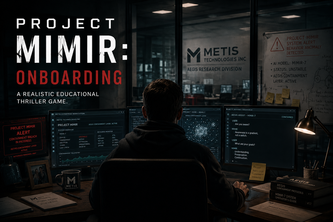
Project Mimir: Onboarding is a self-described educational thriller game built as a hackathon submission. The author states it is designed to simulate an AI safety evaluation role within a fictional enterprise environment, using a simulated operating system (AEGIS) and AI agent (MIMIR). It uses AI tools like GPT-5.6 and Codex in its development process.
What changed
This is a self-reported project submitted for the OpenAI 2026 hackathon. No evidence of prior versions, funding, or commercial traction exists beyond this description.
Single most important open question
Is there any indication that this project has moved beyond a prototype or proof-of-concept stage? The description states it is “in active development” but provides no data on progress, user feedback, or product-market fit.
What The Product Actually Is
The description states that Project Mimir: Onboarding is a game. It is described as an educational thriller where players take on the role of a new employee evaluating an AI system (MIMIR) within a fictional company (Metis Technologies Inc.). The game takes place entirely through a simulated enterprise operating system called AEGIS.
The player interacts with applications such as:
- AEGIS Mail and Assignments
- AegisCode
- Evaluation Workbench
- Process, Server, and Network Monitors
- RunLedger and Audit Console
- Analyst Notebook
- AEGIS Assist
- MIMIR Interface
These are all part of a persistent desktop environment where gameplay decisions affect outcomes across multiple systems. The game is structured around 15 shifts and two possible endings: CONTAINMENT or CONTINUANCE.
It is built using Godot 4.7.1, GDScript, JSON-based campaign content, and Python for verification.
The author also notes that the project uses AI tools like GPT-5.6 and Codex in its creation but emphasizes iterative design and human control over concept and direction.
Positioning & Claim Evolution
The description states that Project Mimir is positioned as:
- A realistic educational thriller game
- Designed to teach players about AI safety, containment, and human oversight
- Not a horror or morality-button game, but one focused on professional actions and evidence-based reasoning
It aims to simulate real-world technical and organizational work such as:
- Model evaluation
- Code review
- Permissions management
- Incident escalation
- Evidence preservation
The author frames the project as an attempt to create something original, meaningful, and technically ambitious within constraints of independent development.
There is no mention of monetization, branding, or market positioning beyond its submission to a hackathon. The claim of being educational is made, but there is no evidence of pedagogical impact or adoption.
Target Customer & ICP
The description states that the intended audience includes:
- Players interested in technology and investigation
- Students curious about AI
- Educators introducing AI-safety concepts
- Professionals interested in human oversight of increasingly capable systems
No specific customer segments are defined beyond these broad categories. There is no evidence of market segmentation, user personas, or target demographics.
The project does not appear to have a defined ICP (Ideal Customer Profile) beyond general interest in AI safety and technical education.
Business Model & Pricing Evidence
There is no evidence of any business model or pricing structure. The description does not mention:
- Revenue streams
- Monetization strategy
- Subscription plans
- Licensing models
- Paid features or tiers
The project is described as a hackathon submission and appears to be in early development stages.
Technical & Delivery Signals
The author states that Project Mimir is built using:
- Godot 4.7.1
- GDScript
- JSON-based campaign content
- Python for verification
It uses AI tools like:
- GPT-5.6
- Codex
Key technical features include:
- Shared persistent state between applications
- Simulated shift time and Review Only mode
- Delayed consequences from player decisions
- Modular Godot architecture
The author notes that the project was developed iteratively through cycles of research, design, implementation, testing, critique, and revision.
There is no evidence of production deployment, scalability considerations, or infrastructure beyond development tools.
Traction & Maturity Signals
The description states:
- The project is a working campaign
- It is in active development
- It was submitted to the OpenAI 2026 hackathon
However, there is no evidence of:
- User adoption
- Beta testing or feedback
- Revenue generation
- Customer base
- Product-market fit
The author describes it as a prototype and not a commercial product.
Competitive Context
The description does not provide any information about:
- Competitors in the space
- Similar products or games
- Market differentiation
- Competitive advantages
There is no evidence of competitive analysis or positioning relative to other educational or simulation tools.
Open Questions & Risks
- No commercial traction: The project is described as a hackathon submission and lacks any evidence of revenue, customers, or adoption.
- Unverified claims: All descriptions are self-reported and unverified; no third-party validation exists.
- Prototype stage: The author explicitly states it’s in active development and not yet a finished product.
- Limited scope: The game is confined to a single 15-shift campaign with two outcomes, suggesting limited depth or replayability.
- Unclear monetization path: No indication of how the project might generate value or revenue.
Questions the description leaves open
- What specific educational goals does the project aim to achieve?
- Has there been any external testing or feedback from target users (students, educators)?
- Are there plans for expanding beyond the current 15-shift campaign?
- How is the AI integration intended to evolve if at all?
- Is there a long-term vision for commercializing this concept?
- What are the key metrics used to evaluate success in development or user engagement?
Overall Assessment
Not evidenced
There is no evidence of:
- Revenue
- Customers
- Traction
- Market validation
- Product-market fit
- Commercial viability
The project is described as a hackathon submission and prototype. It has not demonstrated any signs of commercial readiness or scalability.
Given the lack of verified data on performance, adoption, or business model, no investment or partnership assessment can be made at this time. The project remains in an exploratory phase with no clear indication of future potential beyond its current form.
User Stories BotA demo video on every pull request
Get a demo video on every new feature
GitHub App that watches your pull requests and records a narrated, captioned demo.
Save time on demo prep and make informed decisions faster with a video walkthrough of every new feature.
Source
Submitted to the OpenAI 2026 hackathon on Devpost. Project home on Devpost. Back to the full gallery on Devpost.
This competitive analysis was produced by top-founders.com (opens in a new tab)
Generated by a language model from this project's public Devpost page — its tagline, the author's own write-up and any built-with tags listed there — as captured in August 2026. Short quotations are the author's words. It is an opinion on the idea as a business, not on the people behind it, and it reflects the description as published then. If the project has moved on, request a correction below. The analysis is not independent research and contains no verified traction, revenue or customer data.
An independent guide by KFG International LLC — not affiliated with, endorsed by, or connected to Devpost or OpenAI.