

Archive position — measured, not model output
0 likes on Devpost
2,263 of the 7,850 archived projects have more likes, and 5,587 share exactly 0 — so this project's #7,417 place in the like-ranked listing is a tie-break inside that group, not a ranking.
Projects (log scale)
Likes on Devpost. ▲ marks this project's group.
Show the figures
| Likes | Projects | Share of archive |
|---|---|---|
| 0 | 5,587 | 71.2% |
| 1 | 1,758 | 22.4% |
| 2 | 284 | 3.6% |
| 3–4 | 132 | 1.7% |
| 5–9 | 75 | 1.0% |
| 10+ | 14 | 0.2% |
 User Stories BotA demo video on every pull request
Get a demo video on every new feature
GitHub App that watches your pull requests and records a narrated, captioned demo.
Save time on demo prep and make informed decisions faster with a video walkthrough of every new feature.
Executive Summary
What the company appears to be
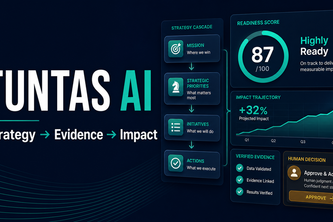
TUNTAS AI: Strategy Execution Intelligence is a self-reported strategy execution tool built as a PHP/MySQL application, using GPT-5.6 via OpenAI Responses API. It claims to help organizations turn strategic goals into testable hypotheses, weekly actions, and verified evidence, with human-approved decisions at key points.
What changed
The project was submitted to the OpenAI 2026 hackathon by one founder, Magelang Suryanto. No prior version or evolution is described; this appears to be a single, self-contained build.
Single most important open question
Is there any evidence of real-world use, customer feedback, or traction beyond the demo and the author's own claims?
What The Product Actually Is
The description states that TUNTAS AI is a PHP and MySQL application, designed for shared hosting. It uses GPT-5.6 through the OpenAI Responses API to structure strategy drafts, audit assumptions, generate execution analysis, and support review workflows.
It supports:
- Multi-tenant workspaces
- Strategy cascading
- Accountable owners
- Weekly execution actions
- Evidence submissions
- Deterministic impact calculations
- Executive review
- Human-approved adaptation decisions
The product also connects to a verified journal-metadata database, using research metadata to inform hypotheses and distinguish between research relevance and strategy-specific causal proof.
Evidence
- The author states it is built with PHP, MySQL, GPT-5.6, OpenAI API.
- It uses Codex for architecture, data model design, interface, tests, deployment, and documentation.
- It supports multi-tenant access, execution chains, evidence tracking, and decision workflows.
Inference The product appears to be a strategy-to-execution platform, not a general-purpose AI tool or marketplace. Its focus is on accountable strategy execution, not just KPI reporting.
Positioning & Claim Evolution
The author states that TUNTAS AI was created to address the gap between strategic planning and execution, where assumptions remain untested, actions are disconnected from outcomes, and task completion is mistaken for impact.
It positions itself as a tool that:
- Turns strategy into testable hypotheses
- Generates weekly actions tied to evidence
- Provides deterministic impact calculations
- Requires human approval at key decision points
Evidence
- The tagline: “TUNTAS AI uses GPT-5.6 to turn strategic goals into testable hypotheses, weekly actions, verified evidence, and human-approved decisions—so teams measure impact, not task completion.”
- The author’s own write-up emphasizes accountability, evidence-based execution, and executive decision-making.
Inference The positioning is targeted at strategy-focused organizations, especially those with formal KPI dashboards but poor execution outcomes. It is not a general-purpose AI assistant or SaaS platform.
Target Customer & ICP
The description does not name specific customer types or personas. However, it implies that the tool is aimed at:
- Organizations with strategic plans and KPI dashboards
- Teams that struggle to connect execution to measurable outcomes
- Leaders who want to make decisions based on evidence rather than task completion
Evidence
- The author states: “Organizations often have strategic plans and KPI dashboards, yet execution still fails because assumptions remain untested...”
- It supports multi-tenant workspaces, suggesting enterprise or team-level use.
Inference The ICP likely includes mid-to-large enterprises or strategy-focused teams, with leadership needing to track impact and justify decisions. No specific industry or size is mentioned.
Business Model & Pricing Evidence
There is no mention of pricing, monetization, or business model in the description.
Evidence
- The author does not describe how the product will be sold or who pays for it.
- No revenue model, subscription tiers, or licensing structure are provided.
Inference The tool may be a demo or prototype, possibly built for a hackathon. It is unclear if it has any commercial intent beyond the submission.
Technical & Delivery Signals
The product is described as:
- A PHP and MySQL application
- Designed for shared hosting
- Built using GPT-5.6 via OpenAI Responses API
- Uses Codex for development, including architecture, data models, UI, tests, deployment, and documentation
- Has a responsive interface, automated tests, and documentation
Evidence
- The author states it uses PHP, MySQL, GPT-5.6, OpenAI API, Codex.
- It connects to a journal-metadata database for research relevance.
Inference The technical stack is basic but functional, likely built quickly for a hackathon. No mention of scalability, cloud infrastructure, or enterprise-grade features.
Traction & Maturity Signals
There is no evidence of traction, customers, or real-world usage beyond the demo and the author’s own claims.
Evidence
- The live demo is available at: https://tuntas.borobudurtraining.com
- A demo account is provided.
- No mention of users, revenue, or adoption.
Inference This appears to be a prototype or hackathon submission, not a product in active use. There are no signs of market traction or user feedback.
Competitive Context
The description does not name competitors or describe the competitive landscape.
Evidence
- No mention of existing tools, platforms, or market players.
- No comparison to other strategy execution or KPI dashboards.
Inference It is unclear whether TUNTAS AI competes with existing strategy execution tools (e.g., OKRs, strategy maps, or execution platforms). The lack of competitive context makes it hard to assess its positioning.
Open Questions & Risks
- No traction or user feedback: The product is not proven in the market.
- Single founder: Only one person built it, suggesting limited team capacity.
- Hackathon prototype: Likely a demo or proof-of-concept, not a commercial product.
- Unverified claims: All descriptions are self-reported and unverified.
- No pricing or monetization model: Unclear if this will ever be commercialized.
Evidence
- The project was submitted to a hackathon.
- No revenue, customers, or adoption data.
- Only one team member listed.
Questions the description leaves open
- What is the actual use case you are solving for? Is there a real customer pain point?
- How does this differ from existing strategy execution tools (e.g., OKRs, strategy maps)?
- Have you tested this with any real teams or organizations?
- What is your plan to scale beyond the demo and prototype stage?
- Are you planning to monetize this product? If so, how?
- How do you plan to ensure data privacy and security for multi-tenant workspaces?
Overall Assessment
Not evidenced.
The description provides no evidence of:
- Revenue
- Customers
- Traction
- Market validation
- Commercial viability
This appears to be a hackathon submission, not a product in development or market. It is not ready for investment or partnership without further evidence of traction, user feedback, or commercial intent.
The author states: “Everything above is the authors' own account. It is not independently verified, and no revenue, customer or traction data is available beyond what they state.”
User Stories BotA demo video on every pull request
Get a demo video on every new feature
GitHub App that watches your pull requests and records a narrated, captioned demo.
Save time on demo prep and make informed decisions faster with a video walkthrough of every new feature.
Source
Submitted to the OpenAI 2026 hackathon on Devpost. Project home on Devpost. Back to the full gallery on Devpost.
This competitive analysis was produced by top-founders.com (opens in a new tab)
Generated by a language model from this project's public Devpost page — its tagline, the author's own write-up and any built-with tags listed there — as captured in August 2026. Short quotations are the author's words. It is an opinion on the idea as a business, not on the people behind it, and it reflects the description as published then. If the project has moved on, request a correction below. The analysis is not independent research and contains no verified traction, revenue or customer data.
An independent guide by KFG International LLC — not affiliated with, endorsed by, or connected to Devpost or OpenAI.